



On this page:
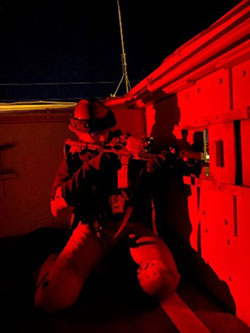
The Nuclear Regulatory Commission has carried out force-on-force (FOF) inspections regularly at commercial operating nuclear power plants since 1991 as part of its comprehensive security program. These inspections are an important part of the overall security evaluation performed through the Reactor Oversight Process baseline inspection program. The NRC uses FOF inspections to evaluate a site's protective strategy in action against a mock adversary force and to identify improvements in the effectiveness of plant security programs under NRC regulations (10 CFR Part 73) to prevent radiological sabotage.
FOF inspections assess a nuclear plant’s physical protection measures to defend against the "design basis threat," or DBT. The DBT describes an adversary that plant owners must protect against through their physical protection systems and response strategies. The NRC continually reassesses the DBT for appropriate updates and makes revisions as necessary.
The Modern Force-on-Force Program
Before Sept. 11, 2001, NRC conducted FOF inspections about once every eight years at all U.S. commercial nuclear power plant sites, as part of the baseline security inspection program. Following the Sept. 11 attacks, the NRC enhanced its FOF program, requiring plants to defend against a revised DBT that more appropriately reflected the current threat environment. The enhanced FOF program also improved the level of realism associated with the inspection to better reflect actual adversary and security force engagements. The NRC's redesigned FOF program was fully implemented in November 2004.
Today, the NRC evaluates each plant site every three years in accordance with the Atomic Energy Act of 1954, as amended, and the Reactor Oversight Process. Additionally, all licensees conduct tactical security exercises in the intervening years with all of their security personnel. While many of the details of the tactical security exercises an FOF inspections are Safeguards Information, which is protected from public disclosure under the Atomic Energy Act, the NRC publishes a publicly available document –– NUREG-1885, "Report to Congress on the Security Inspection Program for Commercial Power Reactor and Category I Fuel Cycle Facilities: Results and Status Update - Annual Reports" each year.
The NRC gives plant operators advance notice of FOF inspections for safety and logistical purposes and to provide for coordination of two sets of security officers –– one for maintaining actual security, and another for participating in the inspection. A key goal is to balance personnel safety, while maintaining actual plant security during exercises that are as realistic as possible.
Inspectors preparing FOF exercises use information from tabletop drills, previous inspection reports, plant walkdowns, and security plan reviews to design commando-style attacks to probe for potential weaknesses in the plant’s defenses. The site’s defenders aim to keep the attackers from destroying or damaging key equipment needed to protect the public. Any potentially significant weakness in the protective strategy identified during FOF inspections is promptly addressed by the site and evaluated by the NRC.
FOF inspection teams include active-duty military advisors from the U.S. Special Operations Command. They provide expertise on adversary tactics and help the NRC evaluate site security forces and systems. The advisors also provide an independent evaluation of the adversary force’s performance during the FOF exersise.
Mock Adversary Force
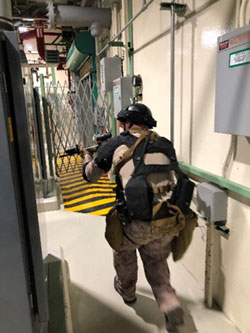
A credible, independent, well-trained, and consistent mock adversary force is vital to the FOF program. The modern FOF program uses an NRC-approved mock adversary force specifically trained to NRC standards and physical fitness qualifications. The required training includes enhanced team tactics, communications, mission planning and proficiency in all potential advesary firearms.
The NRC primarily uses one mock adversary force in FOF inspections; however, the NRC has developed a process for licensees to seek NRC approval to use their own mock adversary forces. To avoid any conflict of interest, the NRC requires a clear separation of functions and personnel between the mock adversary forces and plant security forces. Additionally, the NRC performs inspections of the licensee mock adversary force to verify that the licensee's training and qualification program is equivalent to NRC standards.
NRC’s Overall Security Program
FOF inspections are an essential part of the NRC’s security evaluation of plant owners’ security programs and their compliance with NRC security requirements. The agency continues to evaluate its overall security program in response to changes in the threat environment, technological advancements, risk insights, and lessons learned. As a result, substantial improvements to nuclear plant security have been made to protect against terrorism and radiological sabotage. These include well-trained security forces, robust physical barriers, intrusion detection systems, surveillance systems and plant access controls.
Together, these efforts help make nuclear power plants among the best protected private sector facilities in the nation.