


Licensing Process Overview
The NRC licenses fuel cycle facilities that include uranium conversion, uranium enrichment, fuel fabrication, and plutonium processing and fuel fabrication. The NRC is also preparing to license reprocessing facilities. A company that wishes to operate a fuel cycle facility must apply to the NRC for a license. The applicant must demonstrate how the facility will be operated to ensure adequate safety and safeguards and protection of the environment in accordance with NRC regulations found in 10 CFR Parts 20, 30, 40, 51, 70, 73, 74, and 95. The licensing process typically includes:
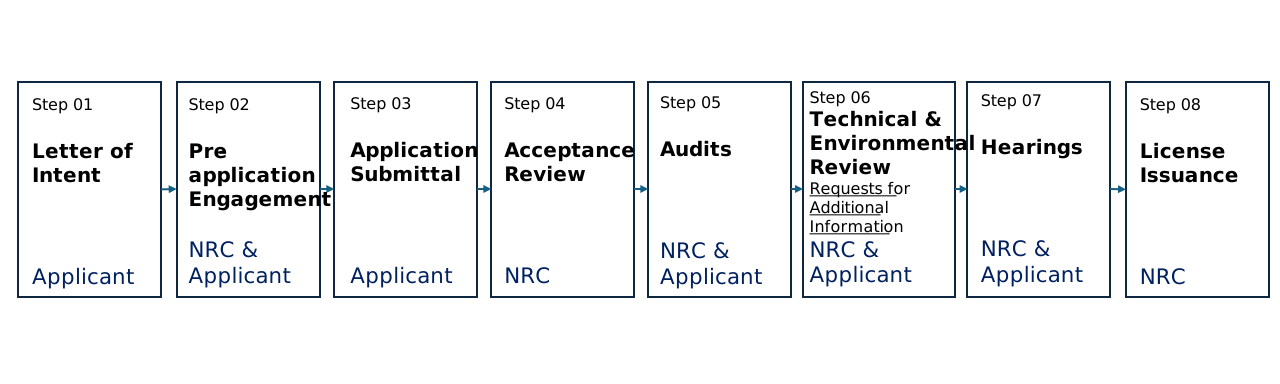
- Letters of Intent: Notify NRC early to start planning engagement. The NRC staff can use this letter as a basis to open a docket, select the review team, hold a pre-submittal meeting (i.e., Pre-Application Meeting), and budget for the future licensing action review. The NRC may also consider the need for a site visit, if appropriate. (Example of Letter of Intent)
- Pre-Application Engagement: Pre-application engagement meetings provide a way for prospective applicants to convey their licensing approach. This allows NRC staff to gain a better understanding of the prospective applicant’s technologies and processes and identify potential safety or regulatory issues with the approach. The pre-application meetings provide for an early understanding of the scope of the review and facilitate, as well as inform, the development of an overall review schedule and resource estimates. During this process, the NRC staff will follow OEDO Procedure-0235 “Driving Regulatory Decisions Through More Effective Communications,” to provide actionable feedback that can help a prospective applicant improve the quality of their application and address issues early. A prospective applicant may also request that the NRC staff review draft application documents using a modified version of the new reactor readiness assessment and provide feedback on issues that could 1) impact acceptance, 2) become requests for additional information, or 3) improve the efficiency of the staff’s review.
- Application Submittal: The quality of an application has a significant impact on the resources expended in the review process. Applications that include sufficient administrative and technical information (e.g., the license application, environmental reports, supporting plans, etc.) allow NRC staff to use time and resources efficiently. Applicants can submit applications either electronically or in hard copies pursuant to 10 CFR 70.5. Electronic submission for licensing applications will be processed through the NRC’s web site as a general form. Click here to prepare for and start the submittal process.
- Acceptance Review: During the acceptance review, NRC staff determine whether the applicant provided sufficient administrative and technical information in the application to proceed with a detailed technical review. NRC staff expect the application to be of high quality (i.e., complete and accurate) without the need for substantial or complex Requests for Supplemental Information (RSI) during the acceptance review or Requests for Additional Information (RAI) during the formal review to address applicable NRC requirements. Upon concluding that an application is acceptable, NRC staff will issue an acceptance letter notifying the applicant and public of the action and the application will be considered formally docketed. The letter will include the proposed schedule and estimated resources for the review. To allow an applicant to address issues early, the letter may also include observations from the acceptance review that could later become formal RAIs. (Example of Acceptance Review Letter).
- Audits: To allow staff to conduct reviews more efficiently and to gain deeper insight into the applicant’s information, NRC staff may visit the applicant in-person or virtually to perform an audit. This audit is an action to examine and evaluate an applicant’s information related to a possible or ongoing submittal to gain an understanding of the action requested and identify information required for docketing to support a regulatory decision. As part of its safety review, the NRC may perform a type of audit called a "horizontal and vertical slice." The “horizontal and vertical slice” refers to the NRC staff’s sampling methodology to review the applicant's full integrated safety analysis (ISA) to verify that potential hazards have been appropriately considered and mitigated. The horizontal review is a high-level examination of multiple facility processes to ensure the completeness of the ISA analysis. These processes are examined to confirm that all accident sequences were considered and that the ISA summary includes those having potential consequences exceeding the performance requirements of 10 CFR 70.61. The vertical slice review is an in-depth, detailed examination of a few specific accident sequences to ensure the ISA methodology is applied accurately. The horizontal and vertical slice review is conducted onsite due to the large quantity of internal documents that must be reviewed (e.g., probability hazard analyses, procedures, checklists, guidance documents), the need for discussions with the applicant’s ISA development team, and the fact that not all of the information is not required to be submitted on the docket. The horizontal and vertical slice review is a key element of the staff’s finding of reasonable assurance of adequate protection and discussed in more detail in Section 3.5.2.3 of NUREG-1520, “Standard Review Plan for Fuel Cycle Facilities License Applications”.
- Technical Review for the Safety Evaluation Report: Following the acceptance review, NRC staff perform a detailed technical review of the applicant’s license application, and supplement information for compliance with safety and security regulations. The review is primarily performed using the NRC’s standard review plan for fuel cycle facilities, NUREG-1520, “Standard Review Plan for Fuel Cycle Facilities License Applications”. There are 3 possible outcomes of the technical review: (1) approval of the applicant’s application or amendment request, (2) denial of the application, or (3) approval with license conditions. This evaluation is captured in the Safety Evaluation Report. (Example of Safety Evaluation Report)
- Environmental Review: For license applications with requirements pursuant to 10 CFR Part 51, NRC staff will review the environmental report provided by the applicant and provide an evaluation in the form of a categorical exclusion, Environmental Assessment (EA) or Environmental Impact Statement (EIS). In developing its environmental report, an applicant can incorporate by reference other reasonably available public material, such as planning studies or relevant information that could cut down on the bulk of the report. More information on the process can be found on ADAMS Document ML25149A256. The applicant may also act as the non-federal representative for endangered species act consultations. Learn more about it here. (Example Environmental Impact Statement)
- Requests for Additional Information: An RAI is the mechanism that NRC staff utilize for obtaining additional information needed to make a regulatory decision as to whether a license should be granted, renewed, modified, or denied. The applicant will typically have 30 days to respond to the RAI, unless another date is agreed upon. (Example of RAI)
- Hearings: Section 189 of the Atomic Energy Act of 1954 (AEA) provides that person whose interests may be affected by the granting, suspending, revoking or amending of a NRC license, construction permit, or application to transfer control may request a hearing on the matter. Major licensing actions for fuel cycle facilities may be involved in two types of hearings: public (i.e., contested hearings) and mandatory. Mandatory hearings are required for each application for issuance of a license for construction and operation of a uranium enrichment facility and reprocessing facilities that are production facilities. Public hearings may be granted to those that have demonstrated the appropriate standing and have filed at least one admissible contention. For major licensing actions for fuel cycle facilities, the public is notified of the opportunity to request a hearing through the Federal Register. Other licensing actions will be posted on the NRC’s public website here or here.
- License Issuance: NRC issues a decision after safety and environmental reviews are complete and any required hearings are completed. A notice of issuance will then be published on the NRC public website. For major licensing actions for which a notice of proposed action pursuant to 10 CFR 2.105 has been previously published to the Federal Register, a notice of issuance will also be published to the Federal Register.
Regulations and Guidance
Fuel cycle facility licensing is governed by NRC regulations. Applicants should review applicable regulations and guidance documents to ensure a high-quality application.
- Guidance
- SNM Regulations
- Source Material Regulations
- Fire Protection Regulations and Guidance for Fuel Cycle Facilities
- Nuclear Material Control and Accounting
Other guidance that may be useful to applicants and other stakeholders are:
- Chemical Toxicity of Uranium Hexafluoride Compared to Acute Effects of Radiation (NUREG-1391)
- Chemical Process Safety at Fuel Cycle Facilities (NUREG-1601)
- Material Control & Accountability – Acceptable Standard Format and Content for the Fundamental Nuclear Material Control Plan Required for Special Nuclear Material of Moderate Strategic Significance (NUREG-2159)
- Environmental Review Guidance for Licensing Actions Associated with NMSS Programs (NUREG-1748)
Below is a list of guidance documents in use by NRC staff during the licensing process. All documents shown are publicly available in ADAMS Public Search:
- Overview and Expectations of the Certification and Licensing Process (ML22130A659)
- Acceptance Review Process (ML22161B042)
- Safety Evaluation Reports (ML22273A029)
- Requests for Additional Information (ML22208A272)
For more information regarding the licensing process and environmental reviews, please see the following:
- OEDO Procedure-0235 “Driving Regulatory Decisions Through More Effective Communications.”
- Licensing
- Environmental Reviews
- Hearing Process
Oversight
The NRC fuel cycle facility oversight program includes inspections in the areas of safety, safeguards, and environmental protection. This oversight program applies to major commercial facilities processing highly enriched uranium, low-enriched uranium, natural uranium, depleted uranium, and/or plutonium.