




Spotlight
Materials Licensing FAQs
- What is a materials license?
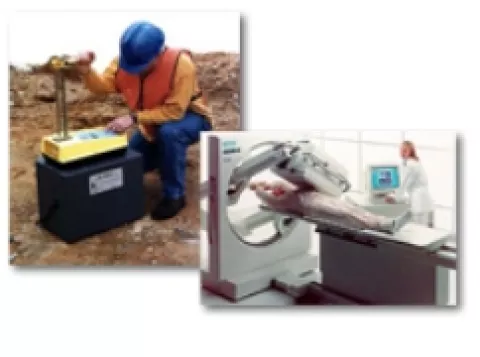
A materials license authorizes the licensee to engage in certain regulated activities involving byproduct, source, and/or special nuclear material. Examples of regulated activities include manufacture, distribution, possession, and use. The materials licenses addressed on this page are those which involve the various categories of medical, industrial, academic, and other materials uses and activities (i.e., program areas) referenced in the Materials Licensees Toolkits Index.
- Which type of license do I need?
The NRC issues different types of materials licenses:
Specific licenses are issued to a specific named applicant for activities involving radioactive material, such as possession, distribution, and use of byproduct, source, and/or special nuclear material. An application must be submitted by the applicant or licensee.
Some examples of specific licenses include the following:
- Manufacturer's Possession License: Issued to a manufacturer to possess, use, and manufacture licensed material for distribution. It can also authorize distribution to other entities with a specific license.
- General Distribution License: Issued to manufacturers and distributors to distribute licensed materials to persons who are generally licensed to possess and use the materials.
- Medical Distribution License: Issued to manufacturers and distributors to allow distribution of certain sources and devices for medical use.
- Master Materials License: Issued to a Federal organization, authorizing the possession and use of radioactive materials at multiple sites. The Master Materials License (MML) authorizes the licensee to issue its own radioactive materials permits to its various facilities, which are then responsible for adhering to NRC and MML requirements and inspection programs.
Exempt distribution licenses are specific licenses that authorize distribution of byproduct or source material to persons exempt from regulatory requirements for an NRC or Agreement State license. Exempt distribution licenses are only issued by NRC Headquarters. Exempt distribution licenses do not authorize possession or use of licensed materials, so applicants for an exempt distribution license must also obtain a specific license authorizing whatever possession and use will occur. This is accomplished by contacting and submitting an application to the applicable regulatory authority (NRC or Agreement State) based on the physical location where that possession and use will occur.
In contrast to specific and exempt distribution licenses, general licenses are provided by regulation and permit certain activities involving radioactive materials without requiring an individual application. Consequently, there are no pre-application engagements in connection with general licenses. In some cases, general licensees are required to register devices and materials, as in the case of the registration requirements in 10 CFR 31.5. These registrations are different than the sealed source and device registrations discussed elsewhere on this page.
- Where can an NRC materials license be used?
In general, an NRC materials license can authorize licensed activities to be performed in states that do not participate in the Agreement State program, as well as in areas of exclusive Federal jurisdiction within Agreement States (e.g., certain facilities or areas controlled exclusively by the Federal government, such as military bases).
NRC materials licenses generally identify the specific locations where licensed activities may occur (e.g., where licensed materials may be used and stored). For certain types of uses such as radiography, well logging, or use of portable moisture density gauges, the license may also authorize use at temporary job sites in states that do not participate in the Agreement State program, as well as in areas of exclusive Federal jurisdiction within Agreement States.
An Agreement State is a State that has entered into a formal agreement with the NRC to assume responsibility for licensing and regulation of certain radioactive materials and regulated activities within its boundaries. Use of licensed materials in an Agreement State will generally require coordination with and authorization by the appropriate state regulatory agency when the location of use is not an area of exclusive Federal jurisdiction. Visit current list of Agreement States (including names, addresses, and telephone numbers of responsible officials).
Detailed guidance on these topics can be found in the NUREG 1556 guidance series.
- How do I apply for an NRC license?
First, start with NRC Form 313 and complete Items 1-4 and 13. The form must be signed by a person duly authorized to act for and on behalf of the applicant or licensee.
Second, provide a response to Items 5-11, as applicable. For new licenses and license renewals a response to all items is required. For license amendments, only the relevant changes to the license should be addressed.
Detailed licensing guidance is available in the NUREG 1556 series for each program area of materials use. The cross-reference table below links to the corresponding full volume of NUREG 1556 which provides detailed information regarding Items 5-11 for each program area of use (second column), as well as to checklists within each NUREG 1556 volume that may be of assistance to applicants in ensuring that all categories of information are provided in their applications (third column).
Cross-Reference Table for NRC Licensing Guidance by Program areas for Prospective Applicant
License/Registration | NUREG 1556 Applicable Volume | Checklists of relevant categories of information in application |
|---|---|---|
Portable Gauge | Appendix B | |
Industrial Radiography | Appendix C | |
Sealed Source and Devices | Appendix A | |
Fixed Gauges | Appendix B | |
Self-Shielded Irradiator | Appendix B | |
Part 36 Irradiator | Appendix C | |
Academic and R&D | Appendix B | |
Exempt Distribution | Pages 9-9 to 9-44: 10 CFR 32.14, Certain Consumer Products, Page 9-12; 10 CFR 32.18, Manufacturing and Distribution exempt quantities, Page 9-17; 10 CFR 32.21, Radioactive Drug, Page 9-19; 10 CFR 32.22, Self-luminous, Page 9-24; 10 CFR 32.26, ,Gas and Aerosol Detectors, Page 9-29; 10 CFR 32.30, Industrial Devices, Page 9-36; 10 CFR 40.52, Source Material, Page 9-44 | |
Medical Use | Appendix C | |
Master Material | Appendix B | |
Broad Scope | Appendix B -Table B-1 | |
Manufacturing and distribution | Appendix B | |
Commercial Radiopharmacy | Appendix B | |
Well logging | Appendix B and C | |
Transfers of Control (all uses) | Appendix E | |
General Distribution | Appendix F and Appendix G, for FAQs | |
Special Nuclear Material of less than critical mass | Appendix B - Table B-1 | |
Service Provider | Appendix B - Table B-1 through B-4 | |
Production of Radioactive Material Using an Accelerator | Appendix B |
- I already have a materials license; how do I make changes?
Amendments to licenses for possession and use are commonly required for:
- Changes to the company name or mailing address listed on the license.
- Changes to the materials or uses authorized on the license.
- Changes to the Radiation Safety Officer (RSO)
- Changes to the Authorized Users (AUs) named on the license.
- Changes to the facilities or locations where materials are used and stored.
- Changes to the radiation safety program or previously submitted commitments or procedures.
Amendments to exempt distribution licenses are commonly required for:
- Changes to the company name or mailing address listed on the license.
- Changes to the materials or uses authorized on the license.
Section 8 of each guidance document in the NUREG 1556 series provides detailed guidance on the contents of applications, including for each of the topics listed above. When submitting a license amendment request you only need to submit information regarding the specific change requested.
The amendment request must include either a copy of NRC Form 313 or a cover letter that has been signed and dated by a person duly authorized to act for and on behalf of the applicant or licensee.
- Where do I submit my application?
You may submit your application by either electronic or physical mail to the appropriate regional office, as listed below.
If you are located in:
Alabama, Connecticut, Delaware, District of Columbia, Florida, Georgia, Kentucky, Maine, Maryland, Massachusetts, New Hampshire, New Jersey, New York, North Carolina, Pennsylvania, Puerto Rico, Rhode Island, South Carolina, Tennessee, Vermont, Virginia, Virgin Islands, or West Virginia:
Licensing Assistance Team
Division of Radiological Safety and Security
U.S. Nuclear Regulatory Commission, Region I
475 Allendale Road, Suite 102
King of Prussia, PA 19406-1415
R1DRSSMail.Resource@nrc.gov
If you are located in:
Illinois, Indiana, Iowa, Michigan, Minnesota, Missouri, Ohio, or Wisconsin:
Materials Licensing Branch
Division of Radiological Safety and Security
U.S. Nuclear Regulatory Commission, Region III
2056 Westings Ave., Suite 400
Naperville, IL 60563-2657
R3-DRSSMail.Resource@nrc.gov
If you are located in:
Alaska, Arizona, Arkansas, California, Colorado, Hawaii, Idaho, Kansas, Louisiana, Mississippi, Montana, Nebraska, Nevada, New Mexico, North Dakota, Oklahoma, Oregon, Pacific Trust Territories, South Dakota, Texas, Utah, Washington, or Wyoming.
Materials Licensing Branch
U.S. Nuclear Regulatory Commission, Region IV
1600 E. Lamar Boulevard
Arlington, TX 76011-4511
R4licensing@nrc.gov
For exempt distribution you may submit your application by either electronic or physical mail to NRC HQ, as listed below.
Material Safety and Licensing Branch
Division of Materials Safety, Security, State, and Tribal Programs
Two White Flint North
11545 Rockville Pike
Rockville, MD 20852-2738
Email: LBLicensingAssistant.Resource@nrc.gov
- What are the fees associated with obtaining and maintaining an NRC license? How can I pay my fee?
The NRC assesses fees for new license applications, as well as for license amendments that increase the scope of an existing license to a higher fee category or add a new fee category (e.g., new program area). The required application fees are listed by program area in 10 CFR 170.31 tables. The NRC will not issue the new license until the fee is received. For help with identifying the appropriate fees, please contact NRC staff at the appropriate office.
The NRC also assesses an annual fee each year as described in 10 CFR 171.16.
Effective October 1, 2024, the NRC accepts only electronic forms of payment. All payments to NRC must be submitted using the electronic options available at www.pay.gov. Federal agencies may also make payments through the Intra-Governmental Payment and Collection (IPAC) system.
The NRC no longer accepts paper checks. Please see the NRC Payment Methods brochure. NRC licensees and stakeholders seeking assistance with electronic payment methods may contact the NRC Fees Helpdesk at fees.resource@nrc.gov or by phone at 301-415-7554.
- Are there web-based options to submit a materials license application?
Yes, NRC now offers the option for applicants and existing byproduct materials licensees to submit materials applications through its Web-based Licensing System (online Form 313 portal). Through the portal, eligible users can submit new applications, track the status of their licenses, and request amendments and renewals all in one centralized location. To get started, eligible users must first complete a quick credentialing process that ensures secure and authorized access to the system. Credentialing is fast and simple. Begin here:
Get credentialed for WBL. For assistance with credentialing or using the portal, please review the Frequently Asked Questions (FAQs).
More information, user guides, and videos, are available in the WBL portal page.
- I am a small business or entity, am I eligible for reduced annual fees?
The NRC has established two tiers of fees for licensees that qualify as a small entity under 10 CFR 2.810 and 10 CFR 171.16(c). To determine if you are eligible for reduced annual fees complete NRC Form 526 and submit all required documentation to SmallEntity.Resource@nrc.gov. You must submit NRC Form 526 and required documentation every year to retain eligibility for reduced fees.
For more information see the Annual Small Entity Certification FAQ sheet.
- I have an Agreement State license – can I use it in areas under NRC jurisdiction?
The NRC has processes for reciprocal recognition of Agreement State licenses for work performed in areas of NRC jurisdiction. Activities conducted by Agreement State licensees in non-Agreement States, areas of exclusive Federal jurisdiction, and offshore waters, must meet the general license provisions of 10 CFR 150.20, "Recognition of Agreement State Licenses."
Please review Frequently Asked Questions About NRC Reciprocity for additional information.
- Can I transfer my NRC license to another organization?
NRC regulations require that NRC consent be obtained prior to transferring control of the license either directly or indirectly, such as via a sale of the company holding the license.
NRC guidance document NUREG 1556, Volume 15, Revision 1 provides comprehensive guidance on the transfer of control process. The same process is used for all types of materials licenses and the information required for licensing can be found in Appendix E, "Information Needed for Transfer of Control Application."
Applications for transfers of control are required to be posted publicly for comment for 30 days. It is important that a request to transfer licenses be submitted at least 30 days prior to the planned closing date of the associated transaction to maintain regulatory compliance.
- I am no longer using radioactive materials; how do I request termination of my license?
Complete NRC Form 314 (or provide equivalent information) and submit to the appropriate Regional office. The certification must be signed by a duly authorized individual.
Attach required supporting documentation, which commonly includes:
For sealed sources:
- Provide final disposition information for all sealed sources, such as a letter from the source manufacturer, waste broker, or receiving licensee who is authorized to possess the device, confirming that the device has been transferred.
- If the license authorized materials that were never acquired, a statement should be provided confirming such.
- A copy of all final leak test records.
For unsealed licensed materials:
- Records demonstrating that radioactive licensed materials have either been transferred to another licensed entity, or disposed of in accordance with NRC requirements.
- Final status surveys of all areas where unsealed licensed materials were used or stored to demonstrate the absence of licensed radioactive materials and that the premises are suitable for release in accordance with the NRC's regulatory criteria for decommissioning. Final status surveys should be performed in each area where licensed radioactive materials were used or stored, and should include pertinent details including:
- A description of radioisotopes and forms of radioactive licensed materials used in each area surveyed.
- Information on when radioactive licensed materials were last used in each area.
- The date of the survey.
- Information on the survey instruments used, including the manufacturer and model number of each instrument used, the last date of calibration at the time of use, and each instruments efficiency or correction factor as applicable.
- Data sets provided should include background readings and the units used should be clearly stated.
More detailed guidance regarding the termination of materials activities and licenses can be found in the applicable NUREG 1556 guidance documents and in NUREG 1757, Volume 1, Revision 2 "Decommissioning Process for Materials Licensees." Additional information, including a decommissioning plan, may be required for licensees whose decommissioning or termination activities fall under Decommissioning Groups 3 or higher, as described NUREG 1757, Volume 1, Revision 2.
Page Last Reviewed/Updated Thursday, August 27, 2026
Page Last Reviewed/Updated Thursday, August 27, 2026