


What is a Sealed Source and Device (SSD) registration certificate?
The regulations at 10 CFR 30.32(g) and 10 CFR 32.210 codify the current and longstanding practice whereby manufacturers, distributors, or custom users of certain sealed sources of radioactive material and devices containing sealed sources submit the radiation safety information necessary for the NRC or applicable Agreement State to perform an independent, technical safety evaluation and issue a certificate of registration of radiation safety information on those sealed sources and devices (SSD). The registration certificate summarizes radiation safety information for the sealed source or device and generally contains certain provisions and limitations regarding licensure, possession, use, or other topics of relevance to maintaining radiological safety.
Is a possession and/or distribution license needed in addition to an SSD registration certificate?
Yes, an SSD registration certificate by itself does not authorize regulated activity, such as possession, distribution, or use of radioactive material. A person must obtain any applicable materials license(s) (e.g., specific licenses authorizing distribution or possession) from the NRC or applicable Agreement State, depending on jurisdiction, prior to engaging in regulated activity.
What are the types of Sealed Source and Device registration certificates NRC issues?
The NRC issues four types of registration certificates associated with the materials licenses as follows:
- Specifically licensed (Sources and/or Devices) - to be used by specific licensees
- Generally licensed (Devices Only) - to be used by general licensees
- Both – Specifically and Generally Licensed (Devices Only)- Some devices are distributed as "B" (both specifically licensed and general licensed devices). - To be used by both specific licensees and general licensees.
- Exempt Products (Devices Only) - to be used by persons exempt from licensing.
- Who evaluates applications for Sealed Source and Device registration certificates?
Applicant and its Location | Regulatory Agency |
|---|---|
Distributor of products to persons exempt from licensing, regardless of location | NRC Headquarters |
Federal agency regardless of location | NRC Headquarters |
Non-Federal entity in non-Agreement State, District of Columbia, or U.S. territory or possession | NRC Headquarters |
Non-Federal entity in Agreement State with authority to issue sealed source and device registration certificates | Agreement State (See figure below) |
Non-Federal entity in Agreement State that does not have authority to issue sealed source and device registration certificates | NRC Headquarters
|
Distributors of products that contains naturally occurring or accelerator-produced radioactive material [Naturally Occurring Radioactive Material (NORM) or Naturally Occurring Radioactive Material or Accelerator-Produced (NARM), respectively]. | NRC Headquarters |
Sealed Source and Device Certification Authority by State
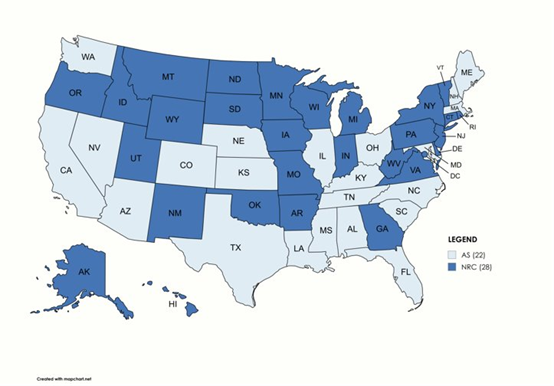
Where do I submit my application for an SSD registration certificate?
Distributors applying for an SSD registration certificate for which the NRC is the regulatory agency, as indicated in the previous chart and graphic, should submit their application to:
Material Safety and Licensing Branch
Division of Materials Safety, Security, State, and Tribal Programs
Two White Flint North
11545 Rockville Pike
Rockville, MD 20852-2738How do I apply for a new registration certificate for a sealed source and/or device or amendment to an existing registration certificate?
Start by using the Application and Review Checklist in Appendix A of NUREG 1556, Volume 3, Revision 2. In that same volume, Section 10, Application and Review Process, provides guidance on what information should be included in the application. The application must be signed by a person duly authorized to act for and on behalf of the applicant or certificate holder. Additional information on modifications to existing registration certificates can be found in Section 13 of the NUREG 1556, Volume 3, Revision 2.
My product is imported from a foreign country, what should I do?
Please note the provisions in 10 CFR 110.53(a) require a foreign vendor to establish an address in the U.S. to which the NRC can correspond and serve papers, as necessary to accomplish its mission. Accordingly, the NRC accepts applications with a U.S. address from a foreign vendor and issues the registration certificate to the U.S. representative of the foreign vendor. The registration certificate designates the U.S. representative as the distributor of the product and lists the foreign vendor as the manufacturer. If the U.S. representative of the foreign vendor is located in one of the Agreement States that have authority to issue registration certificates, you will need to contact the respective Agreement State. See Section 5.5, Foreign Vendors, in NUREG 1556, Volume 3, Revision 2.
I need an expedited review. How do I request one?
For expedited reviews on the basis of national security, the NRC will give an application high priority and expedite the review if the product is necessary for protecting national security. The criteria that the NRC will generally use in making this determination can be found in Section 9.2.1 of NUREG 1556, Volume 3, Revision 2.
For expedited reviews for reasons other than national security, an application may be assigned a higher priority upon request, if the NRC makes a determination that an expedited review process is warranted due to considerations such as dire public health and safety needs or commercial hardship for the applicant. Requests for higher priority should include adequate justification. The company president or chief executive officer of the applicant or certificate holder should make the request in writing to the appropriate NRC manager. The information that should be submitted with the application can be found in Section 9.2.2 of NUREG 1556, Volume 3, Revision 2.
What are the fees associated with obtaining and maintaining an SSD registration certificate?
Each application for which a fee is specified must be accompanied by the appropriate fee, including applications for new registration certificates. Refer to 10 CFR 170.31, "Schedules of fees for materials licenses and other regulatory services, including inspections, and import and export licenses," to determine the amount of the fee. The NRC will not issue the registration certificate until the fee payment is received.
Most NRC registration certificate holders are also subject to annual fees; refer to 10 CFR 171.16, "Annual fees: Materials licensees, holders of certificates of compliance, holders of sealed source and device registrations, holders of quality assurance program approvals, and government agencies licensed by the NRC."
Effective October 1, 2024, the NRC accepts only electronic forms of payment. All payments to NRC must be submitted using the electronic options available at www.pay.gov. Federal agencies may also make payments through the Intra-Governmental Payment and Collection (IPAC) system.
The NRC no longer accepts paper checks. Please see the NRC Payment Methods brochure. NRC certificate holders and prospective applicants seeking assistance with electronic payment methods may contact the NRC Fees Helpdesk at fees.resource@nrc.gov or by phone at 301-415-7554.
I am a small business or entity; am I eligible for reduced annual fees?
Consult 10 CFR 171.11 for information on exemptions from annual fees and 10 CFR 171.16(c) on reduced annual fees for registration certificate holders that qualify as "small entities." Note that in order to pay reduced fees, a certificate holder that qualifies as a "small entity" must provide proper certification of this status to the NRC each year, along with its annual fee payment.
I no longer plan to commercially distribute my product; what should I do?
If you are no longer planning to commercially distribute your product you must request that your registration certificate, be inactivated. The regulation in 10 CFR 32.211 states in part that a certificate holder who no longer manufactures or initially transfers any of the sealed source(s) or device(s) (SSDs) covered by a particular certificate issued by the NRC shall request inactivation of the registration certificate.
I'm seeking to distribute a sealed source or device designed to be used by persons exempt from licensing. Do I need an SSD registration certificate?
An SSD registration certificate is required for distribution of certain devices designed to be used by persons exempt from licensing requirements. Distribution of these products will also require that the distributor obtains an exempt distribution license, as well as a separate license authorizing possession and use, as applicable. Information about exempt distribution licensing can be found in the Exempt Distribution Licensee Toolkit. The NRC requires and issues registration certificates for the following types of SSDs that are eligible for exempt distribution:
- 10 CFR 32.22 - Self-Luminous Products Containing Tritium, Krvpton-85 or Promethium-147: Requirements for License to Manufacture, Process, Produce, or Initially Transfer
- 10 CFR 32.26 – Gas and Aerosol Detectors Containing Byproduct Material: Requirements for License to Manufacture, Process, Produce, or Initially Transfer.
- 10 CFR 32.30 – Certain Industrial Devices Containing Byproduct Material: Requirements for License to Manufacture, Process, Produce, or Initially Transfer.