


1.0 Site Identification
Type of Site: | Complex Decommissioning Site |
Location: | West Valley, NY |
License No.: | CSF-1 |
Docket No.: | 0500201, POOM-032 |
License Status: | DECON |
Project Manager: | Cardelia H. Maupin |
2.0 Site Status Summary
Located 48 kilometers (km) (30 miles) south of Buffalo, New York, the West Valley Demonstration Project (WVDP) site is located on the Western New York Nuclear Service Center (WNYNSC) and comprises 1,335 hectares (ha) (3,300 acres (ac)) of land established for a former reprocessing facility. The 1980 WVDP Act gives the U.S. Department of Energy (DOE) exclusive possession of the WVDP site, an 80-ha (200-ac) portion of the WNYNSC, which includes the former reprocessing facility, the Nuclear Regulatory Commission (NRC)-licensed disposal area (NDA), high-level waste (HLW) tanks, waste lagoons, and above ground waste storage areas. The WNYNSC contains a former commercial nuclear fuel reprocessing facility that operated from 1966 to 1972, and produced approximately 2,271 cubic meters (m3) (600,000 gallon (gal)) of liquid HLW. The WNYNSC also contains contaminated structures and two radioactive waste disposal areas: (i) a 6-ha (15-ac) New York State-licensed disposal area (SDA) which is not on WVDP premises that operated as a commercial low-level waste (LLW) disposal facility from 1963 to 1975, and (ii) the 2.8-ha (7-ac) NDA that received radioactive waste from the reprocessing plant and associated facilities from 1966 through 1986.
In 1980, Congress enacted the WVDP Act. Under the Act, DOE assumed exclusive possession of the 200-acre portion of the WNYNSC which includes the former reprocessing facility, the NDA, the HLW tanks, waste lagoons, and above ground waste storage areas. The WVDP Act authorized DOE to solidify, transport and dispose of HLW that exists at the site; to dispose of LLW and transuranic waste produced by the WVDP; and to decontaminate and decommission facilities used for the WVDP in accordance with requirements prescribed by NRC. In 1981, NRC put the technical specifications of the license in abeyance to allow DOE to carry out the WVDP Act. In 2002, DOE completed the solidification of liquid HLW which was placed into 275 stainless steel canisters. The HLW canisters are expected to be stored on-site until shipped for disposal to a federal repository.
In 2002, the Commission issued its final policy statement on decommissioning criteria for the WVDP. The policy statement prescribed the NRC's License Termination Rule (LTR) (10 CFR part 20, subpart E) as the decommissioning criteria for the WVDP, reflecting the fact that the applicable goal for the entire NRC--licensed site is compliance with the requirements of the LTR.
In 1990, DOE and the licensee (New York State Energy Research and Development Authority) (NYSERDA) agreed to prepare a joint Environmental Impact Statement (EIS) to address the completion of WVDP and closure or long-term management of the WNYNSC. NRC is a cooperating agency for this EIS in accordance with its responsibilities under the WVDP Act. In September 2005, NRC and other cooperating agencies initiated a review of a preliminary (pre-decisional) draft of this EIS. In April 2006, cooperating agencies forwarded comments to DOE on the preliminary draft EIS.
In November 2006, the DOE convened a "Core Team" of federal and state agencies involved in the EIS. The Core Team's goal was to assist in addressing technical issues related to the EIS. DOE issued a draft EIS for public comment in December 2008, and issued a final EIS in January 2010. In April 2010, DOE issued the EIS Record of Decision which implements the DOE and NYSERDA preferred alternative (Phased Decision-making Alternative) identified in the EIS. DOE's preferred alternative to decommissioning the WVDP site employs a two-phased approach to decommissioning the site. Phase 1 involves the decommissioning of most site facilities, including demolition of the Main Plant Process Building (MPPB) and Vitrification Facility and studies to reduce uncertainties associated with decommissioning the remaining facilities (referred to as Phase 1 studies). Phase 2 involves the completion of the decommissioning process and long-term management decision-making for the site.
Phase 1 of the decommissioning approach was conducted in accordance with the DOE WVDP Phase 1 Decommissioning Plan (DP) and was estimated to take 10 years to complete. According to the DOE Phase 1 DP, DOE estimated that the Phase 1 Decommissioning could be completed in 10 years at an annual funding profile of $75 —$100M. Phase 1 Decommissioning includes relocating the 275 HLW canisters and three non-conforming HLW canisters to long-term interim storage on-site with the demolition of on-site structures (Remote Handled Waste Facility, Vitrification Facility, and MPPB) continuing to ship LLW, and managing the NDA.
In 2017, DOE completed the deactivation of the Vitrification Facility. In July 2018, DOE completed a major milestone which included processing, shipping, and disposing of all legacy waste on-site. The remaining legacy waste shipments were completed by October 2018. In FY 2019, DOE completed demolition of the Vitrification Facility. DOE continues with performing decommissioning under the Phase I DP.
Ongoing performance of site operations are conducted to support Phase 1 Decommissioning. These activities include Maintenance & Utilities, Permeable Treatment Wall Operations, Remote Handled Waste Facility Operations & Maintenance, Low-Level Radiological Waste Treatment System Operations, Waste Tank Farm Maintenance, and NDA Maintenance.
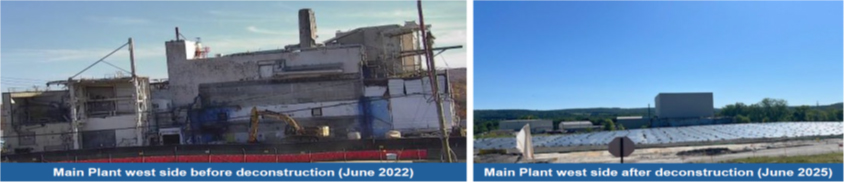
Demolition of the MPPB is part of Phase I Decommissioning. The MPPB Decontamination and Demolition Work Plan was developed in 2017. In April 2019, the DOE informed the NRC staff that it was moving forward with the demolition of the above grade portion of the MPPB Decontamination and Demolition Work Plan after a hiatus. In addition, DOE WVDP requested that NRC resume its review of its responses to NRC's comments on the MPPB Decontamination and Demolition Work Plan. The DOE incorporated lessons-learned from the successful demolition of the Vitrification Facility at West Valley, as well as other demolition activities at other DOE sites. The NRC staff completed its review in May 2019 requesting proof of concept information before open air demolition begins. In May 2020, the DOE changed its approach to the MPPB Decontamination and Demolition Work Plan. The NRC reviewed the changes and provided additional comments to DOE in September 2020. DOE implemented the MPPB Decontamination and Demolition Work Plan after NRC's review. In May and June 2025, major milestones were achieved with the completion of the demolition of the MPPB to grade. This marked completion of Phase 1A of the project. The next phase of the project, Phase 1B, will address below grade decommissioning and demolition. It is anticipated that the below grade decommissioning project will require the removal of more material than the above grade decommissioning and demolition. Due to the extent of infrastructure upgrades and planning needed to support Phase 1B, it is expected to be several years before significant excavation work begins.
Before and After Pictures of the Demolition of the MPPB at WVDP courtesy of DOE WVDP:

MPPB Deconstruction
The Phase 2 decommissioning involves the completion of the decommissioning process and long-term management decision-making for the site. During 2018, DOE and NYSERDA completed Phase 1 studies which included erosion, exhumation, and engineered barriers. The Phase I studies are separate from the EIS process. The results of these studies will be used to assist decision-making and to inform the Phase 2 Supplemental EIS (SEIS).
In early FY 2018, the NRC confirmed its intent to act as a cooperating agency for the SEIS and attended SEIS scoping meetings held by DOE and NYSERDA in April 2018. Since 2018, DOE and the licensee have been building a probabilistic performance assessment (PPA) framework or model which they intend to use to inform the SEIS. In addition, since 2018, DOE and NYSERDA have been working to develop the Draft SEIS for Phase 2 Decommissioning, and the draft Phase 2 DP. These plans cannot be completed until the SEIS is completed. NYSERDA also intends to prepare a draft proposed DP to address anticipated license termination for the Cesium Prong (a localized area of radioactive contamination, primarily consisting of Cesium-137), Bulk Storage Warehouse, and potential soil/streambed sediment contamination outside the WNYNSC. The SDA will also be included to allow a comprehensive view of dose contributions from the entire licensed premises.
The NRC regularly conducts activities that support its monitoring and consultation responsibilities under the WVDP Act of 1980, which requires DOE to carry out decontamination and decommissioning activities consistent with NRC requirements. Each year, the NRC staff conduct several monitoring visits to observe and review the ongoing activities at the site. In addition, in October 2024 and January 2026, the NRC staff supported the DOE WVDP Regulatory Roundtable Meetings. The purpose of the meetings was to discuss the status and next steps for decontaminating and decommissioning of the site in accordance with the WVDP Act of 1980 with NRC, EPA, and New York State regulatory organizations. Engagement in the roundtable also helps NRC staff plan and allocate resources efficiently. During these meetings, NRC staff highlighted the importance of scheduling and planning for upcoming DOE requests for NRC technical reviews, including reviews of DOE’s PPA model and the draft SEIS.
3.0 Major Technical or Regulatory Issues
Current issues include reducing technical uncertainties (e.g., source term, erosion impacts, and long-term risks to members of the public) to support Phase 2 decision-making. Information and results from Phase 1 studies and the PPA will support evaluation of decommissioning alternatives in the SEIS, help optimize overall risk reduction, and inform final decisions by DOE and NYSERDA. DOE and NYSERDA are also developing DPs to implement the Phase 2 decision; these plans will be provided to NRC for review. NRC staff will fulfill its consultative responsibilities under the WVDP Act by reviewing DOE’s DP and providing comments, including stating any objections, as appropriate.
4.0 Estimated Date For Closure
TBD