PART 20—STANDARDS FOR PROTECTION AGAINST RADIATION
Part Index
Subpart A—General Provisions
20.1001 Purpose.
20.1002 Scope.
20.1003 Definitions.
20.1004 Units of radiation dose.
20.1005 Units of radioactivity.
20.1006 Interpretations.
20.1007 Communications.
20.1008 Implementation.
20.1009 Information collection requirements: OMB approval.
Subpart B—Radiation Protection Programs
20.1101 Radiation protection programs.
Subpart C—Occupational Dose Limits
20.1201 Occupational dose limits for adults.
20.1202 Compliance with requirements for summation of external and internal doses.
20.1203 Determination of external dose from airborne radioactive material.
20.1204 Determination of internal exposure.
20.1205 [Reserved]
20.1206 Planned special exposures.
20.1207 Occupational dose limits for minors.
20.1208 Dose equivalent to an embryo/fetus.
Subpart D—Radiation Dose Limits for Individual Members of the Public
20.1301 Dose limits for individual members of the public.
20.1302 Compliance with dose limits for individual members of the public.
Subpart E—Radiological Criteria for License Termination
20.1401 General provisions and scope.
20.1402 Radiological criteria for unrestricted use.
20.1403 Criteria for license termination under restricted conditions.
20.1404 Alternate criteria for license termination.
20.1405 Public notification and public participation.
20.1406 Minimization of contamination.
Subpart F—Surveys and Monitoring
20.1501 General.
20.1502 Conditions requiring individual monitoring of external and internal occupational dose.
Subpart G—Control of Exposure From External Sources in Restricted Areas
20.1601 Control of access to high radiation areas.
20.1602 Control of access to very high radiation areas.
Subpart H—Respiratory Protection and Controls to Restrict Internal Exposure in Restricted Areas
20.1701 Use of process or other engineering controls.
20.1702 Use of other controls.
20.1703 Use of individual respiratory protection equipment.
20.1704 Further restrictions on the use of respiratory protection equipment.
20.1705 Application for use of higher assigned protection factors.
Subpart I—Storage and Control of Licensed Material
20.1801 Security of stored material.
20.1802 Control of material not in storage.
Subpart J—Precautionary Procedures
20.1901 Caution signs.
20.1902 Posting requirements.
20.1903 Exceptions to posting requirements.
20.1904 Labeling containers.
20.1905 Exemptions to labeling requirements.
20.1906 Procedures for receiving and opening packages.
Subpart K—Waste Disposal
20.2001 General requirements.
20.2002 Method for obtaining approval of proposed disposal procedures.
20.2003 Disposal by release into sanitary sewerage.
20.2004 Treatment or disposal by incineration.
20.2005 Disposal of specific wastes.
20.2006 Transfer for disposal and manifests.
20.2007 Compliance with environmental and health protection regulations.
20.2008 Disposal of certain byproduct material.
Subpart L—Records
20.2101 General provisions.
20.2102 Records of radiation protection programs.
20.2103 Records of surveys.
20.2104 Determination of prior occupational dose.
20.2105 Records of planned special exposures.
20.2106 Records of individual monitoring results.
20.2107 Records of dose to individual members of the public.
20.2108 Records of waste disposal.
20.2109 [Reserved]
20.2110 Form of records.
Subpart M—Reports
20.2201 Reports of theft or loss of licensed material.
20.2202 Notification of incidents.
20.2203 Reports of exposures, radiation levels, and concentrations of radioactive material exceeding the constraints or limits.
20.2204 Reports of planned special exposures.
20.2205 Reports to individuals of exceeding dose limits.
20.2206 Reports of individual monitoring.
20.2207 Reports of transactions involving nationally tracked sources.
Subpart N—Exemptions and Additional Requirements
20.2301 Applications for exemptions.
20.2302 Additional requirements.
Subpart O—Enforcement
20.2401 Violations.
20.2402 Criminal penalties.
Appendix A to Part 20—Assigned Protection Factors for Respirators
Appendix B to Part 20—Annual Limits on Intake (ALIs) and Derived Air Concentrations (DACs) of Radionuclides for Occupational Exposure; Effluent Concentrations; Concentrations for Release to Sewerage
Appendix C to Part 20—Quantities of Licensed Material Requiring Labeling
Appendix D to Part 20—United States Nuclear Regulatory Commission Regional Offices
Appendix E to Part 20—Nationally Tracked Source Thresholds
Appendix F to Part 20—[Reserved]
Appendix G to Part 20—Requirements for Transfers of Low-Level Radioactive Waste Intended for Disposal at Licensed Land Disposal Facilities and Manifests
Authority: Atomic Energy Act of 1954, secs. 11, 53, 63, 65, 81, 103, 104, 161, 170H, 182, 186, 223, 234, 274, 1701 (42 U.S.C. 2014, 2073, 2093, 2095, 2111, 2133, 2134, 2201, 2210h, 2232, 2236, 2273, 2282, 2021, 2297f); Energy Reorganization Act of 1974, secs. 201, 202 (42 U.S.C. 5841, 5842); Low-Level Radioactive Waste Policy Amendments Act of 1985, sec. 2 (42 U.S.C. 2021b); 44 U.S.C. 3504 note.
[72 FR 55921, Oct. 1, 2007; 76 FR 35564, Jun. 17, 2011; 77 FR 39904, Jul. 6, 2012; 80 FR 54233, Sep. 9, 2015; 80 FR 58574, Sep. 30, 2015]
Subpart A—General Provisions

Source: 56 FR 23391, May 21, 1991, unless otherwise noted.
§ 20.1001 Purpose.
(a) The regulations in this part establish standards for protection against ionizing radiation resulting from activities conducted under licenses issued by the Nuclear Regulatory Commission. These regulations are issued under the Atomic Energy Act of 1954, as amended, and the Energy Reorganization Act of 1974, as amended.
(b) It is the purpose of the regulations in this part to control the receipt, possession, use, transfer, and disposal of licensed material by any licensee in such a manner that the total dose to an individual (including doses resulting from licensed and unlicensed radioactive material and from radiation sources other than background radiation) does not exceed the standards for protection against radiation prescribed in the regulations in this part. However, nothing in this part shall be construed as limiting actions that may be necessary to protect health and safety.
§ 20.1002 Scope.
The regulations in this part apply to persons licensed by the Commission to receive, possess, use, transfer, or dispose of byproduct, source, or special nuclear material or to operate a production or utilization facility under parts 30 through 36, 39, 40, 50, 52, 60, 61, 63, 70, or 72 of this chapter, and in accordance with 10 CFR 76.60 to persons required to obtain a certificate of compliance or an approved compliance plan under part 76 of this chapter. The limits in this part do not apply to doses due to background radiation, to exposure of patients to radiation for the purpose of medical diagnosis or therapy, to exposure from individuals administered radioactive material and released under § 35.75, or to exposure from voluntary participation in medical research programs.
[67 FR 20370, Apr. 24, 2002; 67 FR 62872, Oct. 9, 2002, as amended at 67 FR 77652, Dec. 19, 2002; 72 FR 49485, Aug. 28, 2007]
§ 20.1003 Definitions.
As used in this part:
Absorbed dose means the energy imparted by ionizing radiation per unit mass of irradiated material. The units of absorbed dose are the rad and the gray (Gy).
Accelerator-produced radioactive material means any material made radioactive by a particle accelerator.
Act means the Atomic Energy Act of 1954 (42 U.S.C. 2011 et seq.), as amended.
Activity is the rate of disintegration (transformation) or decay of radioactive material. The units of activity are the curie (Ci) and the becquerel (Bq).
Adult means an individual 18 or more years of age.
Airborne radioactive material means radioactive material dispersed in the air in the form of dusts, fumes, particulates, mists, vapors, or gases.
Airborne radioactivity area means a room, enclosure, or area in which airborne radioactive materials, composed wholly or partly of licensed material, exist in concentrations—
(1) In excess of the derived air concentrations (DACs) specified in appendix B, to §§ 20.1001-20.2401, or
(2) To such a degree that an individual present in the area without respiratory protective equipment could exceed, during the hours an individual is present in a week, an intake of 0.6 percent of the annual limit on intake (ALI) or 12 DAC-hours.
Air-purifying respirator means a respirator with an air-purifying filter, cartridge, or canister that removes specific air contaminants by passing ambient air through the air-purifying element.
ALARA (acronym for "as low as is reasonably achievable") means making every reasonable effort to maintain exposures to radiation as far below the dose limits in this part as is practical consistent with the purpose for which the licensed activity is undertaken, taking into account the state of technology, the economics of improvements in relation to state of technology, the economics of improvements in relation to benefits to the public health and safety, and other societal and socioeconomic considerations, and in relation to utilization of nuclear energy and licensed materials in the public interest.
Annual limit on intake (ALI) means the derived limit for the amount of radioactive material taken into the body of an adult worker by inhalation or ingestion in a year. ALI is the smaller value of intake of a given radionuclide in a year by the reference man that would result in a committed effective dose equivalent of 5 rems (0.05 Sv) or a committed dose equivalent of 50 rems (0.5 Sv) to any individual organ or tissue. (ALI values for intake by ingestion and by inhalation of selected radionuclides are given in Table 1, Columns 1 and 2, of appendix B to §§ 20.1001-20.2401).
Assigned protection factor (APF) means the expected workplace level of respiratory protection that would be provided by a properly functioning respirator or a class of respirators to properly fitted and trained users. Operationally, the inhaled concentration can be estimated by dividing the ambient airborne concentration by the APF.
Atmosphere-supplying respirator means a respirator that supplies the respirator user with breathing air from a source independent of the ambient atmosphere, and includes supplied-air respirators (SARs) and self-contained breathing apparatus (SCBA) units.
Background radiation means radiation from cosmic sources; naturally occurring radioactive material, including radon (except as a decay product of source or special nuclear material); and global fallout as it exists in the environment from the testing of nuclear explosive devices or from past nuclear accidents such as Chernobyl that contribute to background radiation and are not under the control of the licensee. "Background radiation" does not include radiation from source, byproduct, or special nuclear materials regulated by the Commission.
Bioassay (radiobioassay) means the determination of kinds, quantities or concentrations, and, in some cases, the locations of radioactive material in the human body, whether by direct measurement (in vivo counting) or by analysis and evaluation of materials excreted or removed from the human body.
Byproduct material means—
(1) Any radioactive material (except special nuclear material) yielded in, or made radioactive by, exposure to the radiation incident to the process of producing or using special nuclear material;
(2) The tailings or wastes produced by the extraction or concentration of uranium or thorium from ore processed primarily for its source material content, including discrete surface wastes resulting from uranium solution extraction processes. Underground ore bodies depleted by these solution extraction operations do not constitute "byproduct material" within this definition;
(3)(i) Any discrete source of radium-226 that is produced, extracted, or converted after extraction, before, on, or after August 8, 2005, for use for a commercial, medical, or research activity; or
(ii) Any material that—
(A) Has been made radioactive by use of a particle accelerator; and
(B) Is produced, extracted, or converted after extraction, before, on, or after August 8, 2005, for use for a commercial, medical, or research activity; and
(4) Any discrete source of naturally occurring radioactive material, other than source material, that—
(i) The Commission, in consultation with the Administrator of the Environmental Protection Agency, the Secretary of Energy, the Secretary of Homeland Security, and the head of any other appropriate Federal agency, determines would pose a threat similar to the threat posed by a discrete source of radium-226 to the public health and safety or the common defense and security; and
(ii) Before, on, or after August 8, 2005, is extracted or converted after extraction for use in a commercial, medical, or research activity.
Class (or lung class or inhalation class) means a classification scheme for inhaled material according to its rate of clearance from the pulmonary region of the lung. Materials are classified as D, W, or Y, which applies to a range of clearance half-times: for Class D (Days) of less than 10 days, for Class W (Weeks) from 10 to 100 days, and for Class Y Years) of greater than 100 days.
Collective dose is the sum of the individual doses received in a given period of time by a specified population from exposure to a specified source of radiation.
Commission means the Nuclear Regulatory Commission or its duly authorized representatives.
Committed dose equivalent (HT,50) means the dose equivalent to organs or tissues of reference (T) that will be received from an intake of radioactive material by an individual during the 50-year period following the intake.
Committed effective dose equivalent (HE,50) is the sum of the products of the weighting factors applicable to each of the body organs or tissues that are irradiated and the committed dose equivalent to these organs or tissues (HE,50 = ΣWTHT.50).
Constraint (dose constraint) means a value above which specified licensee actions are required.
Controlled area means an area, outside of a restricted area but inside the site boundary, access to which can be limited by the licensee for any reason.
Critical Group means the group of individuals reasonably expected to receive the greatest exposure to residual radioactivity for any applicable set of circumstances.
Declared pregnant woman means a woman who has voluntarily informed the licensee, in writing, of her pregnancy and the estimated date of conception. The declaration remains in effect until the declared pregnant woman withdraws the declaration in writing or is no longer pregnant.
Decommission means to remove a facility or site safely from service and reduce residual radioactivity to a level that permits—
(1) Release of the property for unrestricted use and termination of the license; or
(2) Release of the property under restricted conditions and termination of the license.
Deep-dose equivalent (Hd), which applies to external whole-body exposure, is the dose equivalent at a tissue depth of 1 cm (1000 mg/cm2).
Demand respirator means an atmosphere-supplying respirator that admits breathing air to the facepiece only when a negative pressure is created inside the facepiece by inhalation.
Department means the Department of Energy established by the Department of Energy Organization Act (Pub. L. 95-91, 91 Stat. 565, 42 U.S.C. 7101 et seq.) to the extent that the Department, or its duly authorized representatives, exercises functions formerly vested in the U.S. Atomic Energy Commission, its Chairman, members, officers, and components and transferred to the U.S. Energy Research and Development Administration and to the Administrator thereof pursuant to sections 104 (b), (c), and (d) of the Energy Reorganization Act of 1974 (Pub. L. 93-438, 88 Stat. 1233 at 1237, 42 U.S.C. 5814) and retransferred to the Secretary of Energy pursuant to section 301(a) of the Department of Energy Organization Act (Pub. L. 95-91, 91 Stat 565 at 577-578, 42 U.S.C. 7151).
Derived air concentration (DAC) means the concentration of a given radionuclide in air which, if breathed by the reference man for a working year of 2,000 hours under conditions of light work (inhalation rate 1.2 cubic meters of air per hour), results in an intake of one ALI. DAC values are given in Table 1, Column 3, of appendix B to §§ 20.1001-20.2401.
Derived air concentration-hour (DAC-hour) is the product of the concentration of radioactive material in air (expressed as a fraction or multiple of the derived air concentration for each radionuclide) and the time of exposure to that radionuclide, in hours. A licensee may take 2,000 DAC-hours to represent one ALI, equivalent to a committed effective dose equivalent of 5 rems (0.05 Sv).
Discrete source means a radionuclide that has been processed so that its concentration within a material has been purposely increased for use for commercial, medical, or research activities.
Disposable respirator means a respirator for which maintenance is not intended and that is designed to be discarded after excessive breathing resistance, sorbent exhaustion, physical damage, or end-of-service-life renders it unsuitable for use. Examples of this type of respirator are a disposable half-mask respirator or a disposable escape-only self-contained breathing apparatus (SCBA).
Distinguishable from background means that the detectable concentration of a radionuclide is statistically different from the background concentration of that radionuclide in the vicinity of the site or, in the case of structures, in similar materials using adequate measurement technology, survey, and statistical techniques.
Dose or radiation dose is a generic term that means absorbed dose, dose equivalent, effective dose equivalent, committed dose equivalent, committed effective dose equivalent, or total effective dose equivalent, as defined in other paragraphs of this section.
Dose equivalent (HT) means the product of the absorbed dose in tissue, quality factor, and all other necessary modifying factors at the location of interest. The units of dose equivalent are the rem and sievert (Sv).
Dosimetry processor means an individual or organization that processes and evaluates individual monitoring equipment in order to determine the radiation dose delivered to the equipment.
Effective dose equivalent (HE) is the sum of the products of the dose equivalent to the organ or tissue (HT) and the weighting factors (WT) applicable to each of the body organs or tissues that are irradiated (HE = ΣWTHT).
Embryo/fetus means the developing human organism from conception until the time of birth.
Entrance or access point means any location through which an individual could gain access to radiation areas or to radioactive materials. This includes entry or exit portals of sufficient size to permit human entry, irrespective of their intended use.
Exposure means being exposed to ionizing radiation or to radioactive material.
External dose means that portion of the dose equivalent received from radiation sources outside the body.
Extremity means hand, elbow, arm below the elbow, foot, knee, or leg below the knee.
Filtering facepiece (dust mask) means a negative pressure particulate respirator with a filter as an integral part of the facepiece or with the entire facepiece composed of the filtering medium, not equipped with elastomeric sealing surfaces and adjustable straps.
Fit factor means a quantitative estimate of the fit of a particular respirator to a specific individual, and typically estimates the ratio of the concentration of a substance in ambient air to its concentration inside the respirator when worn.
Fit test means the use of a protocol to qualitatively or quantitatively evaluate the fit of a respirator on an individual.
Generally applicable environmental radiation standards means standards issued by the Environmental Protection Agency (EPA) under the authority of the Atomic Energy Act of 1954, as amended, that impose limits on radiation exposures or levels, or concentrations or quantities of radioactive material, in the general environment outside the boundaries of locations under the control of persons possessing or using radioactive material.
Government agency means any executive department, commission, independent establishment, corporation wholly or partly owned by the United States of America, which is an instrumentality of the United States, or any board, bureau, division, service, office, officer, authority, administration, or other establishment in the executive branch of the Government.
Gray [See § 20.1004].
Helmet means a rigid respiratory inlet covering that also provides head protection against impact and penetration.
High radiation area means an area, accessible to individuals, in which radiation levels from radiation sources external to the body could result in an individual receiving a dose equivalent in excess of 0.1 rem (1 mSv) in 1 hour at 30 centimeters from the radiation source or 30 centimeters from any surface that the radiation penetrates.
Hood means a respiratory inlet covering that completely covers the head and neck and may also cover portions of the shoulders and torso.
Individual means any human being.
Individual monitoring means—
(1) The assessment of dose equivalent by the use of devices designed to be worn by an individual;
(2) The assessment of committed effective dose equivalent by bioassay (see Bioassay) or by determination of the time-weighted air concentrations to which an individual has been exposed, i.e., DAC-hours; or
(3) The assessment of dose equivalent by the use of survey data.
Individual monitoring devices (individual monitoring equipment) means devices designed to be worn by a single individual for the assessment of dose equivalent such as film badges, thermoluminescence dosimeters (TLDs), pocket ionization chambers, and personal ("lapel") air sampling devices.
Internal dose means that portion of the dose equivalent received from radioactive material taken into the body.
Lens dose equivalent (LDE) applies to the external exposure of the lens of the eye and is taken as the dose equivalent at a tissue depth of 0.3 centimeter (300 mg/cm2).
License means a license issued under the regulations in parts 30 through 36, 39, 40, 50, 60, 61, 63, 70, or 72 of this chapter.
Licensed material means source material, special nuclear material, or byproduct material received, possessed, used, transferred or disposed of under a general or specific license issued by the Commission.
Licensee means the holder of a license.
Limits (dose limits) means the permissible upper bounds of radiation doses.
Loose-fitting facepiece means a respiratory inlet covering that is designed to form a partial seal with the face.
Lost or missing licensed material means licensed material whose location is unknown. It includes material that has been shipped but has not reached its destination and whose location cannot be readily traced in the transportation system.
Member of the public means any individual except when that individual is receiving an occupational dose.
Minor means an individual less than 18 years of age.
Monitoring (radiation monitoring, radiation protection monitoring) means the measurement of radiation levels, concentrations, surface area concentrations or quantities of radioactive material and the use of the results of these measurements to evaluate potential exposures and doses.
Nationally tracked source is a sealed source containing a quantity equal to or greater than Category 1 or Category 2 levels of any radioactive material listed in Appendix E of this part. In this context a sealed source is defined as radioactive material that is sealed in a capsule or closely bonded, in a solid form and which is not exempt from regulatory control. It does not mean material encapsulated solely for disposal, or nuclear material contained in any fuel assembly, subassembly, fuel rod, or fuel pellet. Category 1 nationally tracked sources are those containing radioactive material at a quantity equal to or greater than the Category 1 threshold. Category 2 nationally tracked sources are those containing radioactive material at a quantity equal to or greater than the Category 2 threshold but less than the Category 1 threshold.
Negative pressure respirator (tight fitting) means a respirator in which the air pressure inside the facepiece is negative during inhalation with respect to the ambient air pressure outside the respirator.
Nonstochastic effect means health effects, the severity of which varies with the dose and for which a threshold is believed to exist. Radiation-induced cataract formation is an example of a nonstochastic effect (also called a deterministic effect).
NRC means the Nuclear Regulatory Commission or its duly authorized representatives.
Occupational dose means the dose received by an individual in the course of employment in which the individual's assigned duties involve exposure to radiation or to radioactive material from licensed and unlicensed sources of radiation, whether in the possession of the licensee or other person. Occupational dose does not include doses received from background radiation, from any medical administration the individual has received, from exposure to individuals administered radioactive material and released under § 35.75, from voluntary participation in medical research programs, or as a member of the public.
Particle accelerator means any machine capable of accelerating electrons, protons, deuterons, or other charged particles in a vacuum and of discharging the resultant particulate or other radiation into a medium at energies usually in excess of 1 megaelectron volt. For purposes of this definition, "accelerator" is an equivalent term.
Person means—
(1) Any individual, corporation, partnership, firm, association, trust, estate, public or private institution, group, Government agency other than the Commission or the Department of Energy (except that the Department shall be considered a person within the meaning of the regulations in 10 CFR chapter I to the extent that its facilities and activities are subject to the licensing and related regulatory authority of the Commission under section 202 of the Energy Reorganization Act of 1974 (88 Stat. 1244), the Uranium Mill Tailings Radiation Control Act of 1978 (92 Stat. 3021), the Nuclear Waste Policy Act of 1982 (96 Stat. 2201), and section 3(b)(2) of the Low-Level Radioactive Waste Policy Amendments Act of 1985 (99 Stat. 1842)), any State or any political subdivision of or any political entity within a State, any foreign government or nation or any political subdivision of any such government or nation, or other entity; and
(2) Any legal successor, representative, agent, or agency of the foregoing.
Planned special exposure means an infrequent exposure to radiation, separate from and in addition to the annual dose limits.
Positive pressure respirator means a respirator in which the pressure inside the respiratory inlet covering exceeds the ambient air pressure outside the respirator.
Powered air-purifying respirator (PAPR) means an air-purifying respirator that uses a blower to force the ambient air through air-purifying elements to the inlet covering.
Pressure demand respirator means a positive pressure atmosphere-supplying respirator that admits breathing air to the facepiece when the positive pressure is reduced inside the facepiece by inhalation.
Public dose means the dose received by a member of the public from exposure to radiation or to radioactive material released by a licensee, or to any other source of radiation under the control of a licensee. Public dose does not include occupational dose or doses received from background radiation, from any medical administration the individual has received, from exposure to individuals administered radioactive material and released under § 35.75, or from voluntary participation in medical research programs.
Qualitative fit test (QLFT) means a pass/fail fit test to assess the adequacy of respirator fit that relies on the individual's response to the test agent.
Quality Factor (Q) means the modifying factor (listed in tables 1004(b).1 and 1004(b).2 of § 20.1004) that is used to derive dose equivalent from absorbed dose.
Quantitative fit test (QNFT) means an assessment of the adequacy of respirator fit by numerically measuring the amount of leakage into the respirator.
Quarter means a period of time equal to one-fourth of the year observed by the licensee (approximately 13 consecutive weeks), providing that the beginning of the first quarter in a year coincides with the starting date of the year and that no day is omitted or duplicated in consecutive quarters.
Rad (See § 20.1004).
Radiation (ionizing radiation) means alpha particles, beta particles, gamma rays, x-rays, neutrons, high-speed electrons, high-speed protons, and other particles capable of producing ions. Radiation, as used in this part, does not include non-ionizing radiation, such as radio- or microwaves, or visible, infrared, or ultraviolet light.
Radiation area means an area, accessible to individuals, in which radiation levels could result in an individual receiving a dose equivalent in excess of 0.005 rem (0.05 mSv) in 1 hour at 30 centimeters from the radiation source or from any surface that the radiation penetrates.
Reference man means a hypothetical aggregation of human physical and physiological characteristics arrived at by international consensus. These characteristics may be used by researchers and public health workers to standardize results of experiments and to relate biological insult to a common base.
Rem (See § 20.1004).
Residual radioactivity means radioactivity in structures, materials, soils, groundwater, and other media at a site resulting from activities under the licensee's control. This includes radioactivity from all licensed and unlicensed sources used by the licensee, but excludes background radiation. It also includes radioactive materials remaining at the site as a result of routine or accidental releases of radioactive material at the site and previous burials at the site, even if those burials were made in accordance with the provisions of 10 CFR part 20.
Respiratory protective device means an apparatus, such as a respirator, used to reduce the individual's intake of airborne radioactive materials.
Restricted area means an area, access to which is limited by the licensee for the purpose of protecting individuals against undue risks from exposure to radiation and radioactive materials. Restricted area does not include areas used as residential quarters, but separate rooms in a residential building may be set apart as a restricted area.
Sanitary sewerage means a system of public sewers for carrying off waste water and refuse, but excluding sewage treatment facilities, septic tanks, and leach fields owned or operated by the licensee.
Self-contained breathing apparatus (SCBA) means an atmosphere-supplying respirator for which the breathing air source is designed to be carried by the user.
Shallow-dose equivalent (Hs), which applies to the external exposure of the skin of the whole body or the skin of an extremity, is taken as the dose equivalent at a tissue depth of 0.007 centimeter (7 mg/cm2).
Sievert (See § 20.1004).
Site boundary means that line beyond which the land or property is not owned, leased, or otherwise controlled by the licensee.
Source material means—
(1) Uranium or thorium or any combination of uranium and thorium in any physical or chemical form; or
(2) Ores that contain, by weight, one-twentieth of 1 percent (0.05 percent), or more, of uranium, thorium, or any combination of uranium and thorium. Source material does not include special nuclear material.
Special nuclear material means—
(1) Plutonium, uranium-233, uranium enriched in the isotope 233 or in the isotope 235, and any other material that the Commission, pursuant to the provisions of section 51 of the Act, determines to be special nuclear material, but does not include source material; or
(2) Any material artificially enriched by any of the foregoing but does not include source material.
Stochastic effects means health effects that occur randomly and for which the probability of the effect occurring, rather than its severity, is assumed to be a linear function of dose without threshold. Hereditary effects and cancer incidence are examples of stochastic effects.
Supplied-air respirator (SAR) or airline respirator means an atmosphere-supplying respirator for which the source of breathing air is not designed to be carried by the user.
Survey means an evaluation of the radiological conditions and potential hazards incident to the production, use, transfer, release, disposal, or presence of radioactive material or other sources of radiation. When appropriate, such an evaluation includes a physical survey of the location of radioactive material and measurements or calculations of levels of radiation, or concentrations or quantities of radioactive material present.
Tight-fitting facepiece means a respiratory inlet covering that forms a complete seal with the face.
Total Effective Dose Equivalent (TEDE) means the sum of the effective dose equivalent (for external exposures) and the committed effective dose equivalent (for internal exposures).
Unrestricted area means an area, access to which is neither limited nor controlled by the licensee.
Uranium fuel cycle means the operations of milling of uranium ore, chemical conversion of uranium, isotopic enrichment of uranium, fabrication of uranium fuel, generation of electricity by a light-water-cooled nuclear power plant using uranium fuel, and reprocessing of spent uranium fuel to the extent that these activities directly support the production of electrical power for public use. Uranium fuel cycle does not include mining operations, operations at waste disposal sites, transportation of radioactive material in support of these operations, and the reuse of recovered non-uranium special nuclear and byproduct materials from the cycle.
User seal check (fit check) means an action conducted by the respirator user to determine if the respirator is properly seated to the face. Examples include negative pressure check, positive pressure check, irritant smoke check, or isoamyl acetate check.
Very high radiation area means an area, accessible to individuals, in which radiation levels from radiation sources external to the body could result in an individual receiving an absorbed dose in excess of 500 rads (5 grays) in 1 hour at 1 meter from a radiation source or 1 meter from any surface that the radiation penetrates.
(Note: At very high doses received at high dose rates, units of absorbed dose (e.g., rads and grays) are appropriate, rather than units of dose equivalent (e.g., rems and sieverts)).
Waste means those low-level radioactive wastes containing source, special nuclear, or byproduct material that are acceptable for disposal in a land disposal facility. For the purposes of this definition, low-level radioactive waste means radioactive waste not classified as high-level radioactive waste, transuranic waste, spent nuclear fuel, or byproduct material as defined in paragraphs (2), (3), and (4) of the definition of Byproduct material set forth in this section.
Week means 7 consecutive days starting on Sunday.
Weighting factor WT, for an organ or tissue (T) is the proportion of the risk of stochastic effects resulting from irradiation of that organ or tissue to the total risk of stochastic effects when the whole body is irradiated uniformly. For calculating the effective dose equivalent, the values of WT are:
Organ Dose Weighting Factors
| Organ or Tissue |
WT |
| Gonads |
0.25 |
| Breast |
0.15 |
| Red bone marrow |
0.12 |
| Lung |
0.12 |
| Thyroid |
0.03 |
| Bone surfaces |
0.03 |
| Remainder |
10.30 |
| Whole Body |
21.00 |
1 0.30 results from 0.06 for each of 5 "remainder" organs (excluding the skin and the lens of the eye) that receive the highest doses.
2 For the purpose of weighting the external whole body dose (for adding it to the internal dose), a single weighting factor, wT=1.0, has been specified. The use of other weighting factors for external exposure will be approved on a case-by-case basis until such time as specific guidance is issued.
Whole body means, for purposes of external exposure, head, trunk (including male gonads), arms above the elbow, or legs above the knee.
Working level (WL) is any combination of short-lived radon daughters (for radon-222: polonium-218, lead-214, bismuth-214, and polonium-214; and for radon-220: polonium-216, lead-212, bismuth-212, and polonium-212) in 1 liter of air that will result in the ultimate emission of 1.3x10⁵ MeV of potential alpha particle energy.
Working level month (WLM) means an exposure to 1 working level for 170 hours (2,000 working hours per year/12 months per year=approximately 170 hours per month).
Year means the period of time beginning in January used to determine compliance with the provisions of this part. The licensee may change the starting date of the year used to determine compliance by the licensee provided that the change is made at the beginning of the year and that no day is omitted or duplicated in consecutive years.
[56 FR 23391, May 21, 1991, as amended at 57 FR 57878, Dec. 8, 1992; 58 FR 7736, Feb. 9, 1993; 60 FR 36043, July 13, 1995; 60 FR 48625, Sept. 20, 1995; 61 FR 65127, Dec. 10, 1996; 62 FR 4133, Jan. 29, 1997; 62 FR 39087, July 21, 1997; 63 FR 39481, July 23, 1998; 64 FR 54556, Oct. 7, 1999; 66 FR 55789, Nov. 2, 2001; 67 FR 16304, Apr. 5, 2002; 67 FR 20370, Apr. 24, 2002; 67 FR 62872, Oct. 9, 2002; 72 FR 55921, Oct. 1, 2007; 72 FR 68058, Dec. 4, 2007; 74 FR 62680, Dec. 1, 2009]
§ 20.1004 Units of radiation dose.
(a) Definitions. As used in this part, the units of radiation dose are:
Gray (Gy) is the SI unit of absorbed dose. One gray is equal to an absorbed dose of 1 Joule/kilogram (100 rads).
Rad is the special unit of absorbed dose. One rad is equal to an absorbed dose of 100 ergs/gram or 0.01 joule/kilogram (0.01 gray).
Rem is the special unit of any of the quantities expressed as dose equivalent. The dose equivalent in rems is equal to the absorbed dose in rads multiplied by the quality factor (1 rem=0.01 sievert).
Sievert is the SI unit of any of the quantities expressed as dose equivalent. The dose equivalent in sieverts is equal to the absorbed dose in grays multiplied by the quality factor (1 Sv=100 rems).
(b) As used in this part, the quality factors for converting absorbed dose to dose equivalent are shown in table 1004(b).1.
Table 1004(b).1-Quality Factors and Absorbed Dose Equivalencies
| Type of radiation |
Quality factor |
Absorbed dose equal to a unit dose equivalenta |
| (Q) |
| X-, gamma, or beta radiation |
1 |
1 |
| Alpha particles, multiple-charged particles, fission fragments and heavy particles of unknown charge |
20 |
0.05 |
| Neutrons of unknown energy |
10 |
0.1 |
| High-energy protons |
10 |
0.1 |
a Absorbed dose in rad equal to 1 rem or the absorbed dose in gray equal to 1 sievert.
(c) If it is more convenient to measure the neutron fluence rate than to determine the neutron dose equivalent rate in rems per hour or sieverts per hour, as provided in paragraph (b) of this section, 1 rem (0.01 Sv) of neutron radiation of unknown energies may, for purposes of the regulations in this part, be assumed to result from a total fluence of 25 million neutrons per square centimeter incident upon the body. If sufficient information exists to estimate the approximate energy distribution of the neutrons, the licensee may use the fluence rate per unit dose equivalent or the appropriate Q value from table 1004(b).2 to convert a measured tissue dose in rads to dose equivalent in rems.
Table 1004(b).2.—Mean Quality Factors, Q, and Fluence Per Unit Dose Equivalent for Monoenergetic Neutrons
| |
Neutron energy (MeV) |
Quality factora (Q) |
Fluence per unit dose equivalentb
(neutrons cm-2 rem -1) |
| (thermal)..... |
2.5 x 10⁻⁸ |
2 |
980 x 106 |
| 1 x 10⁻⁷ |
2 |
980 x 106 |
| 1 x 10⁻⁶ |
2 |
810 x 106 |
| 1 x 10⁻⁵ |
2 |
810 x 106 |
| 1 x 10⁻⁴ |
2 |
840 x 106 |
| 1 x 10⁻³ |
2 |
980 x 106 |
| 1 x 10⁻² |
2.5 |
1010 x 106 |
| 1 x 10⁻¹ |
7.5 |
170 x 106 |
| 5 x 10⁻¹ |
11 |
39 x 106 |
| 1 |
11 |
27 x 106 |
| 2.5 |
9 |
29 x 106 |
| 5 |
8 |
23 x 106 |
| 7 |
7 |
24 x 106 |
| 10 |
6.5 |
24 x 106 |
| 14 |
7.5 |
17 x 106 |
| 20 |
8 |
16 x 106 |
| 40 |
7 |
14 x 106 |
| 60 |
5.5 |
16 x 106 |
| 1 x 10² |
4 |
20 x 106 |
| 2 x 10² |
3.5 |
19 x 106 |
| 3 x 10² |
3.5 |
16 x 106 |
| 4 x 10² |
3.5 |
14 x 106 |
a Value of quality factor (Q) at the point where the dose equivalent is maximum in a 30-cm diameter cylinder tissue-equivalent phantom.
b Monoenergetic neutrons incident normally on a 30-cm diameter cylinder tissue-equivalent phantom.
§ 20.1005 Units of radioactivity.
For the purposes of this part, activity is expressed in the special unit of curies (Ci) or in the SI unit of becquerels (Bq), or their multiples, or disintegrations (transformations) per unit of time.
(a) One becquerel=1 disintegration per second (s-1).
(b) One curie=3.7x10¹⁰ disintegrations per second=3.7x10¹⁰ becquerels=2.22x10¹² disintegrations per minute.
[56 FR 23391, May 21, 1991; 56 FR 61352, Dec. 3, 1991]
§ 20.1006 Interpretations.
Except as specifically authorized by the Commission in writing, no interpretation of the meaning of the regulations in this part by an officer or employee of the Commission other than a written interpretation by the General Counsel will be recognized to be binding upon the Commission.
§ 20.1007 Communications.
Unless otherwise specified, communications or reports concerning the regulations in this part should be addressed to the Executive Director for Operations (EDO), and sent either by mail to the U.S. Nuclear Regulatory Commission, Washington, DC 20555-0001; by hand delivery to the NRC's offices at 11555 Rockville Pike, Rockville, Maryland; or, where practicable, by electronic submission, for example, via Electronic Information Exchange, or CD-ROM. Electronic submissions must be made in a manner that enables the NRC to receive, read, authenticate, distribute, and archive the submission, and process and retrieve it a single page at a time. Detailed guidance on making electronic submissions can be obtained by visiting the NRC’s Web site at http://www.nrc.gov/site-help/e-submittals.html; by e-mail to MSHD.Resource@nrc.gov; or by writing the Office of the Chief Information Officer, U.S. Nuclear Regulatory Commission, Washington, DC 20555–0001. The guidance discusses, among other topics, the formats the NRC can accept, the use of electronic signatures, and the treatment of nonpublic information.
[68 FR 58801, Oct. 10, 2003 as amended at 70 FR 69421, Nov. 16, 2005; 72 FR 33386, Jun. 18, 2007; 74 FR 62680, Dec. 1, 2009; 80 FR 74979, Dec. 1, 2015]
§ 20.1008 Implementation.
(a) [Reserved]
(b) The applicable section of §§ 20.1001-20.2402 must be used in lieu of requirements in the standards for protection against radiation in effect prior to January 1, 19941 that are cited in license conditions or technical specifications, except as specified in paragraphs (c), (d), and (e) of this section. If the requirements of this part are more restrictive than the existing license condition, then the licensee shall comply with this part unless exempted by paragraph (d) of this section.
(c) Any existing license condition or technical specification that is more restrictive than a requirement in §§ 20.1001-20.2402 remains in force until there is a technical specification change, license amendment, or license renewal.
(d) If a license condition or technical specification exempted a licensee from a requirement in the standards for protection against radiation in effect prior to January 1, 1994,1 it continues to exempt a licensee from the corresponding provision of §§ 20.1001-20.2402.
(e) If a license condition cites provisions in requirements in the standards for protection against radiation in effect prior to January 1, 19941 and there are no corresponding provisions in §§ 20.1001-20.2402, then the license condition remains in force until there is a technical specification change, license amendment, or license renewal that modifies or removes this condition.
1 See §§ 20.1-20.602 codified as of January 1, 1993.
[59 FR 41643, Aug. 15, 1994]
§ 20.1009 Information collection requirements: OMB approval.
(a) The Nuclear Regulatory Commission has submitted the information collection requirements contained in this part to the Office of Management and Budget (OMB) for approval as required by the Paperwork Reduction Act (44 U.S.C. 3501 et seq.). The NRC may not conduct or sponsor, and a person is not required to respond to, a collection of information unless it displays a currently valid OMB control number. OMB has approved the information collection requirements contained in this part under control number 3150–0014.
(b) The approved information collection requirements contained in this part appear in §§ 20.1003, 20.1101, 20.1202, 20.1203, 20.1204, 20.1206, 20.1208, 20.1301, 20.1302, 20.1403, 20.1404, 20.1406, 20.1501, 20.1601, 20.1703, 20.1901, 20.1904, 20.1905, 20.1906, 20.2002, 20.2004, 20.2005, 20.2006, 20.2102, 20.2103, 20.2104, 20.2105, 20.2106, 20.2107, 20.2108, 20.2110, 20.2201, 20.2202, 20.2203, 20.2204, 20.2205, 20.2206, 20.2207, 20.2301, and appendix G to this part.
(c) This part contains information collection requirements in addition to those approved under the control number specified in paragraph (a) of this section. These information collection requirements and the control numbers under which they are approved are as follows:
(1) In § 20.2104, NRC Form 4 is approved under control number 3150–0005.
(2) In §§ 20.2106 and 20.2206, NRC Form 5 is approved under control number 3150–0006.
(3) In § 20.2006 and appendix G to 10 CFR Part 20, NRC Form 540 and 540A is approved under control number 3150–0164.
(4) In § 20.2006 and appendix G to 10 CFR Part 20, NRC Form 541 and 541A is approved under control number 3150–0166.
(5) In § 20.2006 and appendix G to 10 CFR Part 20, NRC Form 542 and 542A is approved under control number 3150–0165.
(6) In § 20.2207, NRC Form 748 is approved under control number 3150–0202.
[63 FR 50128, Sept. 21, 1998, as amended at 67 FR 67099, Nov. 4, 2002; 71 FR 65686, Nov. 8, 2006; 72 FR 55922, Oct. 1, 2007; 77 FR 39905, Jul. 6, 2012]
Subpart B—Radiation Protection Programs
Source: 56 FR 23396, May 21, 1991, unless otherwise noted.
§ 20.1101 Radiation protection programs.
(a) Each licensee shall develop, document, and implement a radiation protection program commensurate with the scope and extent of licensed activities and sufficient to ensure compliance with the provisions of this part. (See § 20.2102 for recordkeeping requirements relating to these programs.)
(b) The licensee shall use, to the extent practical, procedures and engineering controls based upon sound radiation protection principles to achieve occupational doses and doses to members of the public that are as low as is reasonably achievable (ALARA).
(c) The licensee shall periodically (at least annually) review the radiation protection program content and implementation.
(d) To implement the ALARA requirements of § 20.1101 (b), and notwithstanding the requirements in § 20.1301 of this part, a constraint on air emissions of radioactive material to the environment, excluding Radon-222 and its daughters, shall be established by licensees other than those subject to § 50.34a, such that the individual member of the public likely to receive the highest dose will not be expected to receive a total effective dose equivalent in excess of 10 mrem (0.1 mSv) per year from these emissions. If a licensee subject to this requirement exceeds this dose constraint, the licensee shall report the exceedance as provided in § 20.2203 and promptly take appropriate corrective action to ensure against recurrence.
[56 FR 23396, May 21, 1991, as amended at 61 FR 65127, Dec. 10, 1996; 63 FR 39482, July 23, 1998]
Subpart C—Occupational Dose Limits
Source: 56 FR 23396, May 21, 1991, unless otherwise noted.
§ 20.1201 Occupational dose limits for adults.
(a) The licensee shall control the occupational dose to individual adults, except for planned special exposures under § 20.1206, to the following dose limits.
(1) An annual limit, which is the more limiting of—
(i) The total effective dose equivalent being equal to 5 rems (0.05 Sv); or
(ii) The sum of the deep-dose equivalent and the committed dose equivalent to any individual organ or tissue other than the lens of the eye being equal to 50 rems (0.5 Sv).
(2) The annual limits to the lens of the eye, to the skin of the whole body, and to the skin of the extremities, which are:
(i) A lens dose equivalent of 15 rems (0.15 Sv), and
(ii) A shallow-dose equivalent of 50 rem (0.5 Sv) to the skin of the whole body or to the skin of any extremity.
(b) Doses received in excess of the annual limits, including doses received during accidents, emergencies, and planned special exposures, must be subtracted from the limits for planned special exposures that the individual may receive during the current year (see § 20.1206(e)(1)) and during the individual's lifetime (see § 20.1206(e)(2)).
(c) When the external exposure is determined by measurement with an external personal monitoring device, the deep-dose equivalent must be used in place of the effective dose equivalent, unless the effective dose equivalent is determined by a dosimetry method approved by the NRC. The assigned deep-dose equivalent must be for the part of the body receiving the highest exposure. The assigned shallow-dose equivalent must be the dose averaged over the contiguous 10 square centimeters of skin receiving the highest exposure. The deep-dose equivalent, lens-dose equivalent, and shallow-dose equivalent may be assessed from surveys or other radiation measurements for the purpose of demonstrating compliance with the occupational dose limits, if the individual monitoring device was not in the region of highest potential exposure, or the results of individual monitoring are unavailable.
(d) Derived air concentration (DAC) and annual limit on intake (ALI) values are presented in table 1 of appendix B to part 20 and may be used to determine the individual's dose (see § 20.2106) and to demonstrate compliance with the occupational dose limits.
(e) In addition to the annual dose limits, the licensee shall limit the soluble uranium intake by an individual to 10 milligrams in a week in consideration of chemical toxicity (see footnote 3 of appendix B to part 20).
(f) The licensee shall reduce the dose that an individual may be allowed to receive in the current year by the amount of occupational dose received while employed by any other person (see § 20.2104(e)).
[56 FR 23396, May 21, 1991, as amended at 60 FR 20185, Apr. 25, 1995; 63 FR 39482, July 23, 1998; 67 FR 16304, Apr. 5, 2002; 72 FR 68059, Dec. 4, 2007]
§ 20.1202 Compliance with requirements for summation of external and internal doses.
(a) If the licensee is required to monitor under both §§ 20.1502(a) and (b), the licensee shall demonstrate compliance with the dose limits by summing external and internal doses. If the licensee is required to monitor only under § 20.1502(a) or only under § 20.1502(b), then summation is not required to demonstrate compliance with the dose limits. The licensee may demonstrate compliance with the requirements for summation of external and internal doses by meeting one of the conditions specified in paragraph (b) of this section and the conditions in paragraphs (c) and (d) of this section.
(Note: The dose equivalents for the lens of the eye, the skin, and the extremities are not included in the summation, but are subject to separate limits.)
(b) Intake by inhalation. If the only intake of radionuclides is by inhalation, the total effective dose equivalent limit is not exceeded if the sum of the deep-dose equivalent divided by the total effective dose equivalent limit, and one of the following, does not exceed unity:
(1) The sum of the fractions of the inhalation ALI for each radionuclide, or
(2) The total number of derived air concentration-hours (DAC-hours) for all radionuclides divided by 2,000, or
(3) The sum of the calculated committed effective dose equivalents to all significantly irradiated1 organs or tissues (T) calculated from bioassay data using appropriate biological models and expressed as a fraction of the annual limit.
(c) Intake by oral ingestion. If the occupationally exposed individual also receives an intake of radionuclides by oral ingestion greater than 10 percent of the applicable oral ALI, the licensee shall account for this intake and include it in demonstrating compliance with the limits.
(d) Intake through wounds or absorption through skin. The licensee shall evaluate and, to the extent practical, account for intakes through wounds or skin absorption.
Note: The intake through intact skin has been included in the calculation of DAC for hydrogen-3 and does not need to be further evaluated.
[56 FR 23396, May 21, 1991, as amended at 57 FR 57878, Dec. 8, 1992]
1 An organ or tissue is deemed to be significantly irradiated if, for that organ or tissue, the product of the weighting factor, wT, and the committed dose equivalent, HT,50, per unit intake is greater than 10 percent of the maximum weighted value of HT,50, (i.e., wT HT,50) per unit intake for any organ or tissue.
§ 20.1203 Determination of external dose from airborne radioactive material.
Licensees shall, when determining the dose from airborne radioactive material, include the contribution to the deep-dose equivalent, lens dose equivalent, and shallow-dose equivalent from external exposure to the radioactive cloud (see appendix B to part 20, footnotes 1 and 2).
Note: Airborne radioactivity measurements and DAC values should not be used as the primary means to assess the deep-dose equivalent when the airborne radioactive material includes radionuclides other than noble gases or if the cloud of airborne radioactive material is not relatively uniform. The determination of the deep-dose equivalent to an individual should be based upon measurements using instruments or individual monitoring devices.
[56 FR 23396, May 21, 1991, as amended at 60 FR 20185, Apr. 25, 1995; 63 FR 39482, July 23, 1998]
§ 20.1204 Determination of internal exposure.
(a) For purposes of assessing dose used to determine compliance with occupational dose equivalent limits, the licensee shall, when required under § 20.1502, take suitable and timely measurements of—
(1) Concentrations of radioactive materials in air in work areas; or
(2) Quantities of radionuclides in the body; or
(3) Quantities of radionuclides excreted from the body; or
(4) Combinations of these measurements.
(b) Unless respiratory protective equipment is used, as provided in § 20.1703, or the assessment of intake is based on bioassays, the licensee shall assume that an individual inhales radioactive material at the airborne concentration in which the individual is present.
(c) When specific information on the physical and biochemical properties of the radionuclides taken into the body or the behavior or the material in an individual is known, the licensee may—
(1) Use that information to calculate the committed effective dose equivalent, and, if used, the licensee shall document that information in the individual's record; and
(2) Upon prior approval of the Commission, adjust the DAC or ALI values to reflect the actual physical and chemical characteristics of airborne radioactive material (e.g., aerosol size distribution or density); and
(3) Separately assess the contribution of fractional intakes of Class D, W, or Y compounds of a given radionuclide (see appendix B to part 20) to the committed effective dose equivalent.
(d) If the licensee chooses to assess intakes of Class Y material using the measurements given in § 20.1204(a)(2) or (3), the licensee may delay the recording and reporting of the assessments for periods up to 7 months, unless otherwise required by §§ 20.2202 or 20.2203, in order to permit the licensee to make additional measurements basic to the assessments.
(e) If the identity and concentration of each radionuclide in a mixture are known, the fraction of the DAC applicable to the mixture for use in calculating DAC-hours must be either—
(1) The sum of the ratios of the concentration to the appropriate DAC value (e.g., D, W, Y) from appendix B to part 20 for each radionuclide in the mixture; or
(2) The ratio of the total concentration for all radionuclides in the mixture to the most restrictive DAC value for any radionuclide in the mixture.
(f) If the identity of each radionuclide in a mixture is known, but the concentration of one or more of the radionuclides in the mixture is not known, the DAC for the mixture must be the most restrictive DAC of any radionuclide in the mixture.
(g) When a mixture of radionuclides in air exists, licensees may disregard certain radionuclides in the mixture if—
(1) The licensee uses the total activity of the mixture in demonstrating compliance with the dose limits in § 20.1201 and in complying with the monitoring requirements in § 20.1502(b), and
(2) The concentration of any radionuclide disregarded is less than 10 percent of its DAC, and
(3) The sum of these percentages for all of the radionuclides disregarded in the mixture does not exceed 30 percent.
(h)(1) In order to calculate the committed effective dose equivalent, the licensee may assume that the inhalation of one ALI, or an exposure of 2,000 DAC-hours, results in a committed effective dose equivalent of 5 rems (0.05 Sv) for radionuclides that have their ALIs or DACs based on the committed effective dose equivalent.
(2) When the ALI (and the associated DAC) is determined by the nonstochastic organ dose limit of 50 rems (0.5 Sv), the intake of radionuclides that would result in a committed effective dose equivalent of 5 rems (0.05 Sv) (the stochastic ALI) is listed in parentheses in table 1 of appendix B to part 20. In this case, the licensee may, as a simplifying assumption, use the stochastic ALIs to determine committed effective dose equivalent. However, if the licensee uses the stochastic ALIs, the licensee must also demonstrate that the limit in § 20.1201(a)(1)(ii) is met.
[56 FR 23396, May 21, 1991, as amended at 60 FR 20185, Apr. 25, 1995]
§ 20.1205 [Reserved]
§ 20.1206 Planned special exposures.
A licensee may authorize an adult worker to receive doses in addition to and accounted for separately from the doses received under the limits specified in § 20.1201 provided that each of the following conditions is satisfied—
(a) The licensee authorizes a planned special exposure only in an exceptional situation when alternatives that might avoid the dose estimated to result from the planned special exposure are unavailable or impractical.
(b) The licensee (and employer if the employer is not the licensee) specifically authorizes the planned special exposure, in writing, before the exposure occurs.
(c) Before a planned special exposure, the licensee ensures that the individuals involved are—
(1) Informed of the purpose of the planned operation;
(2) Informed of the estimated doses and associated potential risks and specific radiation levels or other conditions that might be involved in performing the task; and
(3) Instructed in the measures to be taken to keep the dose ALARA considering other risks that may be present.
(d) Prior to permitting an individual to participate in a planned special exposure, the licensee ascertains prior doses as required by § 20.2104(b) during the lifetime of the individual for each individual involved.
(e) Subject to § 20.1201(b), the licensee does not authorize a planned special exposure that would cause an individual to receive a dose from all planned special exposures and all doses in excess of the limits to exceed—
(1) The numerical values of any of the dose limits in § 20.1201(a) in any year; and
(2) Five times the annual dose limits in § 20.1201(a) during the individual's lifetime.
(f) The licensee maintains records of the conduct of a planned special exposure in accordance with § 20.2105 and submits a written report in accordance with § 20.2204.
(g) The licensee records the best estimate of the dose resulting from the planned special exposure in the individual's record and informs the individual, in writing, of the dose within 30 days from the date of the planned special exposure. The dose from planned special exposures is not to be considered in controlling future occupational dose of the individual under § 20.1201(a) but is to be included in evaluations required by § 20.1206 (d) and (e).
[56 FR 23396, May 21, 1991, as amended at 63 FR 39482, July 23, 1998]
§ 20.1207 Occupational dose limits for minors.
The annual occupational dose limits for minors are 10 percent of the annual dose limits specified for adult workers in § 20.1201.
§ 20.1208 Dose equivalent to an embryo/fetus.
(a) The licensee shall ensure that the dose equivalent to the embryo/fetus during the entire pregnancy, due to the occupational exposure of a declared pregnant woman, does not exceed 0.5 rem (5 mSv). (For recordkeeping requirements, see § 20.2106.)
(b) The licensee shall make efforts to avoid substantial variation above a uniform monthly exposure rate to a declared pregnant woman so as to satisfy the limit in paragraph (a) of this section.
(c) The dose equivalent to the embryo/fetus is the sum of—
(1) The deep-dose equivalent to the declared pregnant woman; and
(2) The dose equivalent to the embryo/fetus resulting from radionuclides in the embryo/fetus and radionuclides in the declared pregnant woman.
(d) If the dose equivalent to the embryo/fetus is found to have exceeded 0.5 rem (5 mSv), or is within 0.05 rem (0.5 mSv) of this dose, by the time the woman declares the pregnancy to the licensee, the licensee shall be deemed to be in compliance with paragraph (a) of this section if the additional dose equivalent to the embryo/fetus does not exceed 0.05 rem (0.5 mSv) during the remainder of the pregnancy.
[56 FR 23396, May 21, 1991, as amended at 63 FR 39482, July 23, 1998]
Subpart D—Radiation Dose Limits for Individual Members of the Public
Source: 56 FR 23398, May 21, 1991, unless otherwise noted.
§ 20.1301 Dose limits for individual members of the public.
(a) Each licensee shall conduct operations so that—
(1) The total effective dose equivalent to individual members of the public from the licensed operation does not exceed 0.1 rem (1 mSv) in a year, exclusive of the dose contributions from background radiation, from any administration the individual has received, from exposure to individuals administered radioactive material and released under § 35.75, from voluntary participation in medical research programs, and from the licensee's disposal of radioactive material into sanitary sewerage in accordance with § 20.2003, and
(2) The dose in any unrestricted area from external sources, exclusive of the dose contributions from patients administered radioactive material and released in accordance with § 35.75, does not exceed 0.002 rem (0.02 millisievert) in any one hour.
(b) If the licensee permits members of the public to have access to controlled areas, the limits for members of the public continue to apply to those individuals.
(c) Notwithstanding paragraph (a)(1) of this section, a licensee may permit visitors to an individual who cannot be released, under § 35.75, to receive a radiation dose greater than 0.1 rem (1 mSv) if—
(1) The radiation dose received does not exceed 0.5 rem (5 mSv); and
(2) The authorized user, as defined in 10 CFR Part 35, has determined before the visit that it is appropriate.
(d) A licensee or license applicant may apply for prior NRC authorization to operate up to an annual dose limit for an individual member of the public of 0.5 rem (5 mSv). The licensee or license applicant shall include the following information in this application:
(1) Demonstration of the need for and the expected duration of operations in excess of the limit in paragraph (a) of this section;
(2) The licensee's program to assess and control dose within the 0.5 rem (5 mSv) annual limit; and
(3) The procedures to be followed to maintain the dose as low as is reasonably achievable.
(e) In addition to the requirements of this part, a licensee subject to the provisions of EPA's generally applicable environmental radiation standards in 40 CFR part 190 shall comply with those standards.
(f) The Commission may impose additional restrictions on radiation levels in unrestricted areas and on the total quantity of radionuclides that a licensee may release in effluents in order to restrict the collective dose.
[56 FR 23398, May 21, 1991, as amended at 60 FR 48625, Sept. 20, 1995; 62 FR 4133, Jan. 29, 1997; 67 FR 20370, Apr. 24, 2002; 67 FR 62872, Oct. 9, 2002]
§ 20.1302 Compliance with dose limits for individual members of the public.
(a) The licensee shall make or cause to be made, as appropriate, surveys of radiation levels in unrestricted and controlled areas and radioactive materials in effluents released to unrestricted and controlled areas to demonstrate compliance with the dose limits for individual members of the public in § 20.1301.
(b) A licensee shall show compliance with the annual dose limit in § 20.1301 by—
(1) Demonstrating by measurement or calculation that the total effective dose equivalent to the individual likely to receive the highest dose from the licensed operation does not exceed the annual dose limit; or
(2) Demonstrating that—
(i) The annual average concentrations of radioactive material released in gaseous and liquid effluents at the boundary of the unrestricted area do not exceed the values specified in table 2 of appendix B to part 20; and
(ii) If an individual were continuously present in an unrestricted area, the dose from external sources would not exceed 0.002 rem (0.02 mSv) in an hour and 0.05 rem (0.5 mSv) in a year.
(c) Upon approval from the Commission, the licensee may adjust the effluent concentration values in appendix B to part 20, table 2, for members of the public, to take into account the actual physical and chemical characteristics of the effluents (e.g., aerosol size distribution, solubility, density, radioactive decay equilibrium, chemical form).
[56 FR 23398, May 21, 1991; 56 FR 61352, Dec. 3, 1991, as amended at 57 FR 57878, Dec. 8, 1992; 60 FR 20185, Apr. 25, 1995]
Subpart E—Radiological Criteria for License Termination
Source: 62 FR 39088, July 21, 1987, unless otherwise noted.
§ 20.1401 General provisions and scope.
(a) The criteria in this subpart apply to the decommissioning of facilities licensed under parts 30, 40, 50, 52, 60, 61, 63, 70, and 72 of this chapter, and release of part of a facility or site for unrestricted use in accordance with § 50.83 of this chapter, as well as other facilities subject to the Commission's jurisdiction under the Atomic Energy Act of 1954, as amended, and the Energy Reorganization Act of 1974, as amended. For high-level and low-level waste disposal facilities (10 CFR parts 60, 61, and 63), the criteria apply only to ancillary surface facilities that support radioactive waste disposal activities. The criteria do not apply to uranium and thorium recovery facilities already subject to appendix A to 10 CFR part 40 or the uranium solution extraction facilities.
(b) The criteria in this subpart do not apply to sites which:
(1) Have been decommissioned prior to the effective date of the rule in accordance with criteria identified in the Site Decommissioning Management Plan (SDMP) Action Plan of April 16, 1992 (57 FR 13389);
(2) Have previously submitted and received Commission approval on a license termination plan (LTP) or decommissioning plan that is compatible with the SDMP Action Plan criteria; or
(3) Submit a sufficient LTP or decommissioning plan before August 20, 1998 and such LTP or decommissioning plan is approved by the Commission before August 20, 1999 and in accordance with the criteria identified in the SDMP Action Plan, except that if an EIS is required in the submittal, there will be a provision for day-for-day extension.
(c) After a site has been decommissioned and the license terminated in accordance with the criteria in this subpart, or after part of a facility or site has been released for unrestricted use in accordance with § 50.83 of this chapter and in accordance with the criteria in this subpart, the Commission will require additional cleanup only, if based on new information, it determines that the criteria of this subpart were not met and residual radioactivity remaining at the site could result in significant threat to public health and safety.
(d) When calculating TEDE to the average member of the critical group the licensee shall determine the peak annual TEDE dose expected within the first 1000 years after decommissioning.
[62 FR 39088, July 21, 1997, as amended at 66 FR 55789, Nov. 2, 2001; 72 FR 49485, Aug. 28, 2007]
§ 20.1402 Radiological criteria for unrestricted use.
A site will be considered acceptable for unrestricted use if the residual radioactivity that is distinguishable from background radiation results in a TEDE to an average member of the critical group that does not exceed 25 mrem (0.25 mSv) per year, including that from groundwater sources of drinking water, and the residual radioactivity has been reduced to levels that are as low as reasonably achievable (ALARA). Determination of the levels which are ALARA must take into account consideration of any detriments, such as deaths from transportation accidents, expected to potentially result from decontamination and waste disposal.
§ 20.1403 Criteria for license termination under restricted conditions.
A site will be considered acceptable for license termination under restricted conditions if:
(a) The licensee can demonstrate that further reductions in residual radioactivity necessary to comply with the provisions of § 20.1402 would result in net public or environmental harm or were not being made because the residual levels associated with restricted conditions are ALARA. Determination of the levels which are ALARA must take into account consideration of any detriments, such as traffic accidents, expected to potentially result from decontamination and waste disposal;
(b) The licensee has made provisions for legally enforceable institutional controls that provide reasonable assurance that the TEDE from residual radioactivity distinguishable from background to the average member of the critical group will not exceed 25 mrem (0.25 mSv) per year;
(c) The licensee has provided sufficient financial assurance to enable an independent third party, including a governmental custodian of a site, to assume and carry out responsibilities for any necessary control and maintenance of the site. Acceptable financial assurance mechanisms are—
(1) Funds placed into a trust segregated from the licensee's assets and outside the licensee's administrative control, and in which the adequacy of the trust funds is to be assessed based on an assumed annual 1 percent real rate of return on investment;
(2) A statement of intent in the case of Federal, State, or local Government licensees, as described in § 30.35(f)(4) of this chapter; or
(3) When a governmental entity is assuming custody and ownership of a site, an arrangement that is deemed acceptable by such governmental entity.
(d) The licensee has submitted a decommissioning plan or License Termination Plan (LTP) to the Commission indicating the licensee's intent to decommission in accordance with §§ 30.36(d), 40.42(d), 50.82 (a) and (b), 70.38(d), or 72.54 of this chapter, and specifying that the licensee intends to decommission by restricting use of the site. The licensee shall document in the LTP or decommissioning plan how the advice of individuals and institutions in the community who may be affected by the decommissioning has been sought and incorporated, as appropriate, following analysis of that advice.
(1) Licensees proposing to decommission by restricting use of the site shall seek advice from such affected parties regarding the following matters concerning the proposed decommissioning—
(i) Whether provisions for institutional controls proposed by the licensee;
(A) Will provide reasonable assurance that the TEDE from residual radioactivity distinguishable from background to the average member of the critical group will not exceed 25 mrem (0.25 mSv) TEDE per year;
(B) Will be enforceable; and
(C) Will not impose undue burdens on the local community or other affected parties.
(ii) Whether the licensee has provided sufficient financial assurance to enable an independent third party, including a governmental custodian of a site, to assume and carry out responsibilities for any necessary control and maintenance of the site;
(2) In seeking advice on the issues identified in § 20.1403(d)(1), the licensee shall provide for:
(i) Participation by representatives of a broad cross section of community interests who may be affected by the decommissioning;
(ii) An opportunity for a comprehensive, collective discussion on the issues by the participants represented; and
(iii) A publicly available summary of the results of all such discussions, including a description of the individual viewpoints of the participants on the issues and the extent of agreement and disagreement among the participants on the issues; and
(e) Residual radioactivity at the site has been reduced so that if the institutional controls were no longer in effect, there is reasonable assurance that the TEDE from residual radioactivity distinguishable from background to the average member of the critical group is as low as reasonably achievable and would not exceed either—
(1) 100 mrem (1 mSv) per year; or
(2) 500 mrem (5 mSv) per year provided the licensee—
(i) Demonstrates that further reductions in residual radioactivity necessary to comply with the 100 mrem/y (1 mSv/y) value of paragraph (e)(1) of this section are not technically achievable, would be prohibitively expensive, or would result in net public or environmental harm;
(ii) Makes provisions for durable institutional controls;
(iii) Provides sufficient financial assurance to enable a responsible government entity or independent third party, including a governmental custodian of a site, both to carry out periodic rechecks of the site no less frequently than every 5 years to assure that the institutional controls remain in place as necessary to meet the criteria of § 20.1403(b) and to assume and carry out responsibilities for any necessary control and maintenance of those controls. Acceptable financial assurance mechanisms are those in paragraph (c) of this section.
[76 FR 35564 Jun. 17, 2011]
§ 20.1404 Alternate criteria for license termination.
(a) The Commission may terminate a license using alternate criteria greater than the dose criterion of §§ 20.1402, 20.1403(b), and 20.1403(d)(1)(i) (A), if the licensee—
(1) Provides assurance that public health and safety would continue to be protected, and that it is unlikely that the dose from all man-made sources combined, other than medical, would be more than the 1 mSv/y (100 mrem/y) limit of subpart D, by submitting an analysis of possible sources of exposure;
(2) Has employed to the extent practical restrictions on site use according to the provisions of § 20.1403 in minimizing exposures at the site; and
(3) Reduces doses to ALARA levels, taking into consideration any detriments such as traffic accidents expected to potentially result from decontamination and waste disposal.
(4) Has submitted a decommissioning plan or License Termination Plan (LTP) to the Commission indicating the licensee's intent to decommission in accordance with §§ 30.36(d), 40.42(d), 50.82 (a) and (b), 70.38(d), or 72.54 of this chapter, and specifying that the licensee proposes to decommission by use of alternate criteria. The licensee shall document in the decommissioning plan or LTP how the advice of individuals and institutions in the community who may be affected by the decommissioning has been sought and addressed, as appropriate, following analysis of that advice. In seeking such advice, the licensee shall provide for:
(i) Participation by representatives of a broad cross section of community interests who may be affected by the decommissioning;
(ii) An opportunity for a comprehensive, collective discussion on the issues by the participants represented; and
(iii) A publicly available summary of the results of all such discussions, including a description of the individual viewpoints of the participants on the issues and the extent of agreement and disagreement among the participants on the issues.
(5) Has provided sufficient financial assurance in the form of a trust fund to enable an independent third party, including a governmental custodian of a site, to assume and carry out responsibilities for any necessary control and maintenance of the site.
(b) The use of alternate criteria to terminate a license requires the approval of the Commission after consideration of the NRC staff's recommendations that will address any comments provided by the Environmental Protection Agency and any public comments submitted pursuant to § 20.1405.
[76 FR 35564 Jun. 17, 2011]
§ 20.1405 Public notification and public participation.
Upon the receipt of an LTP or decommissioning plan from the licensee, or a proposal by the licensee for release of a site pursuant to §§ 20.1403 or 20.1404, or whenever the Commission deems such notice to be in the public interest, the Commission shall:
(a) Notify and solicit comments from:
(1) local and State governments in the vicinity of the site and any Indian Nation or other indigenous people that have treaty or statutory rights that could be affected by the decommissioning; and
(2) the Environmental Protection Agency for cases where the licensee proposes to release a site pursuant to § 20.1404.
(b) Publish a notice in the Federal Register and in a forum, such as local newspapers, letters to State or local organizations, or other appropriate forum, that is readily accessible to individuals in the vicinity of the site, and solicit comments from affected parties.
§ 20.1406 Minimization of contamination.
(a) Applicants for licenses, other than early site permits and manufacturing licenses under part 52 of this chapter and renewals, whose applications are submitted after August 20, 1997, shall describe in the application how facility design and procedures for operation will minimize, to the extent practicable, contamination of the facility and the environment, facilitate eventual decommissioning, and minimize, to the extent practicable, the generation of radioactive waste.
(b) Applicants for standard design certifications, standard design approvals, and manufacturing licenses under part 52 of this chapter, whose applications are submitted after August 20, 1997, shall describe in the application how facility design will minimize, to the extent practicable, contamination of the facility and the environment, facilitate eventual decommissioning, and minimize, to the extent practicable, the generation of radioactive waste.
(c) Licensees shall, to the extent practical, conduct operations to minimize the introduction of residual radioactivity into the site, including the subsurface, in accordance with the existing radiation protection requirements in Subpart B and radiological criteria for license termination in Subpart E of this part.
[72 FR 49485, Aug. 28, 2007; 76 FR 35564 Jun. 17, 2011]
Subpart F—Surveys and Monitoring
Source: 56 FR 23398, May 21, 1991, unless otherwise noted.
§ 20.1501 General.
(a) Each licensee shall make or cause to be made, surveys of areas, including the subsurface, that —
(1) May be necessary for the licensee to comply with the regulations in this part; and
(2) Are reasonable under the circumstances to evaluate—
(i) The magnitude and extent of radiation levels; and
(ii) Concentrations or quantities of residual radioactivity; and
(iii) The potential radiological hazards of the radiation levels and residual radioactivity detected.
(b) Notwithstanding § 20.2103(a) of this part, records from surveys describing the location and amount of subsurface residual radioactivity identified at the site must be kept with records important for decommissioning, and such records must be retained in accordance with §§ 30.35(g), 40.36(f), 50.75(g), 70.25(g), or 72.30(d), as applicable.
(c) The licensee shall ensure that instruments and equipment used for quantitative radiation measurements (e.g., dose rate and effluent monitoring) are calibrated periodically for the radiation measured.
(d) All personnel dosimeters (except for direct and indirect reading pocket ionization chambers and those dosimeters used to measure the dose to the extremities) that require processing to determine the radiation dose and that are used by licensees to comply with § 20.1201, with other applicable provisions of this chapter, or with conditions specified in a license must be processed and evaluated by a dosimetry processor—
(1) Holding current personnel dosimetry accreditation from the National Voluntary Laboratory Accreditation Program (NVLAP) of the National Institute of Standards and Technology; and
(2) Approved in this accreditation process for the type of radiation or radiations included in the NVLAP program that most closely approximates the type of radiation or radiations for which the individual wearing the dosimeter is monitored.
[56 FR 23398, May 21, 1991, as amended at 63 FR 39482, July 23, 1998; 76 FR 35564 Jun. 17, 2011]
§ 20.1502 Conditions requiring individual monitoring of external and internal occupational dose.
Each licensee shall monitor exposures to radiation and radioactive material at levels sufficient to demonstrate compliance with the occupational dose limits of this part. As a minimum—
(a) Each licensee shall monitor occupational exposure to radiation from licensed and unlicensed radiation sources under the control of the licensee and shall supply and require the use of individual monitoring devices by—
(1) Adults likely to receive, in 1 year from sources external to the body, a dose in excess of 10 percent of the limits in § 20.1201(a),
(2) Minors likely to receive, in 1 year, from radiation sources external to the body, a deep dose equivalent in excess of 0.1 rem (1 mSv), a lens dose equivalent in excess of 0.15 rem (1.5 mSv), or a shallow dose equivalent to the skin or to the extremities in excess of 0.5 rem (5 mSv);
(3) Declared pregnant women likely to receive during the entire pregnancy, from radiation sources external to the body, a deep dose equivalent in excess of 0.1 rem (1 mSv);2 and
(4) Individuals entering a high or very high radiation area.
(b) Each licensee shall monitor (see § 20.1204) the occupational intake of radioactive material by and assess the committed effective dose equivalent to—
(1) Adults likely to receive, in 1 year, an intake in excess of 10 percent of the applicable ALI(s) in table 1, Columns 1 and 2, of appendix B to §§ 20.1001-20.2402;
(2) Minors likely to receive, in 1 year, a committed effective dose equivalent in excess of 0.1 rem (1 mSv); and
(3) Declared pregnant women likely to receive, during the entire pregnancy, a committed effective dose equivalent in excess of 0.1 rem (1 mSv).
[56 FR 23398, May 21, 1991, as amended at 60 FR 20185, Apr. 25, 1995; 63 FR 39482, July 23, 1998]
2 All of the occupational doses in § 20.1201 continue to be applicable to the declared pregnant worker as long as the embryo/fetus dose limit is not exceeded.
Subpart G—Control of Exposure From External Sources in Restricted Areas
Source: 56 FR 23398, May 21, 1991, unless otherwise noted.
§ 20.1601 Control of access to high radiation areas.
(a) The licensee shall ensure that each entrance or access point to a high radiation area has one or more of the following features—
(1) A control device that, upon entry into the area, causes the level of radiation to be reduced below that level at which an individual might receive a deep-dose equivalent of 0.1 rem (1 mSv) in 1 hour at 30 centimeters from the radiation source or from any surface that the radiation penetrates;
(2) A control device that energizes a conspicuous visible or audible alarm signal so that the individual entering the high radiation area and the supervisor of the activity are made aware of the entry; or
(3) Entryways that are locked, except during periods when access to the areas is required, with positive control over each individual entry.
(b) In place of the controls required by paragraph (a) of this section for a high radiation area, the licensee may substitute continuous direct or electronic surveillance that is capable of preventing unauthorized entry.
(c) A licensee may apply to the Commission for approval of alternative methods for controlling access to high radiation areas.
(d) The licensee shall establish the controls required by paragraphs (a) and (c) of this section in a way that does not prevent individuals from leaving a high radiation area.
(e) Control is not required for each entrance or access point to a room or other area that is a high radiation area solely because of the presence of radioactive materials prepared for transport and packaged and labeled in accordance with the regulations of the Department of Transportation provided that—
(1) The packages do not remain in the area longer than 3 days; and
(2) The dose rate at 1 meter from the external surface of any package does not exceed 0.01 rem (0.1 mSv) per hour.
(f) Control of entrance or access to rooms or other areas in hospitals is not required solely because of the presence of patients containing radioactive material, provided that there are personnel in attendance who will take the necessary precautions to prevent the exposure of individuals to radiation or radioactive material in excess of the limits established in this part and to operate within the ALARA provisions of the licensee's radiation protection program.
§ 20.1602 Control of access to very high radiation areas.
In addition to the requirements in § 20.1601, the licensee shall institute additional measures to ensure that an individual is not able to gain unauthorized or inadvertent access to areas in which radiation levels could be encountered at 500 rads (5 grays) or more in 1 hour at 1 meter from a radiation source or any surface through which the radiation penetrates.
Subpart H—Respiratory Protection and Controls to Restrict Internal Exposure in Restricted Areas
Source: 56 FR 23400, May 21, 1991, unless otherwise noted.
§ 20.1701 Use of process or other engineering controls.
The licensee shall use, to the extent practical, process or other engineering controls (e.g., containment, decontamination, or ventilation) to control the concentration of radioactive material in air.
[64 FR 54556, Oct. 7, 1999]
§ 20.1702 Use of other controls.
(a) When it is not practical to apply process or other engineering controls to control the concentrations of radioactive material in the air to values below those that define an airborne radioactivity area, the licensee shall, consistent with maintaining the total effective dose equivalent ALARA, increase monitoring and limit intakes by one or more of the following means—
(1) Control of access;
(2) Limitation of exposure times;
(3) Use of respiratory protection equipment; or
(4) Other controls.
(b) If the licensee performs an ALARA analysis to determine whether or not respirators should be used, the licensee may consider safety factors other than radiological factors. The licensee should also consider the impact of respirator use on workers' industrial health and safety.
[64 FR 54556, Oct. 7, 1999]
§ 20.1703 Use of individual respiratory protection equipment.
If the licensee assigns or permits the use of respiratory protection equipment to limit the intake of radioactive material,
(a) The licensee shall use only respiratory protection equipment that is tested and certified by the National Institute for Occupational Safety and Health (NIOSH) except as otherwise noted in this part.
(b) If the licensee wishes to use equipment that has not been tested or certified by NIOSH, or for which there is no schedule for testing or certification, the licensee shall submit an application to the NRC for authorized use of this equipment except as provided in this part. The application must include evidence that the material and performance characteristics of the equipment are capable of providing the proposed degree of protection under anticipated conditions of use. This must be demonstrated either by licensee testing or on the basis of reliable test information.
(c) The licensee shall implement and maintain a respiratory protection program that includes:
(1) Air sampling sufficient to identify the potential hazard, permit proper equipment selection, and estimate doses;
(2) Surveys and bioassays, as necessary, to evaluate actual intakes;
(3) Testing of respirators for operability (user seal check for face sealing devices and functional check for others) immediately prior to each use;
(4) Written procedures regarding—
(i) Monitoring, including air sampling and bioassays;
(ii) Supervision and training of respirator users;
(iii) Fit testing;
(iv) Respirator selection;
(v) Breathing air quality;
(vi) Inventory and control;
(vii) Storage, issuance, maintenance, repair, testing, and quality assurance of respiratory protection equipment;
(viii) Recordkeeping; and
(ix) Limitations on periods of respirator use and relief from respirator use;
(5) Determination by a physician that the individual user is medically fit to use respiratory protection equipment:
(i) Before the initial fitting of a face sealing respirator;
(ii) Before the first field use of non-face sealing respirators, and
(iii) Either every 12 months thereafter, or periodically at a frequency determined by a physician.
(6) Fit testing, with fit factor > 10 times the APF for negative pressure devices, and a fit factor > 500 for any positive pressure, continuous flow, and pressure-demand devices, before the first field use of tight fitting, face-sealing respirators and periodically thereafter at a frequency not to exceed 1 year. Fit testing must be performed with the facepiece operating in the negative pressure mode.
(d) The licensee shall advise each respirator user that the user may leave the area at any time for relief from respirator use in the event of equipment malfunction, physical or psychological distress, procedural or communication failure, significant deterioration of operating conditions, or any other conditions that might require such relief.
(e) The licensee shall also consider limitations appropriate to the type and mode of use. When selecting respiratory devices the licensee shall provide for vision correction, adequate communication, low temperature work environments, and the concurrent use of other safety or radiological protection equipment. The licensee shall use equipment in such a way as not to interfere with the proper operation of the respirator.
(f) Standby rescue persons are required whenever one-piece atmosphere-supplying suits, or any combination of supplied air respiratory protection device and personnel protective equipment are used from which an unaided individual would have difficulty extricating himself or herself. The standby persons must be equipped with respiratory protection devices or other apparatus appropriate for the potential hazards. The standby rescue persons shall observe or otherwise maintain continuous communication with the workers (visual, voice, signal line, telephone, radio, or other suitable means), and be immediately available to assist them in case of a failure of the air supply or for any other reason that requires relief from distress. A sufficient number of standby rescue persons must be immediately available to assist all users of this type of equipment and to provide effective emergency rescue if needed.
(g) Atmosphere-supplying respirators must be supplied with respirable air of grade D quality or better as defined by the Compressed Gas Association in publication G-7.1, "Commodity Specification for Air," 1997 and included in the regulations of the Occupational Safety and Health Administration (29 CFR 1910.134(i)(1)(ii)(A) through (E). Grade D quality air criteria include—
(1) Oxygen content (v/v) of 19.5-23.5%;
(2) Hydrocarbon (condensed) content of 5 milligrams per cubic meter of air or less;
(3) Carbon monoxide (CO) content of 10 ppm or less;
(4) Carbon dioxide content of 1,000 ppm or less; and
(5) Lack of noticable odor.
(h) The licensee shall ensure that no objects, materials or substances, such as facial hair, or any conditions that interfere with the face—facepiece seal or valve function, and that are under the control of the respirator wearer, are present between the skin of the wearer's face and the sealing surface of a tight-fitting respirator facepiece.
(i) In estimating the dose to individuals from intake of airborne radioactive materials, the concentration of radioactive material in the air that is inhaled when respirators are worn is initially assumed to be the ambient concentration in air without respiratory protection, divided by the assigned protection factor. If the dose is later found to be greater than the estimated dose, the corrected value must be used. If the dose is later found to be less than the estimated dose, the corrected value may be used.
[64 FR 54557, Oct. 7, 1999, as amended at 67 FR 77652, Dec. 19, 2002]
§ 20.1704 Further restrictions on the use of respiratory protection equipment.
The Commission may impose restrictions in addition to the provisions of §§ 20.1702, 20.1703, and Appendix A to Part 20, in order to:
(a) Ensure that the respiratory protection program of the licensee is adequate to limit doses to individuals from intakes of airborne radioactive materials consistent with maintaining total effective dose equivalent ALARA; and
(b) Limit the extent to which a licensee may use respiratory protection equipment instead of process or other engineering controls.
[64 FR 54557, Oct. 7, 1999]
§ 20.1705 Application for use of higher assigned protection factors.
The licensee shall obtain authorization from the Commission before using assigned protection factors in excess of those specified in Appendix A to Part 20. The Commission may authorize a licensee to use higher assigned protection factors on receipt of an application that—
(a) Describes the situation for which a need exists for higher protection factors; and
(b) Demonstrates that the respiratory protection equipment provides these higher protection factors under the proposed conditions of use.
[64 FR 54557, Oct. 7, 1999]
Subpart I—Storage and Control of Licensed Material
Source: 56 FR 23401, May 21, 1991, unless otherwise noted.
§ 20.1801 Security of stored material.
The licensee shall secure from unauthorized removal or access licensed materials that are stored in controlled or unrestricted areas.
§ 20.1802 Control of material not in storage.
The licensee shall control and maintain constant surveillance of licensed material that is in a controlled or unrestricted area and that is not in storage.
Subpart J—Precautionary Procedures
Source: 56 FR 23401, May 21, 1991, unless otherwise noted.
§ 20.1901 Caution signs.
(a) Standard radiation symbol. Unless otherwise authorized by the Commission, the symbol prescribed by this part shall use the colors magenta, or purple, or black on yellow background. The symbol prescribed by this part is the three-bladed design:
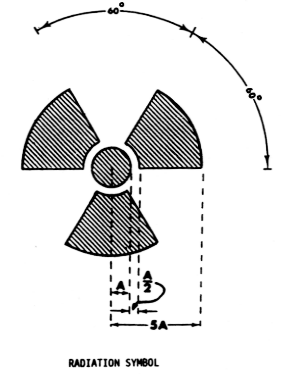
(1) Cross-hatched area is to be magenta, or purple, or black, and
(2) The background is to be yellow.
(b) Exception to color requirements for standard radiation symbol. Notwithstanding the requirements of paragraph (a) of this section, licensees are authorized to label sources, source holders, or device components containing sources of licensed materials that are subjected to high temperatures, with conspicuously etched or stamped radiation caution symbols and without a color requirement.
(c) Additional information on signs and labels. In addition to the contents of signs and labels prescribed in this part, the licensee may provide, on or near the required signs and labels, additional information, as appropriate, to make individuals aware of potential radiation exposures and to minimize the exposures.
§ 20.1902 Posting requirements.
(a) Posting of radiation areas. The licensee shall post each radiation area with a conspicuous sign or signs bearing the radiation symbol and the words "CAUTION, RADIATION AREA."
(b) Posting of high radiation areas. The licensee shall post each high radiation area with a conspicuous sign or signs bearing the radiation symbol and the words "CAUTION, HIGH RADIATION AREA" or "DANGER, HIGH RADIATION AREA."
(c) Posting of very high radiation areas. The licensee shall post each very high radiation area with a conspicuous sign or signs bearing the radiation symbol and words "GRAVE DANGER, VERY HIGH RADIATION AREA."
(d) Posting of airborne radioactivity areas. The licensee shall post each airborne radioactivity area with a conspicuous sign or signs bearing the radiation symbol and the words "CAUTION, AIRBORNE RADIOACTIVITY AREA" or "DANGER, AIRBORNE RADIOACTIVITY AREA."
(e) Posting of areas or rooms in which licensed material is used or stored. The licensee shall post each area or room in which there is used or stored an amount of licensed material exceeding 10 times the quantity of such material specified in appendix C to part 20 with a conspicuous sign or signs bearing the radiation symbol and the words "CAUTION, RADIOACTIVE MATERIAL(S)" or "DANGER, RADIOACTIVE MATERIAL(S)."
[56 FR 23401, May 21, 1991, as amended at 60 FR 20185, Apr. 25, 1995]
§ 20.1903 Exceptions to posting requirements.
(a) A licensee is not required to post caution signs in areas or rooms containing radioactive materials for periods of less than 8 hours, if each of the following conditions is met:
(1) The materials are constantly attended during these periods by an individual who takes the precautions necessary to prevent the exposure of individuals to radiation or radioactive materials in excess of the limits established in this part; and
(2) The area or room is subject to the licensee's control.
(b) Rooms or other areas in hospitals that are occupied by patients are not required to be posted with caution signs pursuant to § 20.1902 provided that the patient could be released from licensee control pursuant to § 35.75 of this chapter.
(c) A room or area is not required to be posted with a caution sign because of the presence of a sealed source provided the radiation level at 30 centimeters from the surface of the source container or housing does not exceed 0.005 rem (0.05 mSv) per hour.
(d) Rooms in hospitals or clinics that are used for teletherapy are exempt from the requirement to post caution signs under § 20.1902 if—
(1) Access to the room is controlled pursuant to 10 CFR 35.615; and
(2) Personnel in attendance take necessary precautions to prevent the inadvertent exposure of workers, other patients, and members of the public to radiation in excess of the limits established in this part.
[56 FR 23401, May 21, 1991, as amended at 57 FR 39357, Aug. 31, 1992; 62 FR 4133, Jan. 29, 1997; 63 FR 39482, July 23, 1998]
§ 20.1904 Labeling containers.
(a) The licensee shall ensure that each container of licensed material bears a durable, clearly visible label bearing the radiation symbol and the words "CAUTION, RADIOACTIVE MATERIAL" or "DANGER, RADIOACTIVE MATERIAL." The label must also provide sufficient information (such as the radionuclide(s) present, an estimate of the quantity of radioactivity, the date for which the activity is estimated, radiation levels, kinds of materials, and mass enrichment) to permit individuals handling or using the containers, or working in the vicinity of the containers, to take precautions to avoid or minimize exposures.
(b) Each licensee shall, prior to removal or disposal of empty uncontaminated containers to unrestricted areas, remove or deface the radioactive material label or otherwise clearly indicate that the container no longer contains radioactive materials.
§ 20.1905 Exemptions to labeling requirements.
A licensee is not required to label—
(a) Containers holding licensed material in quantities less than the quantities listed in appendix C to part 20; or
(b) Containers holding licensed material in concentrations less than those specified in table 3 of appendix B to part 20; or
(c) Containers attended by an individual who takes the precautions necessary to prevent the exposure of individuals in excess of the limits established by this part; or
(d) Containers when they are in transport and packaged and labeled in accordance with the regulations of the Department of Transportation,3 or
(e) Containers that are accessible only to individuals authorized to handle or use them, or to work in the vicinity of the containers, if the contents are identified to these individuals by a readily available written record (examples of containers of this type are containers in locations such as water-filled canals, storage vaults, or hot cells). The record must be retained as long as the containers are in use for the purpose indicated on the record; or
(f) Installed manufacturing or process equipment, such as reactor components, piping, and tanks; or
(g) Containers holding licensed material (other than sealed sources that are either specifically or generally licensed) at a facility licensed under Parts 50 or 52 of this chapter, not including non-power reactors, that are within an area posted under the requirements in § 20.1902 if the containers are:
(1) Conspicuously marked (such as by providing a system of color coding of containers) commensurate with the radiological hazard;
(2) Accessible only to individuals who have sufficient instruction to minimize radiation exposure while handling or working in the vicinity of the containers; and
(3) Subject to plant procedures to ensure they are appropriately labeled, as specified at § 20.1904 before being removed from the posted area.
[56 FR 23401, May 21, 1991, as amended at 60 FR 20185, Apr. 25, 1995; 72 FR 68059, Dec. 4, 2007]
3 Labeling of packages containing radioactive materials is required by the Department of Transportation (DOT) if the amount and type of radioactive material exceeds the limits for an excepted quantity or article as defined and limited by DOT regulations 49 CFR 173.403 (m) and (w) and 173.421-424.
§ 20.1906 Procedures for receiving and opening packages.
(a) Each licensee who expects to receive a package containing quantities of radioactive material in excess of a Type A quantity, as defined in § 71.4 and appendix A to part 71 of this chapter, shall make arrangements to receive—
(1) The package when the carrier offers it for delivery; or
(2) Notification of the arrival of the package at the carrier's terminal and to take possession of the package expeditiously.
(b) Each licensee shall—
(1) Monitor the external surfaces of a labeled3a package for radioactive contamination unless the package contains only radioactive material in the form of a gas or in special form as defined in 10 CFR 71.4;
(2) Monitor the external surfaces of a labeled3a package for radiation levels unless the package contains quantities of radioactive material that are less than or equal to the Type A quantity, as defined in § 71.4 and appendix A to part 71 of this chapter; and
(3) Monitor all packages known to contain radioactive material for radioactive contamination and radiation levels if there is evidence of degradation of package integrity, such as packages that are crushed, wet, or damaged.
(c) The licensee shall perform the monitoring required by paragraph (b) of this section as soon as practical after receipt of the package, but not later than 3 hours after the package is received at the licensee's facility if it is received during the licensee's normal working hours, or not later than 3 hours from the beginning of the next working day if it is received after working hours.
(d) The licensee shall immediately notify the final delivery carrier and the NRC Headquarters Operations Center by telephone at the numbers specified in appendix A to part 73 of this chapter, when—
(1) Removable radioactive surface contamination exceeds the limits of § 71.87(i) of this chapter; or
(2) External radiation levels exceed the limits of § 71.47 of this chapter.
(e) Each licensee shall—
(1) Establish, maintain, and retain written procedures for safely opening packages in which radioactive material is received; and
(2) Ensure that the procedures are followed and that due consideration is given to special instructions for the type of package being opened.
(f) Licensees transferring special form sources in licensee-owned or licensee-operated vehicles to and from a work site are exempt from the contamination monitoring requirements of paragraph (b) of this section, but are not exempt from the survey requirement in paragraph (b) of this section for measuring radiation levels that is required to ensure that the source is still properly lodged in its shield.
3a Labeled with a Radioactive White I, Yellow II, or Yellow III label as specified in U.S. Department of Transportation regulations, 49 CFR 172.403 and 172.436-440.
[56 FR 23401, May 21, 1991, as amended at 57 FR 39357, Aug. 31, 1992; 60 FR 20185, Apr. 25, 1995; 63 FR 39482, July 23, 1998; 85 FR 65661, Oct. 16, 2020]
Subpart K—Waste Disposal
Source: 56 FR 23403, May 21, 1991, unless otherwise noted.
§ 20.2001 General requirements.
(a) A licensee shall dispose of licensed material only—
(1) By transfer to an authorized recipient as provided in § 20.2006 or in the regulations in parts 30, 40, 60, 61, 63, 70, and 72 of this chapter;
(2) By decay in storage; or
(3) By release in effluents within the limits in § 20.1301; or
(4) As authorized under §§ 20.2002, 20.2003, 20.2004, 20.2005, or 20.2008.
(b) A person must be specifically licensed to receive waste containing licensed material from other persons for:
(1) Treatment prior to disposal; or
(2) Treatment or disposal by incineration; or
(3) Decay in storage; or
(4) Disposal at a land disposal facility licensed under part 61 of this chapter; or
(5) Disposal at a geologic repository under part 60 or part 63 of this chapter.
[56 FR 23403, May 21, 1991, as amended at 66 FR 55789, Nov. 2, 2001; 72 FR 55922, Oct. 1, 2007]
§ 20.2002 Method for obtaining approval of proposed disposal procedures.
A licensee or applicant for a license may apply to the Commission for approval of proposed procedures, not otherwise authorized in the regulations in this chapter, to dispose of licensed material generated in the licensee's activities. Each application shall include:
(a) A description of the waste containing licensed material to be disposed of, including the physical and chemical properties important to risk evaluation, and the proposed manner and conditions of waste disposal; and
(b) An analysis and evaluation of pertinent information on the nature of the environment; and
(c) The nature and location of other potentially affected licensed and unlicensed facilities; and
(d) Analyses and procedures to ensure that doses are maintained ALARA and within the dose limits in this part.
§ 20.2003 Disposal by release into sanitary sewerage.
(a) A licensee may discharge licensed material into sanitary sewerage if each of the following conditions is satisfied:
(1) The material is readily soluble (or is readily dispersible biological material) in water; and
(2) The quantity of licensed or other radioactive material that the licensee releases into the sewer in 1 month divided by the average monthly volume of water released into the sewer by the licensee does not exceed the concentration listed in table 3 of appendix B to part 20; and
(3) If more than one radionuclide is released, the following conditions must also be satisfied:
(i) The licensee shall determine the fraction of the limit in table 3 of appendix B to part 20 represented by discharges into sanitary sewerage by dividing the actual monthly average concentration of each radionuclide released by the licensee into the sewer by the concentration of that radionuclide listed in table 3 of appendix B to part 20; and
(ii) The sum of the fractions for each radionuclide required by paragraph (a)(3)(i) of this section does not exceed unity; and
(4) The total quantity of licensed and other radioactive material that the licensee releases into the sanitary sewerage system in a year does not exceed 5 curies (185 GBq) of hydrogen-3, 1 curie (37 GBq) of carbon-14, and 1 curie (37 GBq) of all other radioactive materials combined.
(b) Excreta from individuals undergoing medical diagnosis or therapy with radioactive material are not subject to the limitations contained in paragraph (a) of this section.
[56 FR 23403, May 21, 1991, as amended at 60 FR 20185, Apr. 25, 1995]
§ 20.2004 Treatment or disposal by incineration.
(a) A licensee may treat or dispose of licensed material by incineration only:
(1) As authorized by paragraph (b) of this section; or
(2) If the material is in a form and concentration specified in § 20.2005; or
(3) As specifically approved by the Commission pursuant to § 20.2002.
(b) (1) Waste oils (petroleum derived or synthetic oils used principally as lubricants, coolants, hydraulic or insulating fluids, or metalworking oils) that have been radioactively contaminated in the course of the operation or maintenance of a nuclear power reactor licensed under part 50 of this chapter may be incinerated on the site where generated provided that the total radioactive effluents from the facility, including the effluents from such incineration, conform to the requirements of appendix I to part 50 of this chapter and the effluent release limits contained in applicable license conditions other than effluent limits specifically related to incineration of waste oil. The licensee shall report any changes or additions to the information supplied under §§ 50.34 and 50.34a of this chapter associated with this incineration pursuant to § 50.71 of this chapter, as appropriate. The licensee shall also follow the procedures of § 50.59 of this chapter with respect to such changes to the facility or procedures.
(2) Solid residues produced in the process of incinerating waste oils must be disposed of as provided by § 20.2001.
(3) The provisions of this section authorize onsite waste oil incineration under the terms of this section and supersede any provision in an individual plant license or technical specification that may be inconsistent.
[57 FR 57656, Dec. 7, 1992]
§ 20.2005 Disposal of specific wastes.
(a) A licensee may dispose of the following licensed material as if it were not radioactive:
(1) 0.05 microcurie (1.85 kBq), or less, of hydrogen-3 or carbon-14 per gram of medium used for liquid scintillation counting; and
(2) 0.05 microcurie (1.85 kBq), or less, of hydrogen-3 or carbon-14 per gram of animal tissue, averaged over the weight of the entire animal.
(b) A licensee may not dispose of tissue under paragraph (a)(2) of this section in a manner that would permit its use either as food for humans or as animal feed.
(c) The licensee shall maintain records in accordance with § 20.2108.
§ 20.2006 Transfer for disposal and manifests.
(a) The requirements of this section and appendix G to 10 CFR Part 20 are designed to—
(1) Control transfers of low-level radioactive waste by any waste generator, waste collector, or waste processor licensee, as defined in this part, who ships low-level waste either directly, or indirectly through a waste collector or waste processor, to a licensed low-level waste land disposal facility (as defined in Part 61 of this chapter);
(2) Establish a manifest tracking system; and
(3) Supplement existing requirements concerning transfers and recordkeeping for those wastes.
(b) Any licensee shipping radioactive waste intended for ultimate disposal at a licensed land disposal facility must document the information required on NRC's Uniform Low-Level Radioactive Waste Manifest and transfer this recorded manifest information to the intended consignee in accordance with appendix G to 10 CFR Part 20.
(c) Each shipment manifest must include a certification by the waste generator as specified in section II of appendix G to 10 CFR Part 20.
(d) Each person involved in the transfer for disposal and disposal of waste, including the waste generator, waste collector, waste processor, and disposal facility operator, shall comply with the requirements specified in section III of appendix G to 10 CFR Part 20.
(e) Any licensee shipping byproduct material as defined in paragraphs (3) and (4) of the definition of Byproduct material set forth in § 20.1003 intended for ultimate disposal at a land disposal facility licensed under part 61 of this chapter must document the information required on the NRC’s Uniform Low-Level Radioactive Waste Manifest and transfer this recorded manifest information to the intended consignee in accordance with appendix G to this part.
[63 FR 50128, Sept. 21, 1998; 72 FR 55922, Oct. 1, 2007]
§ 20.2007 Compliance with environmental and health protection regulations.
Nothing in this subpart relieves the licensee from complying with other applicable Federal, State, and local regulations governing any other toxic or hazardous properties of materials that may be disposed of under this subpart.
§ 20.2008 Disposal of certain byproduct material.
(a) Licensed material as defined in paragraphs (3) and (4) of the definition of Byproduct material set forth in §20.1003 may be disposed of in accordance with part 61 of this chapter, even though it is not defined as low-level radioactive waste. Therefore, any licensed byproduct material being disposed of at a facility, or transferred for ultimate disposal at a facility licensed under part 61 of this chapter, must meet the requirements of § 20.2006.
(b) A licensee may dispose of byproduct material, as defined in paragraphs (3) and (4) of the definition of Byproduct material set forth in § 20.1003, at a disposal facility authorized to dispose of such material in accordance with any Federal or State solid or hazardous waste law, including the Solid Waste Disposal Act, as authorized under the Energy Policy Act of 2005.
[72 FR 55922, Oct. 1, 2007]
Subpart L—Records
Source: 56 FR 23404, May 21, 1991, unless otherwise noted.
§ 20.2101 General provisions.
(a) Each licensee shall use the units: curie, rad, rem, including multiples and subdivisions, and shall clearly indicate the units of all quantities on records required by this part.
(b) In the records required by this part, the licensee may record quantities in SI units in parentheses following each of the units specified in paragraph (a) of this section. However, all quantities must be recorded as stated in paragraph (a) of this section.
(c) Not withstanding the requirements of paragraph (a) of this section, when recording information on shipment manifests, as required in § 20.2006(b), information must be recorded in the International System of Units (SI) or in SI and units as specified in paragraph (a) of this section.
(d) The licensee shall make a clear distinction among the quantities entered on the records required by this part (e.g., total effective dose equivalent, shallow-dose equivalent, lens dose equivalent, deep-dose equivalent, committed effective dose equivalent).
[56 FR 23404, May 21, 1991, as amended at 60 FR 15663, Mar. 27, 1995; 63 FR 39483, July 23, 1998]
§ 20.2102 Records of radiation protection programs.
(a) Each licensee shall maintain records of the radiation protection program, including:
(1) The provisions of the program; and
(2) Audits and other reviews of program content and implementation.
(b) The licensee shall retain the records required by paragraph (a)(1) of this section until the Commission terminates each pertinent license requiring the record. The licensee shall retain the records required by paragraph (a)(2) of this section for 3 years after the record is made.
§ 20.2103 Records of surveys.
(a) Each licensee shall maintain records showing the results of surveys and calibrations required by §§ 20.1501 and 20.1906(b). The licensee shall retain these records for 3 years after the record is made.
(b) The licensee shall retain each of the following records until the Commission terminates each pertinent license requiring the record:
(1) Records of the results of surveys to determine the dose from external sources and used, in the absence of or in combination with individual monitoring data, in the assessment of individual dose equivalents. This includes those records of results of surveys to determine the dose from external sources and used, in the absence of or in combination with individual monitoring data, in the assessment of individual dose equivalents required under the standards for protection against radiation in effect prior to January 1, 1994; and
(2) Records of the results of measurements and calculations used to determine individual intakes of radioactive material and used in the assessment of internal dose. This includes those records of the results of measurements and calculations used to determine individual intakes of radioactive material and used in the assessment of internal dose required under the standards for protection against radiation in effect prior to January 1, 1994; and
(3) Records showing the results of air sampling, surveys, and bioassays required pursuant to § 20.1703(c)(1) and (2). This includes those records showing the results of air sampling, surveys, and bioassays required under the standards for protection against radiation in effect prior to January 1, 1994; and
(4) Records of the results of measurements and calculations used to evaluate the release of radioactive effluents to the environment. This includes those records of the results of measurements and calculations used to evaluate the release of radioactive effluents to the environment required under the standards for protection against radiation in effect prior to January 1, 1994.
[56 FR 23404, May 21, 1991, as amended at 60 FR 20185, Apr. 25, 1995; 66 FR 64737, Dec. 14, 2001]
§ 20.2104 Determination of prior occupational dose.
(a) For each individual who is likely to receive an annual occupational dose requiring monitoring under § 20.1502, the licensee shall determine the occupational radiation dose received during the current year.
(b) Prior to permitting an individual to participate in a planned special exposure, the licensee shall determine—
(1) The internal and external doses from all previous planned special exposures; and
(2) All doses in excess of the limits (including doses received during accidents and emergencies) received during the lifetime of the individual.
(c) In complying with the requirements of paragraphs (a) or (b) of this section, a licensee may—
(1) Accept, as a record of the occupational dose that the individual received during the current year, a written signed statement from the individual, or from the individual's most recent employer for work involving radiation exposure, that discloses the nature and the amount of any occupational dose that the individual may have received during the current year;
(2) Accept, as the record of cumulative radiation dose, an up-to-date NRC Form 4, or equivalent, signed by the individual and countersigned by an appropriate official of the most recent employer for work involving radiation exposure, or the individual's current employer (if the individual is not employed by the licensee); and
(3) Obtain reports of the individual's dose equivalent(s) from the most recent employer for work involving radiation exposure, or the individual's current employer (if the individual is not employed by the licensee) by telephone, telegram, electronic media, or letter. The licensee shall request a written verification of the dose data if the authenticity of the transmitted report cannot be established.
(d) The licensee shall record the exposure history of each individual, as required by paragraphs (a) or (b) of this section, on NRC Form 4, or other clear and legible record, including all of the information required by NRC Form 4.4 The form or record must show each period in which the individual received occupational exposure to radiation or radioactive material and must be signed by the individual who received the exposure. For each period for which the licensee obtains reports, the licensee shall use the dose shown in the report in preparing the NRC Form 4. For any period in which the licensee does not obtain a report, the licensee shall place a notation on the NRC Form 4 indicating the periods of time for which data are not available.
(e) If the licensee is unable to obtain a complete record of an individual's current and previously accumulated occupational dose, the licensee shall assume—
(1) In establishing administrative controls under § 20.1201(f) for the current year, that the allowable dose limit for the individual is reduced by 1.25 rems (12.5 mSv) for each quarter for which records were unavailable and the individual was engaged in activities that could have resulted in occupational radiation exposure; and
(2) That the individual is not available for planned special exposures.
(f) The licensee shall retain the records on NRC Form 4 or equivalent until the Commission terminates each pertinent license requiring this record. The licensee shall retain records used in preparing NRC Form 4 for 3 years after the record is made. This includes records required under the standards for protection against radiation in effect prior to January 1, 1994.
[56 FR 23404, May 21, 1991, as amended at 57 FR 57878, Dec. 8, 1992; 60 FR 20186, Apr. 25, 1995; 60 FR 36043, July 13, 1995; 72 FR 68059, Dec. 4, 2007]
4 Licensees are not required to partition historical dose between external dose equivalent(s) and internal committed dose equivalent(s). Further, occupational exposure histories obtained and recorded on NRC Form 4 before January 1, 1994, might not have included effective dose equivalent, but may be used in the absence of specific information on the intake of radionuclides by the individual.
§ 20.2105 Records of planned special exposures.
(a) For each use of the provisions of § 20.1206 for planned special exposures, the licensee shall maintain records that describe—
(1) The exceptional circumstances requiring the use of a planned special exposure; and
(2) The name of the management official who authorized the planned special exposure and a copy of the signed authorization; and
(3) What actions were necessary; and
(4) Why the actions were necessary; and
(5) How doses were maintained ALARA; and
(6) What individual and collective doses were expected to result, and the doses actually received in the planned special exposure.
(b) The licensee shall retain the records until the Commission terminates each pertinent license requiring these records.
§ 20.2106 Records of individual monitoring results.
(a) Recordkeeping requirement. Each licensee shall maintain records of doses received by all individuals for whom monitoring was required pursuant to § 20.1502, and records of doses received during planned special exposures, accidents, and emergency conditions. These records5 must include, when applicable—
(1) The deep-dose equivalent to the whole body, lens dose equivalent, shallow-dose equivalent to the skin, and shallow-dose equivalent to the extremities;
(2) The estimated intake of radionuclides (see § 20.1202);
(3) The committed effective dose equivalent assigned to the intake of radionuclides;
(4) The specific information used to assess the committed effective dose equivalent pursuant to § 20.1204(a) and (c), and when required by § 20.1502;
(5) The total effective dose equivalent when required by § 20.1202; and
(6) The total of the deep-dose equivalent and the committed dose to the organ receiving the highest total dose.
(b) Recordkeeping frequency. The licensee shall make entries of the records specified in paragraph (a) of this section at least annually.
(c) Recordkeeping format. The licensee shall maintain the records specified in paragraph (a) of this section on NRC Form 5, in accordance with the instructions for NRC Form 5, or in clear and legible records containing all the information required by NRC Form 5.
(d) Privacy protection. The records required under this section should be protected from public disclosure because of their personal privacy nature. These records are protected by most State privacy laws and, when transferred to the NRC, are protected by the Privacy Act of 1974, Public Law 93-579, 5 U.S.C. 552a, and the Commission's regulations in 10 CFR part 9.
(e) The licensee shall maintain the records of dose to an embryo/fetus with the records of dose to the declared pregnant woman. The declaration of pregnancy shall also be kept on file, but may be maintained separately from the dose records.
(f) The licensee shall retain the required form or record until the Commission terminates each pertinent license requiring this record. This includes records required under the standards for protection against radiation in effect prior to January 1, 1994.
5 Assessments of dose equivalent and records made using units in effect before the licensee's adoption of this part need not be changed.
[56 FR 23404, May 21, 1991, as amended at 60 FR 20186, Apr. 25, 1995; 63 FR 39483, July 23, 1998]
§ 20.2107 Records of dose to individual members of the public.
(a) Each licensee shall maintain records sufficient to demonstrate compliance with the dose limit for individual members of the public (see § 20.1301).
(b) The licensee shall retain the records required by paragraph (a) of this section until the Commission terminates each pertinent license requiring the record.
§ 20.2108 Records of waste disposal.
(a) Each licensee shall maintain records of the disposal of licensed materials made under §§ 20.2002, 20.2003, 20.2004, 20.2005, 10 CFR part 61 and disposal by burial in soil, including burials authorized before January 28, 1981.6
(b) The licensee shall retain the records required by paragraph (a) of this section until the Commission terminates each pertinent license requiring the record. Requirements for disposition of these records, prior to license termination, are located in §§ 30.51, 40.61, 70.51, and 72.80 for activities licensed under these parts.
6 A previous § 20.304 permitted burial of small quantities of licensed materials in soil before January 28, 1981, without specific Commission authorization.
[56 FR 23404, May 21, 1991, as amended at 60 FR 20186, Apr. 25, 1995; 61 FR 24673, May 16, 1996]
§ 20.2109 [Reserved]
§ 20.2110 Form of records.
Each record required by this part must be legible throughout the specified retention period. The record may be the original or a reproduced copy or a microform provided that the copy or microform is authenticated by authorized personnel and that the microform is capable of producing a clear copy throughout the required retention period. The record may also be stored in electronic media with the capability for producing legible, accurate, and complete records during the required retention period. Records, such as letters, drawings, and specifications, must include all pertinent information, such as stamps, initials, and signatures. The licensee shall maintain adequate safeguards against tampering with and loss of records.
Subpart M—Reports
Source: 56 FR 23406, May 21, 1991, unless otherwise noted.
§ 20.2201 Reports of theft or loss of licensed material.
(a) Telephone reports. (1) Each licensee shall report by telephone as follows:
(i) Immediately after its occurrence becomes known to the licensee, any lost, stolen, or missing licensed material in an aggregate quantity equal to or greater than 1,000 times the quantity specified in appendix C to part 20 under such circumstances that it appears to the licensee that an exposure could result to persons in unrestricted areas; or
(ii) Within 30 days after the occurrence of any lost, stolen, or missing licensed material becomes known to the licensee, all licensed material in a quantity greater than 10 times the quantity specified in appendix C to part 20 that is still missing at this time.
(2) Reports must be made as follows:
(i) Licensees having an installed Emergency Notification System shall make the reports to the NRC Operations Center in accordance with § 50.72 of this chapter, and
(ii) All other licensees shall make reports by telephone to the NRC Headquarters Operations Center at the numbers specified in appendix A to part 73 of this chapter.
(b) Written reports. (1) Each licensee required to make a report under paragraph (a) of this section shall, within 30 days after making the telephone report, make a written report setting forth the following information:
(i) A description of the licensed material involved, including kind, quantity, and chemical and physical form; and
(ii) A description of the circumstances under which the loss or theft occurred; and
(iii) A statement of disposition, or probable disposition, of the licensed material involved; and
(iv) Exposures of individuals to radiation, circumstances under which the exposures occurred, and the possible total effective dose equivalent to persons in unrestricted areas; and
(v) Actions that have been taken, or will be taken, to recover the material; and
(vi) Procedures or measures that have been, or will be, adopted to ensure against a recurrence of the loss or theft of licensed material.
(2) Reports must be made as follows:
(i) For holders of an operating license for a nuclear power plant, the events included in paragraph (b) of this section must be reported in accordance with the procedures described in § 50.73(b), (c), (d), (e), and (g) of this chapter and must include the information required in paragraph (b)(1) of this section, and
(ii) All other licensees shall make reports to the Administrator of the appropriate NRC Regional Office listed in appendix D to part 20.
(c) A duplicate report is not required under paragraph (b) of this section if the licensee is also required to submit a report pursuant to §§ 30.55(c), 37.57, 37.81, 40.64(c), 50.72, 50.73, 70.52, 73.27(b), 73.67(e)(3)(vii), 73.67(g)(3)(iii), 73.1205, or 150.19(c) of this chapter.
(d) Subsequent to filing the written report, the licensee shall also report any additional substantive information on the loss or theft within 30 days after the licensee learns of such information.
(e) The licensee shall prepare any report filed with the Commission pursuant to this section so that names of individuals who may have received exposure to radiation are stated in a separate and detachable part of the report.
[56 FR 23406, May 21, 1991, as amended at 58 FR 69220, Dec. 30, 1993; 60 FR 20186, Apr. 25, 1995; 66 FR 64738, Dec. 14, 2001; 67 FR 3585, Jan. 25, 2002; 78 FR 17006, Mar. 19, 2013; 85 FR 65661, Oct. 16, 2020; 88 FR 15880, Mar. 14, 2023]
§ 20.2202 Notification of incidents.
(a) Immediate notification. Notwithstanding any other requirements for notification, each licensee shall immediately report any event involving byproduct, source, or special nuclear material possessed by the licensee that may have caused or threatens to cause any of the following conditions—
(1) An individual to receive—
(i) A total effective dose equivalent of 25 rems (0.25 Sv) or more; or
(ii) A lens dose equivalent of 75 rems (0.75 Sv) or more; or
(iii) A shallow-dose equivalent to the skin or extremities of 250 rads (2.5 Gy) or more; or
(2) The release of radioactive material, inside or outside of a restricted area, so that, had an individual been present for 24 hours, the individual could have received an intake five times the annual limit on intake (the provisions of this paragraph do not apply to locations where personnel are not normally stationed during routine operations, such as hot-cells or process enclosures).
(b) Twenty-four hour notification. Each licensee shall, within 24 hours of discovery of the event, report any event involving loss of control of licensed material possessed by the licensee that may have caused, or threatens to cause, any of the following conditions:
(1) An individual to receive, in a period of 24 hours—
(i) A total effective dose equivalent exceeding 5 rems (0.05 Sv); or
(ii) A lens dose equivalent exceeding 15 rems (0.15 Sv); or
(iii) A shallow-dose equivalent to the skin or extremities exceeding 50 rems (0.5 Sv); or
(2) The release of radioactive material, inside or outside of a restricted area, so that, had an individual been present for 24 hours, the individual could have received an intake in excess of one occupational annual limit on intake (the provisions of this paragraph do not apply to locations where personnel are not normally stationed during routine operations, such as hot-cells or process enclosures).
(c) The licensee shall prepare any report filed with the Commission pursuant to this section so that names of individuals who have received exposure to radiation or radioactive material are stated in a separate and detachable part of the report.
(d) Reports made by licensees in response to the requirements of this section must be made as follows:
(1) Licensees having an installed Emergency Notification System shall make the reports required by paragraphs (a) and (b) of this section to the NRC Operations Center in accordance with 10 CFR 50.72; and
(2) All other licensees shall make the reports required by paragraphs (a) and (b) of this section by telephone to the NRC Headquarters Operations Center at the numbers specified in appendix A to part 73 of this chapter.
(e) The provisions of this section do not include doses that result from planned special exposures, that are within the limits for planned special exposures, and that are reported under § 20.2204.
[56 FR 23406, May 21, 1991, as amended at 56 FR 40766, Aug. 16, 1991; 57 FR 57879, Dec. 8, 1992; 59 FR 14086, Mar. 25, 1994; 63 FR 39483, July 23, 1998; 85 FR 65661, Oct. 16, 2020]
§ 20.2203 Reports of exposures, radiation levels, and concentrations of radioactive material exceeding the constraints or limits.
(a) Reportable events. In addition to the notification required by § 20.2202, each licensee shall submit a written report within 30 days after learning of any of the following occurrences:
(1) Any incident for which notification is required by § 20.2202; or
(2) Doses in excess of any of the following:
(i) The occupational dose limits for adults in § 20.1201; or
(ii) The occupational dose limits for a minor in § 20.1207; or
(iii) The limits for an embryo/fetus of a declared pregnant woman in § 20.1208; or
(iv) The limits for an individual member of the public in § 20.1301; or
(v) Any applicable limit in the license; or
(vi) The ALARA constraints for air emissions established under § 20.1101(d); or
(3) Levels of radiation or concentrations of radioactive material in—
(i) A restricted area in excess of any applicable limit in the license; or
(ii) An unrestricted area in excess of 10 times any applicable limit set forth in this part or in the license (whether or not involving exposure of any individual in excess of the limits in § 20.1301); or
(4) For licensees subject to the provisions of EPA's generally applicable environmental radiation standards in 40 CFR part 190, levels of radiation or releases of radioactive material in excess of those standards, or of license conditions related to those standards.
(b) Contents of reports. (1) Each report required by paragraph (a) of this section must describe the extent of exposure of individuals to radiation and radioactive material, including, as appropriate:
(i) Estimates of each individual's dose; and
(ii) The levels of radiation and concentrations of radioactive material involved; and
(iii) The cause of the elevated exposures, dose rates, or concentrations; and
(iv) Corrective steps taken or planned to ensure against a recurrence, including the schedule for achieving conformance with applicable limits, ALARA constraints, generally applicable environmental standards, and associated license conditions.
(2) Each report filed pursuant to paragraph (a) of this section must include for each occupationally overexposed1 individual: the name, Social Security account number, and date of birth. The report must be prepared so that this information is stated in a separate and detachable part of the report and must be clearly labeled "Privacy Act Information: Not for Public Disclosure."
(c) For holders of an operating license or a combined license for a nuclear power plant, the occurrences included in paragraph (a) of this section must be reported in accordance with the procedures described in §§ 50.73(b), (c), (d), (e), and (g) of this chapter, and must include the information required by paragraph (b) of this section. Occurrences reported in accordance with § 50.73 of this chapter need not be reported by a duplicate report under paragraph (a) of this section.
(d) All licensees, other than those holding an operating license or a combined license for a nuclear power plant, who make reports under paragraph (a) of this section shall submit the report in writing either by mail addressed to the U.S. Nuclear Regulatory Commission, ATTN: Document Control Desk, Washington, DC 20555–0001; by hand delivery to the NRC's offices at 11555 Rockville Pike, Rockville, Maryland; or, where practicable, by electronic submission, for example, Electronic Information Exchange, or CD–ROM. Electronic submissions must be made in a manner that enables the NRC to receive, read, authenticate, distribute, and archive the submission, and process and retrieve it a single page at a time. Detailed guidance on making electronic submissions can be obtained by visiting the NRC’s Web site at http://www.nrc.gov/site-help/e-submittals.html; by e-mail to MSHD.Resource@nrc.gov; or by writing the Office of the Chief Information Officer, U.S. Nuclear Regulatory Commission, Washington, DC 20555–0001. A copy should be sent to the appropriate NRC Regional Office listed in appendix D to this part.
1 With respect to the limit for the embryo-fetus (§ 20.1208), the identifiers should be those of the declared pregnant woman.
[56 FR 23406, May 21, 1991, as amended at 60 FR 20186, Apr. 25, 1995; 61 FR 65127, Dec. 10, 1996; 68 FR 14309, Mar. 25, 2003; 68 FR 58802, Oct. 10, 2003; 70 FR 69421, Nov. 16, 2005; 72 FR 33386, Jun. 18, 2007; 72 FR 49486, Aug. 28, 2007; 74 FR 62680, Dec. 1, 2009; 80 FR 74979, Dec. 1, 2015]
§ 20.2204 Reports of planned special exposures.
The licensee shall submit a written report to the Administrator of the appropriate NRC Regional Office listed in appendix D to part 20 within 30 days following any planned special exposure conducted in accordance with § 20.1206, informing the Commission that a planned special exposure was conducted and indicating the date the planned special exposure occurred and the information required by § 20.2105.
[56 FR 23406, May 21, 1991, as amended at 60 FR 20186, Apr. 25, 1995]
440.250 [Amended]
§ 20.2205 Reports to individuals of exceeding dose limits.
When a licensee is required by §§ 20.2203 or 20.2204 to report to the Commission any exposure of an identified occupationally exposed individual, or an identified member of the public, to radiation or radioactive material, the licensee shall also provide the individual a report on his or her exposure data included in the report to Commission. This report must be transmitted no later than the transmittal to the Commission.
[60 FR 36043, July 13, 1995; 72 FR 68059, Dec. 4, 2007]
§ 20.2206 Reports of individual monitoring.
(a) This section applies to each person licensed by the Commission to—
(1) Operate a nuclear reactor designed to produce electrical or heat energy pursuant to § 50.21(b) or § 50.22 of this chapter or a testing facility as defined in § 50.2 of this chapter; or
(2) Possess or use byproduct material for purposes of radiography pursuant to Parts 30 and 34 of this chapter; or
(3) Possess or use at any one time, for purposes of fuel processing, fabricating, or reprocessing, special nuclear material in a quantity exceeding 5,000 grams of contained uranium-235, uranium-233, or plutonium, or any combination thereof pursuant to part 70 of this chapter; or
(4) Possess high-level radioactive waste at a geologic repository operations area pursuant to part 60 or 63 of this chapter; or
(5) Possess spent fuel in an independent spent fuel storage installation (ISFSI) pursuant to part 72 of this chapter; or
(6) Receive radioactive waste from other persons for disposal under part 61 of this chapter; or
(7) Possess or use at any time, for processing or manufacturing for distribution pursuant to parts 30, 32, 33 or 35 of this chapter, byproduct material in quantities exceeding any one of the following quantities:
| Radionuclide |
Quantity of radionuclide1 in curies |
| Cesium-137 |
1 |
| Cobalt-60 |
1 |
| Gold-198 |
100 |
| Iodine-131 |
1 |
| Iridium-192 |
10 |
| Krypton-85 |
1,000 |
| Promethium-147 |
10 |
| Technetium-99m |
1,000 |
1 The Commission may require as a license condition, or by rule, regulation, or order pursuant to § 20.2302, reports from licensees who are licensed to use radionuclides not on this list, in quantities sufficient to cause comparable radiation levels.
(b) Each licensee in a category listed in paragraph (a) of this section shall submit an annual report of the results of individual monitoring carried out by the licensee for each individual for whom monitoring was required by § 20.1502 during that year. The licensee may include additional data for individuals for whom monitoring was provided but not required. The licensee shall use Form NRC 5 or electronic media containing all the information required by Form NRC 5.
(c) The licensee shall file the report required by § 20.2206(b), covering the preceding year, on or before April 30 of each year. The licensee shall submit the report to the REIRS Project Manager by an appropriate method listed in § 20.1007 or via the REIRS Web site at http://www.reirs.com.
[56 FR 23406, May 21, 1991, as amended at 56 FR 32072, July 15, 1991; 66 FR 5578, Nov. 2, 2001; 68 FR 58802, Oct. 10, 2003]
§ 20.2207 Reports of transactions involving nationally tracked sources.
Each licensee who manufactures, transfers, receives, disassembles, or disposes of a nationally tracked source shall complete and submit a National Source Tracking Transaction Report as specified in paragraphs (a) through (e) of this section for each type of transaction.
(a) Each licensee who manufactures a nationally tracked source shall complete and submit a National Source Tracking Transaction Report. The report must include the following information:
(1) The name, address, and license number of the reporting licensee;
(2) The name of the individual preparing the report;
(3) The manufacturer, model, and serial number of the source;
(4) The radioactive material in the source;
(5) The initial source strength in becquerels (curies) at the time of manufacture; and
(6) The manufacture date of the source.
(b) Each licensee that transfers a nationally tracked source to another person shall complete and submit a National Source Tracking Transaction Report. The report must include the following information:
(1) The name, address, and license number of the reporting licensee;
(2) The name of the individual preparing the report;
(3) The name and license number of the recipient facility and the shipping address;
(4) The manufacturer, model, and serial number of the source or, if not available, other information to uniquely identify the source;
(5) The radioactive material in the source;
(6) The initial or current source strength in becquerels (curies);
(7) The date for which the source strength is reported;
(8) The shipping date;
(9) The estimated arrival date; and
(10) For nationally tracked sources transferred as waste under a Uniform Low-Level Radioactive Waste Manifest, the waste manifest number and the container identification of the container with the nationally tracked source.
(c) Each licensee that receives a nationally tracked source shall complete and submit a National Source Tracking Transaction Report. The report must include the following information:
(1) The name, address, and license number of the reporting licensee;
(2) The name of the individual preparing the report;
(3) The name, address, and license number of the person that provided the source;
(4) The manufacturer, model, and serial number of the source or, if not available, other information to uniquely identify the source;
(5) The radioactive material in the source;
(6) The initial or current source strength in becquerels (curies);
(7) The date for which the source strength is reported;
(8) The date of receipt; and
(9) For material received under a Uniform Low-Level Radioactive Waste Manifest, the waste manifest number and the container identification with the nationally tracked source.
(d) Each licensee that disassembles a nationally tracked source shall complete and submit a National Source Tracking Transaction Report. The report must include the following information:
(1) The name, address, and license number of the reporting licensee;
(2) The name of the individual preparing the report;
(3) The manufacturer, model, and serial number of the source or, if not available, other information to uniquely identify the source;
(4) The radioactive material in the source;
(5) The initial or current source strength in becquerels (curies);
(6) The date for which the source strength is reported;
(7) The disassemble date of the source.
(e) Each licensee who disposes of a nationally tracked source shall complete and submit a National Source Tracking Transaction Report. The report must include the following information:
(1) The name, address, and license number of the reporting licensee;
(2) The name of the individual preparing the report;
(3) The waste manifest number;
(4) The container identification with the nationally tracked source.
(5) The date of disposal; and
(6) The method of disposal.
(f) The reports discussed in paragraphs (a) through (e) of this section must be submitted by the close of the next business day after the transaction. A single report may be submitted for multiple sources and transactions. The reports must be submitted to the National Source Tracking System by using:
(1) The on-line National Source Tracking System;
(2) Electronically using a computerreadable format;
(3) By facsimile;
(4) By mail to the address on the National Source Tracking Transaction Report Form (NRC Form 748); or
(5) By telephone with followup by facsimile or mail.
(g) Each licensee shall correct any error in previously filed reports or file a new report for any missed transaction within 5 business days of the discovery of the error or missed transaction. Such errors may be detected by a variety of methods such as administrative reviews or by physical inventories required by regulation. In addition, each licensee shall reconcile the inventory of nationally tracked sources possessed by the licensee against that licensee’s data in the National Source Tracking System. The reconciliation must be conducted during the month of January in each year. The reconciliation process must include resolving any discrepancies between the National Source Tracking System and the actual inventory by filing the reports identified by paragraphs (a) through (e) of this section. By January 31 of each year, each licensee must submit to the National Source Tracking System confirmation that the data in the National Source Tracking System is correct.
[72 FR 59163, Oct. 19, 2007; 86 FR 43401, Aug. 9, 2021]
Subpart N—Exemptions and Additional Requirements
Source: 56 FR 23408, May 21, 1991, unless otherwise noted.
§ 20.2301 Applications for exemptions.
The Commission may, upon application by a licensee or upon its own initiative, grant an exemption from the requirements of the regulations in this part if it determines the exemption is authorized by law and would not result in undue hazard to life or property.
§ 20.2302 Additional requirements.
The Commission may, by rule, regulation, or order, impose requirements on a licensee, in addition to those established in the regulations in this part, as it deems appropriate or necessary to protect health or to minimize danger to life or property.
Subpart O—Enforcement
§ 20.2401 Violations.
(a) The Commission may obtain an injunction or other court order to prevent a violation of the provisions of—
(1) The Atomic Energy Act of 1954, as amended;
(2) Title II of the Energy Reorganization Act of 1974, as amended; or
(3) A regulation or order issued pursuant to those Acts.
(b) The Commission may obtain a court order for the payment of a civil penalty imposed under section 234 of the Atomic Energy Act:
(1) For violations of—
(i) Sections 53, 57, 62, 63, 81, 82, 101, 103, 104, 107 or 109 of the Atomic Energy Act of 1954, as amended;
(ii) Section 206 of the Energy Reorganization Act;
(iii) Any rule, regulation, or order issued pursuant to the sections specified in paragraph (b)(1)(i) of this section; and
(iv) Any term, condition, or limitation of any license issued under the sections specified in paragraph (b)(1)(i) of this section.
(2) For any violation for which a license may be revoked under Section 186 of the Atomic Energy Act of 1954, as amended.
[56 FR 23408, May 21, 1991; 56 FR 61352, Dec. 3, 1991, as amended at 57 FR 55071, Nov. 24, 1992]
§ 20.2402 Criminal penalties.
(a) Section 223 of the Atomic Energy Act of 1954, as amended, provides for criminal sanctions for willful violation of, attempted violation of, or conspiracy to violate, any regulation issued under sections 161b, 161i, or 161o of the Act. For purposes of section 223, all the regulations in §§ 20.1001 through 20.2402 are issued under one or more of sections 161b, 161i, or 161o, except for the sections listed in paragraph (b) this section.
(b) The regulations in §§ 20.1001 through 20.2402 that are not issued under Sections 161b, 161i, or 161o for the purposes of Section 223 are as follows: §§ 20.1001, 20.1002, 20.1003, 20.1004, 20.1005, 20.1006, 20.1007, 20.1008, 20.1009, 20.1405, 20.1704, 20.1903, 20.1905, 20.2002, 20.2007, 20.2301, 20.2302, 20.2401, and 20.2402.
[57 FR 55071, Nov. 24, 1992]
Appendix A to Part 20—Assigned Protection Factors for Respiratorsa
| |
Operating mode |
Assigned Protection Factors |
| I. Air Purifying Respirators [Particulateb only]c: |
|
|
| Filtering facepiece disposabled |
Negative Pressure |
(d) |
| Facepiece, half e |
Negative Pressure |
10 |
| Facepiece, full |
Negative Pressure |
100 |
| Facepiece, half |
Powered air-purifying respirators |
50 |
| Facepiece, full |
Powered air-purifying respirators |
1000 |
| Helmet/hood |
Powered air-purifying respirators |
1000 |
| Facepiece, loose-fitting |
Powered air-purifying respirators |
25 |
| II. Atmosphere supplying respirators [particulate, gases and vaporsf]: |
|
|
| 1. Air-line respirator: |
|
|
| Facepiece, half |
Demand |
10 |
| Facepiece, half |
Continuous Flow |
50 |
| Facepiece, half |
Pressure Demand |
50 |
| Facepiece, full |
Demand |
100 |
| Facepiece, full |
Continuous Flow |
1000 |
| Facepiece, full |
Pressure Demand |
1000 |
| Helmet/hood |
Continuous Flow |
1000 |
| Facepiece, loose-fitting |
Continuous Flow |
25 |
| Suit |
Continuous Flow |
(g) |
| 2. Self-contained breathing Apparatus (SCBA): |
|
|
| Facepiece, full |
Demand |
h100 |
| Facepiece, full |
Pressure Demand |
i10,000 |
| Facepiece, full |
Demand, Recirculating |
h100 |
| Facepiece, full |
Positive Pressure Recirculating |
i10,000 |
| III. Combination Respirators: |
|
|
| Any combination of air-purifying and atmosphere-supplying respirators |
Assigned protection factor for type and mode of operation as listed above. |
a These assigned protection factors apply only in a respiratory protection program that meets the requirements of this Part. They are applicable only to airborne radiological hazards and may not be appropriate to circumstances when chemical or other respiratory hazards exist instead of, or in addition to, radioactive hazards. Selection and use of respirators for such circumstances must also comply with Department of Labor regulations.
Radioactive contaminants for which the concentration values in Table 1, Column 3 of Appendix B to Part 20 are based on internal dose due to inhalation may, in addition, present external exposure hazards at higher concentrations. Under these circumstances, limitations on occupancy may have to be governed by external dose limits.
b Air purifying respirators with APF <100 must be equipped with particulate filters that are at least 95 percent efficient. Air purifying respirators with APF = 100 must be equipped with particulate filters that are at least 99 percent efficient. Air purifying respirators with APFs >100 must be equipped with particulate filters that are at least 99.97 percent efficient.
c The licensee may apply to the Commission for the use of an APF greater than 1 for sorbent cartridges as protection against airborne radioactive gases and vapors (e.g., radioiodine).
d Licensees may permit individuals to use this type of respirator who have not been medically screened or fit tested on the device provided that no credit be taken for their use in estimating intake or dose. It is also recognized that it is difficult to perform an effective positive or negative pressure pre-use user seal check on this type of device. All other respiratory protection program requirements listed in § 20.1703 apply. An assigned protection factor has not been assigned for these devices. However, an APF equal to 10 may be used if the licensee can demonstrate a fit factor of at least 100 by use of a validated or evaluated, qualitative or quantitative fit test.
e Under-chin type only. No distinction is made in this Appendix between elastomeric half-masks with replaceable cartridges and those designed with the filter medium as an integral part of the facepiece (e.g., disposable or reusable disposable). Both types are acceptable so long as the seal area of the latter contains some substantial type of seal-enhancing material such as rubber or plastic, the two or more suspension straps are adjustable, the filter medium is at least 95 percent efficient and all other requirements of this Part are met.
f The assigned protection factors for gases and vapors are not applicable to radioactive contaminants that present an absorption or submersion hazard. For tritium oxide vapor, approximately one-third of the intake occurs by absorption through the skin so that an overall protection factor of 3 is appropriate when atmosphere-supplying respirators are used to protect against tritium oxide. Exposure to radioactive noble gases is not considered a significant respiratory hazard, and protective actions for these contaminants should be based on external (submersion) dose considerations.
g No NIOSH approval schedule is currently available for atmosphere supplying suits. This equipment may be used in an acceptable respiratory protection program as long as all the other minimum program requirements, with the exception of fit testing, are met (i.e., § 20.1703).
h The licensee should implement institutional controls to assure that these devices are not used in areas immediately dangerous to life or health (IDLH).
i This type of respirator may be used as an emergency device in unknown concentrations for protection against inhalation hazards. External radiation hazards and other limitations to permitted exposure such as skin absorption shall be taken into account in these circumstances. This device may not be used by any individual who experiences perceptible outward leakage of breathing gas while wearing the device.
[64 FR 54558, Oct. 7, 1999; 64 FR 55524, Oct. 13, 1999]
Appendix B to Part 20—Annual Limits on Intake (ALIs) and Derived Air Concentrations (DACs) of Radionuclides for Occupational Exposure; Effluent Concentrations; Concentrations for Release to Sewerage
[List of Radionuclides – Note: Each radionuclide page contains Tables 1, 2, and 3 for that radionuclide.]
Introduction
For each radionuclide Table 1 indicates the chemical form which is to be used for selecting the appropriate ALI or DAC value. The ALIs and DACs for inhalation are given for an aerosol with an activity median aerodynamic diameter (AMAD) of 1 μm and for three classes (D,W,Y) of radioactive material, which refer to their retention (approximately days, weeks or years) in the pulmonary region of the lung. This classification applies to a range of clearance half-times of less than 10 days for D, for W from 10 to 100 days, and for Y greater than 100 days. The class (D, W, or Y) given in the column headed "Class" applies only to the inhalation ALIs and DACs given in Table 1, columns 2 and 3. Table 2 provides concentration limits for airborne and liquid effluents released to the general environment. Table 3 provides concentration limits for discharges to sanitary sewer systems.
Notation
The values in Tables 1, 2, and 3 are presented in the computer "E" notation. In this notation a value of 6E–02 represents a value of 6x10⁻² or 0.06, 6E+2 represents 6x10² or 600, and 6E+0 represents 6x100 or 6.
Table 1 "Occupational Values"
Note that the columns in Table 1, of this appendix captioned "Oral Ingestion ALI," "Inhalation ALI," and "DAC," are applicable to occupational exposure to radioactive material.
The ALIs in this appendix are the annual intakes of a given radionuclide by "Reference Man" which would result in either (1) a committed effective dose equivalent of 5 rems (stochastic ALI) or (2) a committed dose equivalent of 50 rems to an organ or tissue (non-stochastic ALI). The stochastic ALIs were derived to result in a risk, due to irradiation of organs and tissues, comparable to the risk associated with deep dose equivalent to the whole body of 5 rems. The derivation includes multiplying the committed dose equivalent to an organ or tissue by a weighting factor, wT. This weighting factor is the proportion of the risk of stochastic effects resulting from irradiation of the organ or tissue, T, to the total risk of stochastic effects when the whole body is irradiated uniformly. The values of wT are listed under the definition of weighting factor in § 20.1003. The non-stochastic ALIs were derived to avoid non-stochastic effects, such as prompt damage to tissue or reduction in organ function.
A value of wT=0.06 is applicable to each of the five organs or tissues in the "remainder" category receiving the highest dose equivalents, and the dose equivalents of all other remaining tissues may be disregarded. The following parts of the GI tract—stomach, small intestine, upper large intestine, and lower large intestine—are to be treated as four separate organs.
Note that the dose equivalents for extremities (hands and forearms, feet and lower legs), skin, and lens of the eye are not considered in computing the committed effective dose equivalent, but are subject to limits that must be met separately.
When an ALI is defined by the stochastic dose limit, this value alone, is given. When an ALI is determined by the non-stochastic dose limit to an organ, the organ or tissue to which the limit applies is shown, and the ALI for the stochastic limit is shown in parentheses. (Abbreviated organ or tissue designations are used: LLI wall = lower large intestine wall; St. wall = stomach wall; Blad wall = bladder wall; and Bone surf = bone surface.)
The use of the ALIs listed first, the more limiting of the stochastic and non-stochastic ALIs, will ensure that non-stochastic effects are avoided and that the risk of stochastic effects is limited to an acceptably low value. If, in a particular situation involving a radionuclide for which the non-stochastic ALI is limiting, use of that non-stochastic ALI is considered unduly conservative, the licensee may use the stochastic ALI to determine the committed effective dose equivalent. However, the licensee shall also ensure that the 50-rem dose equivalent limit for any organ or tissue is not exceeded by the sum of the external deep dose equivalent plus the internal committed dose to that organ (not the effective dose). For the case where there is no external dose contribution, this would be demonstrated if the sum of the fractions of the non-stochastic ALIs (ALIns) that contribute to the committed dose equivalent to the organ receiving the highest dose does not exceed unity (i.e., Σ (intake (in μCi) of each radionuclide/ALIns) < 1.0). If there is an external deep dose equivalent contribution of Hd then this sum must be less than 1 – (Hd/50) instead of being < 1.0.
The derived air concentration (DAC) values are derived limits intended to control chronic occupational exposures. The relationship between the DAC and the ALI is given by: DAC=ALI(in μCi)/(2000 hours per working year x 60 minutes/hour x 2 x 10⁴ ml per minute)=[ALI/2.4x109] μCi/ml, where 2x10⁴ ml is the volume of air breathed per minute at work by "Reference Man" under working conditions of "light work."
The DAC values relate to one of two modes of exposure: either external submersion or the internal committed dose equivalents resulting from inhalation of radioactive materials. Derived air concentrations based upon submersion are for immersion in a semi-infinite cloud of uniform concentration and apply to each radionuclide separately.
The ALI and DAC values relate to exposure to the single radionuclide named, but also include contributions from the in-growth of any daughter radionuclide produced in the body by the decay of the parent. However, intakes that include both the parent and daughter radionuclides should be treated by the general method appropriate for mixtures.
The value of ALI and DAC do not apply directly when the individual both ingests and inhales a radionuclide, when the individual is exposed to a mixture of radionuclides by either inhalation or ingestion or both, or when the individual is exposed to both internal and external radiation (see § 20.1202). When an individual is exposed to radioactive materials which fall under several of the translocation classifications (i.e., Class D, Class W, or Class Y) of the same radionuclide, the exposure may be evaluated as if it were a mixture of different radionuclides.
It should be noted that the classification of a compound as Class D, W, or Y is based on the chemical form of the compound and does not take into account the radiological half-life of different radioisotopes. For this reason, values are given for Class D, W, and Y compounds, even for very short-lived radionuclides.
Table 2 "Effluent Concentrations"
The columns in Table 2 of this appendix captioned "Effluents," "Air," and "Water," are applicable to the assessment and control of dose to the public, particularly in the implementation of the provisions of § 20.1302. The concentration values given in Columns 1 and 2 of Table 2 are equivalent to the radionuclide concentrations which, if inhaled or ingested continuously over the course of a year, would produce a total effective dose equivalent of 0.05 rem (50 millirem or 0.5 millisieverts).
Consideration of non-stochastic limits has not been included in deriving the air and water effluent concentration limits because non-stochastic effects are presumed not to occur at the dose levels established for individual members of the public. For radionuclides, where the non-stochastic limit was governing in deriving the occupational DAC, the stochastic ALI was used in deriving the corresponding airborne effluent limit in Table 2. For this reason, the DAC and airborne effluent limits are not always proportional as was the case in appendix B to §§ 20.1-20.601.
The air concentration values listed in Table 2, Column 1, were derived by one of two methods. For those radionuclides for which the stochastic limit is governing, the occupational stochastic inhalation ALI was divided by 2.4 x 10⁹ml, relating the inhalation ALI to the DAC, as explained above, and then divided by a factor of 300. The factor of 300 includes the following components: a factor of 50 to relate the 5-rem annual occupational dose limit to the 0.1-rem limit for members of the public, a factor of 3 to adjust for the difference in exposure time and the inhalation rate for a worker and that for members of the public; and a factor of 2 to adjust the occupational values (derived for adults) so that they are applicable to other age groups.
For those radionuclides for which submersion (external dose) is limiting, the occupational DAC in Table 1, Column 3, was divided by 219. The factor of 219 is composed of a factor of 50, as described above, and a factor of 4.38 relating occupational exposure for 2,000 hours per year to full-time exposure (8,760 hours per year). Note that an additional factor of 2 for age considerations is not warranted in the submersion case.
The water concentrations were derived by taking the most restrictive occupational stochastic oral ingestion ALI and dividing by 7.3 x 10⁷. The factor of 7.3 x 10⁷ (ml) includes the following components: the factors of 50 and 2 described above and a factor of 7.3 x 10⁵ (ml) which is the annual water intake of "Reference Man."
Note 2 of this appendix provides groupings of radionuclides which are applicable to unknown mixtures of radionuclides. These groupings (including occupational inhalation ALIs and DACs, air and water effluent concentrations and sewerage) require demonstrating that the most limiting radionuclides in successive classes are absent. The limit for the unknown mixture is defined when the presence of one of the listed radionuclides cannot be definitely excluded either from knowledge of the radionuclide composition of the source or from actual measurements.
Table 3 "Releases to Sewers"
The monthly average concentrations for release to sanitary sewers are applicable to the provisions in § 20.2003. The concentration values were derived by taking the most restrictive occupational stochastic oral ingestion ALI and dividing by 7.3 x 10⁶(ml). The factor of 7.3 x 10⁶(ml) is composed of a factor of 7.3 x 10⁵(ml), the annual water intake by "Reference Man," and a factor of 10, such that the concentrations, if the sewage released by the licensee were the only source of water ingested by a reference man during a year, would result in a committed effective dose equivalent of 0.5 rem.
List of Elements
| Name |
Atomic |
| Symbol |
No. |
| Actinium |
Ac |
89 |
| Aluminium |
Al |
13 |
| Americium |
Am |
95 |
| Antimony |
Sb |
51 |
| Argon |
Ar |
18 |
| Arsenic |
As |
33 |
| Astatine |
At |
85 |
| Barium |
Ba |
56 |
| Berkelium |
Bk |
97 |
| Beryllium |
Be |
4 |
| Bismuth |
Bi |
83 |
| Bromine |
Br |
35 |
| Cadmium |
Cd |
48 |
| Calcium |
Ca |
20 |
| Califormium |
Cf |
98 |
| Carbon |
C |
6 |
| Cerium |
Ce |
58 |
| Cesium |
Cs |
55 |
| Chlorine |
Cl |
17 |
| Chromium |
Cr |
24 |
| Cobalt |
Co |
27 |
| Copper |
Cu |
29 |
| Curium |
Cm |
96 |
| Dysprosium |
Dy |
66 |
| Einsteinium |
Es |
99 |
| Erbium |
Er |
68 |
| Europium |
Eu |
63 |
| Femium |
Fm |
100 |
| Fluorine |
F |
9 |
| Francium |
Fr |
87 |
| Gadolinium |
Gd |
64 |
| Gallium |
Ga |
31 |
| Germanium |
Ge |
32 |
| Gold |
Au |
79 |
| Hafniim |
Hf |
72 |
| Holmium |
Ho |
67 |
| Hydrogen |
H |
1 |
| Indium |
In |
49 |
| Iodine |
I |
53 |
| Iridium |
Ir |
77 |
| Iron |
Fe |
26 |
| Krypton |
Kr |
36 |
| Lanthanum |
La |
57 |
| Lead |
Pb |
82 |
| Lutetium |
Lu |
71 |
| Magnesium |
Mg |
12 |
| Manganese |
Mn |
25 |
| Mendelevium |
Md |
101 |
| Mercury |
Hg |
80 |
| Molybdenum |
Mo |
42 |
| Neodymium |
Nd |
60 |
| Neptunium |
Np |
93 |
| Nickel |
Ni |
28 |
| Niobium |
Nb |
41 |
| Nitrogen |
N |
7 |
| Osmium |
Os |
76 |
| Oxygen |
O |
8 |
| Palladium |
Pd |
46 |
| Phosphorus |
P |
15 |
| Platinum |
Pt |
78 |
| Plutonium |
Pu |
94 |
| Polonium |
Po |
84 |
| Potassium |
K |
19 |
| Praseodymium |
Pr |
59 |
| Promethium |
Pm |
61 |
| Protactinium |
Pa |
91 |
| Radium |
Ra |
88 |
| Radon |
Rn |
86 |
| Rhenium |
Re |
75 |
| Rhodium |
Rh |
45 |
| Rubidium |
Rb |
37 |
| Ruthenium |
Ru |
44 |
| Samarium |
Sm |
62 |
| Scandium |
Sc |
21 |
| Selenium |
Se |
34 |
| Silicon |
Si |
14 |
| Silver |
Ag |
47 |
| Sodium |
Na |
11 |
| Strontium |
Sr |
38 |
| Sulfur |
S |
16 |
| Tantaium |
Ta |
73 |
| Technetium |
Tc |
43 |
| Tellurium |
Te |
52 |
| Terbium |
Tb |
65 |
| Thallium |
Tl |
81 |
| Thorium |
Th |
90 |
| Thulium |
Tm |
69 |
| Tin |
Sn |
50 |
| Titanium |
Ti |
22 |
| Tungsten |
W |
74 |
| Uranium |
U |
92 |
| Vanadium |
V |
23 |
| Xenon |
Xe |
54 |
| Yterbium |
Yb |
70 |
| Yttrium |
Y |
39 |
| Zinc |
Zn |
30 |
| Zirconium |
Zr |
40 |
[56 FR 23409, May 21, 1991; 56 FR 61352, Dec. 3, 1991, as amended at 57 FR 57879, Dec. 8, 1992. Redesignated at 58 FR 67659, Dec. 22, 1993; 71 FR 15007, Mar. 27, 2006; 72 FR 55922, Oct. 1, 2007; 75 FR 73938, Nov. 30, 2010]
Appendix C to Part 20—Quantities1 of Licensed Material Requiring Labeling
| Radionuclide |
Abbreviation |
Quantity (µCi) |
| Hydrogen-3 |
H-3 |
1,000 |
| Beryllium-7 |
Be-7 |
1,000 |
| Beryllium-10 |
Be-10 |
1 |
| Carbon-11 |
C-11 |
1,000 |
| Carbon-14 |
C-14 |
100 |
| Fluorine-18 |
F-18 |
1,000 |
| Sodium-22 |
Na-22 |
10 |
| Sodium-24 |
Na-24 |
100 |
| Magnesium-28 |
Mg-28 |
100 |
| Aluminum-26 |
Al-26 |
10 |
| Silicon-31 |
Si-31 |
1,000 |
| Silicon-32 |
Si-32 |
1 |
| Phosphorus-32 |
P-32 |
10 |
| Phosphorus-33 |
P-33 |
100 |
| Sulfur-35 |
S-35 |
100 |
| Chlorine-36 |
Cl-36 |
10 |
| Chlorine-38 |
Cl-38 |
1,000 |
| Chlorine-39 |
Cl-39 |
1,000 |
| Argon-39 |
Ar-39 |
1,000 |
| Argon-41 |
Ar-41 |
1,000 |
| Potassium-40 |
K-40 |
100 |
| Potassium-42 |
K-42 |
1,000 |
| Potassium-43 |
K-43 |
1,000 |
| Potassium-44 |
K-44 |
1,000 |
| Potassium-45 |
K-45 |
1,000 |
| Calcium-41 |
Ca-41 |
100 |
| Calcium-45 |
Ca-45 |
100 |
| Calcium-47 |
Ca-47 |
100 |
| Scandium-43 |
Sc-43 |
1,000 |
| Scandium-44m |
Sc-44m |
100 |
| Scandium-44 |
Sc-44 |
100 |
| Scandium-46 |
Sc-46 |
10 |
| Scandium-47 |
Sc-47 |
100 |
| Scandium-48 |
Sc-48 |
100 |
| Scandium-49 |
Sc-49 |
1,000 |
| Titanium-44 |
Ti-44 |
1 |
| Titanium-45 |
Ti-45 |
1,000 |
| Vanadium-47 |
V-47 |
1,000 |
| Vanadium-48 |
V-48 |
100 |
| Vanadium-49 |
V-49 |
1,000 |
| Chromium-48 |
Cr-48 |
1,000 |
| Chromium-49 |
Cr-49 |
1,000 |
| Chromium-51 |
Cr-51 |
1,000 |
| Manganese-51 |
Mn-51 |
1,000 |
| Manganese-52m |
Mn-52m |
1,000 |
| Manganese-52 |
Mn-52 |
100 |
| Manganese-53 |
Mn-53 |
1,000 |
| Manganese-54 |
Mn-54 |
100 |
| Manganese-56 |
Mn-56 |
1,000 |
| Iron-52 |
Fe-52 |
100 |
| Iron-55 |
Fe-55 |
100 |
| Iron-59 |
Fe-59 |
10 |
| Iron-60 |
Fe-60 |
1 |
| Cobalt-55 |
Co-55 |
100 |
| Cobalt-56 |
Co-56 |
10 |
| Cobalt-57 |
Co-57 |
100 |
| Cobalt-58m |
Co-58m |
1,000 |
| Cobalt-58 |
Co-58 |
100 |
| Cobalt-60m |
Co-60m |
1,000 |
| Cobalt-60 |
Co-60 |
1 |
| Cobalt-61 |
Co-61 |
1,000 |
| Cobalt-62m |
Co-62m |
1,000 |
| Nickel-56 |
Ni-56 |
100 |
| Nickel-57 |
Ni-57 |
100 |
| Nickel-59 |
Ni-59 |
100 |
| Nickel-63 |
Ni-63 |
100 |
| Nickel-65 |
Ni-65 |
1,000 |
| Nickel-66 |
Ni-66 |
10 |
| Copper-60 |
Cu-60 |
1,000 |
| Copper-61 |
Cu-61 |
1,000 |
| Copper-64 |
Cu-64 |
1,000 |
| Copper-67 |
Cu-67 |
1,000 |
| Zinc-62 |
Zn-62 |
100 |
| Zinc-63 |
Zn-63 |
1,000 |
| Zinc-65 |
Zn-65 |
10 |
| Zinc-69m |
Zn-69m |
100 |
| Zinc-69 |
Zn-69 |
1,000 |
| Zinc-71m |
Zn-71m |
1,000 |
| Zinc-72 |
Zn-72 |
100 |
| Gallium-65 |
Ga-65 |
1,000 |
| Gallium-66 |
Ga-66 |
100 |
| Gallium-67 |
Ga-67 |
1,000 |
| Gallium-68 |
Ga-68 |
1,000 |
| Gallium-70 |
Ga-70 |
1,000 |
| Gallium-72 |
Ga-72 |
100 |
| Gallium-73 |
Ga-73 |
1,000 |
| Germanium-66 |
Ge-66 |
1,000 |
| Germanium-67 |
Ge-67 |
1,000 |
| Germanium-68 |
Ge-68 |
10 |
| Germanium-69 |
Ge-69 |
1,000 |
| Germanium-71 |
Ge-71 |
1,000 |
| Germanium-75 |
Ge-75 |
1,000 |
| Germanium-77 |
Ge-77 |
1,000 |
| Germanium-78 |
Ge-78 |
1,000 |
| Arsenic-69 |
As-69 |
1,000 |
| Arsenic-70 |
As-70 |
1,000 |
| Arsenic-71 |
As-71 |
100 |
| Arsenic-72 |
As-72 |
100 |
| Arsenic-73 |
As-73 |
100 |
| Arsenic-74 |
As-74 |
100 |
| Arsenic-76 |
As-76 |
100 |
| Arsenic-77 |
As-77 |
100 |
| Arsenic-78 |
As-78 |
1,000 |
| Selenium-70 |
Se-70 |
1,000 |
| Selenium-73m |
Se-73m |
1,000 |
| Selenium-73 |
Se-73 |
100 |
| Selenium-75 |
Se-75 |
100 |
| Selenium-79 |
Se-79 |
100 |
| Selenium-81m |
Se-81m |
1,000 |
| Selenium-81 |
Se-81 |
1,000 |
| Selenium-83 |
Se-83 |
1,000 |
| Bromine-74m |
Br-74m |
1,000 |
| Bromine-74 |
Br-74 |
1,000 |
| Bromine-75 |
Br-75 |
1,000 |
| Bromine-76 |
Br-76 |
100 |
| Bromine-77 |
Br-77 |
1,000 |
| Bromine-80m |
Br-80m |
1,000 |
| Bromine-80 |
Br-80 |
1,000 |
| Bromine-82 |
Br-82 |
100 |
| Bromine-83 |
Br-83 |
1,000 |
| Bromine-84 |
Br-84 |
1,000 |
| Krypton-74 |
Kr-74 |
1,000 |
| Krypton-76 |
Kr-76 |
1,000 |
| Krypton-77 |
Kr-77 |
1,000 |
| Krypton-79 |
Kr-79 |
1,000 |
| Krypton-81 |
Kr-81 |
1,000 |
| Krypton-83m |
Kr-83m |
1,000 |
| Krypton-85m |
Kr-85m |
1,000 |
| Krypton-85 |
Kr-85 |
1,000 |
| Krypton-87 |
Kr-87 |
1,000 |
| Krypton-88 |
Kr-88 |
1,000 |
| Rubidium-79 |
Rb-79 |
1,000 |
| Rubidium-81m |
Rb-81m |
1,000 |
| Rubidium-81 |
Rb-81 |
1,000 |
| Rubidium-82m |
Rb-82m |
1,000 |
| Rubidium-83 |
Rb-83 |
100 |
| Rubidium-84 |
Rb-84 |
100 |
| Rubidium-86 |
Rb-86 |
100 |
| Rubidium-87 |
Rb-87 |
100 |
| Rubidium-88 |
Rb-88 |
1,000 |
| Rubidium-89 |
Rb-89 |
1,000 |
| Strontium-80 |
Sr-80 |
100 |
| Strontium-81 |
Sr-81 |
1,000 |
| Strontium-83 |
Sr-83 |
100 |
| Strontium-85m |
Sr-85m |
1,000 |
| Strontium-85 |
Sr-85 |
100 |
| Strontium-87m |
Sr-87m |
1,000 |
| Strontium-89 |
Sr-89 |
10 |
| Strontium-90 |
Sr-90 |
0.1 |
| Strontium-91 |
Sr-91 |
100 |
| Strontium-92 |
Sr-92 |
100 |
| Yttrium-86m |
Y-86m |
1,000 |
| Yttrium-86 |
Y-86 |
100 |
| Yttrium-87 |
Y-87 |
100 |
| Yttrium-88 |
Y-88 |
10 |
| Yttrium-90m |
Y-90m |
1,000 |
| Yttrium-90 |
Y-90 |
10 |
| Yttrium-91m |
Y-91m |
1,000 |
| Yttrium-91 |
Y-91 |
10 |
| Yttrium-92 |
Y-92 |
100 |
| Yttrium-93 |
Y-93 |
100 |
| Yttrium-94 |
Y-94 |
1,000 |
| Yttrium-95 |
Y-95 |
1,000 |
| Zirconium-86 |
Zr-86 |
100 |
| Zirconium-88 |
Zr-88 |
10 |
| Zirconium-89 |
Zr-89 |
100 |
| Zirconium-93 |
Zr-93 |
1 |
| Zirconium-95 |
Zr-95 |
10 |
| Zirconium-97 |
Zr-97 |
100 |
| Niobium-88 |
Nb-88 |
1,000 |
| Niobium-89m (66 min) |
Nb-89m |
1,000 |
| Niobium-89 (122 min) |
Nb-89 |
1,000 |
| Niobium-89 |
Nb-89 |
1,000 |
| Niobium-90 |
Nb-90 |
100 |
| Niobium-93m |
Nb-93m |
10 |
| Niobium-94 |
Nb-94 |
1 |
| Niobium-95m |
Nb-95m |
100 |
| Niobium-95 |
Nb-95 |
100 |
| Niobium-96 |
Nb-96 |
100 |
| Niobium-97 |
Nb-97 |
1,000 |
| Niobium-98 |
Nb-98 |
1,000 |
| Molybdenum-90 |
Mo-90 |
100 |
| Molybdenum-93m |
Mo-93m |
100 |
| Molybdenum-93 |
Mo-93 |
10 |
| Molybdenum-99 |
Mo-99 |
100 |
| Molybdenum-101 |
Mo-101 |
1,000 |
| Technetium-93m |
Tc-93m |
1,000 |
| Technetium-93 |
Tc-93 |
1,000 |
| Technetium-94m |
Tc-94m |
1,000 |
| Technetium-94 |
Tc-94 |
1,000 |
| Technetium-96m |
Tc-96 |
1,000 |
| Technetium-96 |
Tc-96 |
100 |
| Technetium-97m |
Tc-97m |
100 |
| Technetium-97 |
Tc-97 |
1,000 |
| Technetium-98 |
Tc-98 |
10 |
| Technetium-99m |
Tc-99m |
1,000 |
| Technetium-99 |
Tc-99 |
100 |
| Technetium-101 |
Tc-101 |
1,000 |
| Technetium-104 |
Tc-104 |
1,000 |
| Ruthenium-94 |
Ru-94 |
1,000 |
| Ruthenium-97 |
Ru-97 |
1,000 |
| Ruthenium-103 |
Ru-103 |
100 |
| Ruthenium-105 |
Ru-105 |
1,000 |
| Ruthenium-106 |
Ru-106 |
1 |
| Rhodium-99m |
Rh-99m |
1,000 |
| Rhodium-99 |
Rh-99 |
100 |
| Rhodium-100 |
Rh-100 |
100 |
| Rhodium-101m |
Rh-101m |
1,000 |
| Rhodium-101 |
Rh-101 |
10 |
| Rhodium-102m |
Rh-102m |
10 |
| Rhodium-102 |
Rh-102 |
10 |
| Rhodium-103m |
Rh-103m |
1,000 |
| Rhodium-105 |
Rh-105 |
100 |
| Rhodium-106m |
Rh-106m |
1,000 |
| Rhodium-107 |
Rh-107 |
1,000 |
| Palladium-100 |
Pd-100 |
100 |
| Palladium-101 |
Pd-101 |
1,000 |
| Palladium-103 |
Pd-103 |
100 |
| Palladium-107 |
Pd-107 |
10 |
| Palladium-109 |
Pd-109 |
100 |
| Silver-102 |
Ag-102 |
1,000 |
| Silver-103 |
Ag-103 |
1,000 |
| Silver-104m |
Ag-104m |
1,000 |
| Silver-104 |
Ag-104 |
1,000 |
| Silver-105 |
Ag-105 |
100 |
| Silver-106m |
Ag-106m |
100 |
| Silver-106 |
Ag-106 |
1,000 |
| Silver-108m |
Ag-108m |
1 |
| Silver-110m |
Ag-110m |
10 |
| Silver-111 |
Ag-111 |
100 |
| Silver-112 |
Ag-112 |
100 |
| Silver-115 |
Ag-115 |
1,000 |
| Cadmium-104 |
Cd-104 |
1,000 |
| Cadmium-107 |
Cd-107 |
1,000 |
| Cadmium-109 |
Cd-109 |
1 |
| Cadmium-113m |
Cd-113m |
0.1 |
| Cadmium-113 |
Cd-113 |
100 |
| Cadmium-115m |
Cd-115m |
10 |
| Cadmium-115 |
Cd-115 |
100 |
| Cadmium-117m |
Cd-117m |
1,000 |
| Cadmium-117 |
Cd-117 |
1,000 |
| Indium-109 |
In-109 |
1,000 |
| Indium-110 (69.1 min.) |
In-110 |
1,000 |
| Indium-110 (4.9h) |
In-110 |
1,000 |
| Indium-111 |
In-111 |
100 |
| Indium-112 |
In-112 |
1,000 |
| Indium-113m |
In-113m |
1,000 |
| Indium-114m |
In-114m |
10 |
| Indium-115m |
In-115m |
1,000 |
| Indium-115 |
In-115 |
100 |
| Indium-116m |
In-116m |
1,000 |
| Indium-117m |
In-117m |
1,000 |
| Indium-117 |
In-117 |
1,000 |
| Indium-119m |
In-119m |
1,000 |
| Tin-110 |
Sn-110 |
100 |
| Tin-111 |
Sn-111 |
1,000 |
| Tin-113 |
Sn-113 |
100 |
| Tin-117m |
Sn-117m |
100 |
| Tin-119m |
Sn-119m |
100 |
| Tin-121m |
Sn-121m |
100 |
| Tin-121 |
Sn-121 |
1,000 |
| Tin-123m |
Sn-123m |
1,000 |
| Tin-123 |
Sn-123 |
10 |
| Tin-125 |
Sn-125 |
10 |
| Tin-126 |
Sn-126 |
10 |
| Tin-127 |
Sn-127 |
1,000 |
| Tin-128 |
Sn-128 |
1,000 |
| Antimony-115 |
Sb-115 |
1,000 |
| Antimony-116m |
Sb-116m |
1,000 |
| Antimony-116 |
Sb-116 |
1,000 |
| Antimony-117 |
Sb-117 |
1,000 |
| Antimony-118m |
Sb-118m |
1,000 |
| Antimony-119 |
Sb-119 |
1,000 |
| Antimony-120 (16 min.) |
Sb-120 |
1,000 |
| Antimony-120 (5.76d) |
Sb-120 |
100 |
| Antimony-122 |
Sb-122 |
100 |
| Antimony-124m |
Sb-124m |
1,000 |
| Antimony-124 |
Sb-124 |
10 |
| Antimony-125 |
Sb-125 |
100 |
| Antimony-126m |
Sb-126m |
1,000 |
| Antimony-126 |
Sb-126 |
100 |
| Antimony-127 |
Sb-127 |
100 |
| Antimony-128 (10.4 min.) |
Sb-128 |
1,000 |
| Antimony-128 (9.01h) |
Sb-128 |
100 |
| Antimony-129 |
Sb-129 |
100 |
| Antimony-130 |
Sb-130 |
1,000 |
| Antimony-131 |
Sb-131 |
1,000 |
| Tellurium-116 |
Te-116 |
1,000 |
| Tellurium-121m |
Te-121m |
10 |
| Tellurium-121 |
Te-121 |
100 |
| Tellurium-123m |
Te-123m |
10 |
| Tellurium-123 |
Te-123 |
100 |
| Tellurium-125m |
Te-125m |
10 |
| Tellurium-127m |
Te-127m |
10 |
| Tellurium-127 |
Te-127 |
1,000 |
| Tellurium-129m |
Te-129m |
10 |
| Tellurium-129 |
Te-129 |
1,000 |
| Tellurium-131m |
Te-131m |
10 |
| Tellurium-131 |
Te-131 |
100 |
| Tellurium-132 |
Te-132 |
10 |
| Tellurium-133m |
Te-133m |
100 |
| Tellurium-133 |
Te-133 |
1,000 |
| Tellurium-134 |
Te-134 |
1,000 |
| Iodine-120m |
I-120m |
1,000 |
| Iodine-120 |
I-120 |
100 |
| Iodine-121 |
I-121 |
1,000 |
| Iodine-123 |
I-123 |
100 |
| Iodine-124 |
I-124 |
10 |
| Iodine-125 |
I-125 |
1 |
| Iodine-126 |
I-126 |
1 |
| Iodine-128 |
I-128 |
1,000 |
| Iodine-129 |
I-129 |
1 |
| Iodine-130 |
I-130 |
10 |
| Iodine-131 |
I-131 |
1 |
| Iodine-132m |
I-132m |
100 |
| Iodine-132 |
I-132 |
100 |
| Iodine-133 |
I-133 |
10 |
| Iodine-134 |
I-134 |
1,000 |
| Iodine-135 |
I-135 |
100 |
| Xenon-120 |
Xe-120 |
1,000 |
| Xenon-121 |
Xe-121 |
1,000 |
| Xenon-122 |
Xe-122 |
1,000 |
| Xenon-123 |
Xe-123 |
1,000 |
| Xenon-125 |
Xe-125 |
1,000 |
| Xenon-127 |
Xe-127 |
1,000 |
| Xenon-129m |
Xe-129m |
1,000 |
| Xenon-131m |
Xe-131m |
1,000 |
| Xenon-133m |
Xe-133m |
1,000 |
| Xenon-133 |
Xe-133 |
1,000 |
| Xenon-135m |
Xe-135m |
1,000 |
| Xenon-135 |
Xe-135 |
1,000 |
| Xenon-138 |
Xe-138 |
1,000 |
| Cesium-125 |
Cs-125 |
1,000 |
| Cesium-127 |
Cs-127 |
1,000 |
| Cesium-129 |
Cs-129 |
1,000 |
| Cesium-130 |
Cs-130 |
1,000 |
| Cesium-131 |
Cs-131 |
1,000 |
| Cesium-132 |
Cs-132 |
100 |
| Cesium-134m |
Cs-134m |
1,000 |
| Cesium-134 |
Cs-134 |
10 |
| Cesium-135m |
Cs-135m |
1,000 |
| Cesium-135 |
Cs-135 |
100 |
| Cesium-136 |
Cs-136 |
10 |
| Cesium-137 |
Cs-137 |
10 |
| Cesium-138 |
Cs-138 |
1,000 |
| Barium-126 |
Ba-126 |
1,000 |
| Barium-128 |
B-128 |
100 |
| Barium-131m |
Ba-131m |
1,000 |
| Barium-131 |
Ba-131 |
100 |
| Barium-133m |
Ba-133m |
100 |
| Barium-133 |
Ba-133 |
100 |
| Barium-135m |
Ba-135m |
100 |
| Barium-139 |
Ba-139 |
1,000 |
| Barium-140 |
Ba-140 |
100 |
| Barium-141 |
Ba-141 |
1,000 |
| Barium-142 |
Ba-142 |
1,000 |
| Lanthanum-131 |
La-131 |
1,000 |
| Lanthanum-132 |
La-132 |
100 |
| Lanthanum-135 |
La-135 |
1,000 |
| Lanthanum-137 |
La-137 |
10 |
| Lanthanum-138 |
La-138 |
100 |
| Lanthanum-140 |
La-140 |
100 |
| Lanthanum-141 |
La-141 |
100 |
| Lanthanum-142 |
La-142 |
1,000 |
| Lanthanum-143 |
La-143 |
1,000 |
| Cerium-134 |
Ce-134 |
100 |
| Cerium-135 |
Ce-135 |
100 |
| Cerium-137m |
Ce-137m |
100 |
| Cerium-137 |
Ce-137 |
1,000 |
| Cerium-139 |
Ce-139 |
100 |
| Cerium-141 |
Ce-141 |
100 |
| Cerium-143 |
Ce-143 |
100 |
| Cerium-144 |
Ce-144 |
1 |
| Praseodymium-136 |
Pr-136 |
1,000 |
| Praseodymium-137 |
Pr-137 |
1,000 |
| Praseodymium-138m |
Pe-138m |
1,000 |
| Praseodymium-139 |
Pe-139 |
1,000 |
| Praseodymium-142m |
Pe-142m |
1,000 |
| Praseodymium-142 |
Pe-142 |
100 |
| Praseodymium-143 |
Pe-143 |
100 |
| Praseodymium-144 |
Pe-144 |
1,000 |
| Praseodymium-145 |
Pe-145 |
100 |
| Praseodymium-147 |
Pe-147 |
1,000 |
| Neodymium-136 |
Nd-136 |
1,000 |
| Neodymium-138 |
Nd-138 |
100 |
| Neodymium-139m |
Nd-139m |
1,000 |
| Neodymium-139 |
Nd-139 |
1,000 |
| Neodymium-141 |
Nd-141 |
1,000 |
| Neodymium-147 |
Nd-147 |
100 |
| Neodymium-149 |
Nd-149 |
1,000 |
| Neodymium-151 |
Nd-151 |
1,000 |
| Promethium-141 |
Pm-141 |
1,000 |
| Promethium-143 |
Pm-143 |
100 |
| Promethium-144 |
Pm-144 |
10 |
| Promethium-145 |
Pm-145 |
10 |
| Promethium-146 |
Pm-146 |
1 |
| Promethium-147 |
Pm-147 |
10 |
| Promethium-148m |
Pm-148m |
10 |
| Promethium-148 |
Pm-148 |
10 |
| Promethium-149 |
Pm-149 |
100 |
| Promethium-150 |
Pm-150 |
1,000 |
| Promethium-151 |
Pm-151 |
100 |
| Samarium-141m |
Sm-141m |
1,000 |
| Samarium-141 |
Sm-141 |
1,000 |
| Samarium-142 |
Sm-142 |
1,000 |
| Samarium-145 |
Sm-145 |
100 |
| Samarium-146 |
Sm-146 |
1 |
| Samarium-147 |
Sm-147 |
100 |
| Samarium-151 |
Sm-151 |
10 |
| Samarium-153 |
Sm-153 |
100 |
| Samarium-155 |
Sm-155 |
1,000 |
| Samarium-156 |
Sm-156 |
1,000 |
| Europium-145 |
Eu-145 |
100 |
| Europium-146 |
Eu-146 |
100 |
| Europium-147 |
Eu-147 |
100 |
| Europium-148 |
Eu-148 |
10 |
| Europium-149 |
Eu-149 |
100 |
| Europium-150 (12.62h) |
Eu-150 |
100 |
| Europium-150 (34.2y) |
Eu-150 |
1 |
| Europium-152m |
Eu-152m |
100 |
| Europium-152 |
Eu-152 |
1 |
| Europium-154 |
Eu-154 |
1 |
| Europium-155 |
Eu-155 |
10 |
| Europium-156 |
Eu-156 |
100 |
| Europium-157 |
Eu-157 |
100 |
| Europium-158 |
Eu-158 |
1,000 |
| Gadolinium-145 |
Gd-145 |
1,000 |
| Gadolinium-146 |
Gd-146 |
10 |
| Gadolinium-147 |
Gd-147 |
100 |
| Gadolinium-148 |
Gd-148 |
0.001 |
| Gadolinium-149 |
Gd-149 |
100 |
| Gadolinium-151 |
Gd-151 |
10 |
| Gadolinium-152 |
Gd-152 |
100 |
| Gadolinium-153 |
Gd-153 |
10 |
| Gadolinium-159 |
Gd-159 |
100 |
| Terbium-147 |
Tb-147 |
1,000 |
| Terbium-149 |
Tb-149 |
100 |
| Terbium-150 |
Tb-150 |
1,000 |
| Terbium-151 |
Tb-151 |
100 |
| Terbium-153 |
Tb-153 |
1,000 |
| Terbium-154 |
Tb-154 |
100 |
| Terbium-155 |
Tb-155 |
1,000 |
| Terbium-156m (5.0h) |
Tb-156m |
1,000 |
| Terbium-156m (24.4h) |
Tb-156m |
1,000 |
| Terbium-156 |
Tb-156 |
100 |
| Terbium-157 |
Tb-157 |
10 |
| Terbium-158 |
Tb-158 |
1 |
| Terbium-160 |
Tb-160 |
10 |
| Terbium-161 |
Tb-161 |
100 |
| Dysprosium-155 |
Dy-155 |
1,000 |
| Dysprosium-157 |
Dy-157 |
1,000 |
| Dysprosium-159 |
Dy-159 |
100 |
| Dysprosium-165 |
Dy-165 |
1,000 |
| Dysprosium-166 |
Dy-166 |
100 |
| Holmium-155 |
Ho-155 |
1,000 |
| Holmium-157 |
Ho-157 |
1,000 |
| Holmium-159 |
Ho-159 |
1,000 |
| Holmium-161 |
Ho-161 |
1,000 |
| Holmium-162m |
Ho-162m |
1,000 |
| Holmium-162 |
Ho-162 |
1,000 |
| Holmium-164m |
Hp-164m |
1,000 |
| Holmium-164 |
Ho-164 |
1,000 |
| Holmium-166m |
Ho-166m |
1 |
| Holmium-166 |
Ho-166 |
100 |
| Holmium-167 |
Ho-167 |
1,000 |
| Erbium-161 |
Er-161 |
1,000 |
| Erbium-165 |
Er-165 |
1,000 |
| Erbium-169 |
Er-169 |
100 |
| Erbium-171 |
Er-171 |
100 |
| Erbium-172 |
Er-172 |
100 |
| Thulium-162 |
Tm-162 |
1,000 |
| Thulium-166 |
Tm-166 |
100 |
| Thulium-167 |
Tm-167 |
100 |
| Thulium-170 |
Tm-170 |
10 |
| Thulium-171 |
Tm-171 |
10 |
| Thulium-172 |
Tm-172 |
100 |
| Thulium-173 |
Tm-173 |
100 |
| Thulium-175 |
Tm-175 |
1,000 |
| Ytterbium-162 |
Yb-162 |
1,000 |
| Ytterbium-166 |
Yb-166 |
100 |
| Ytterbium-167 |
Yb-167 |
1,000 |
| Ytterbium-169 |
Yb-169 |
100 |
| Ytterbium-175 |
Yb-175 |
100 |
| Ytterbium-177 |
Yb-177 |
1,000 |
| Ytterbium-178 |
Yb-178 |
1,000 |
| Lutetium-169 |
Lu-169 |
100 |
| Lutetium-170 |
Lu-170 |
100 |
| Lutetium-171 |
Lu-171 |
100 |
| Lutetium-172 |
Lu-172 |
100 |
| Lutetium-173 |
Lu-173 |
10 |
| Lutetium-174m |
Lu-174m |
10 |
| Lutetium-174 |
Lu-174 |
10 |
| Lutetium-176m |
Lu-176m |
1,000 |
| Lutetium-176 |
Lu-176 |
100 |
| Lutetium-177m |
Lu-177m |
10 |
| Lutetium-177 |
Lu-177 |
100 |
| Lutetium-178m |
Lu-178m |
1,000 |
| Lutetium-178 |
Lu-178 |
1,000 |
| Lutetium-179 |
Lu-179 |
1,000 |
| Hafnium-170 |
Hf-170 |
100 |
| Hafnium-172 |
Hf-172 |
1 |
| Hafnium-173 |
Hf-173 |
1,000 |
| Hafnium-175 |
Hf-175 |
100 |
| Hafnium-177m |
Hf-177m |
1,000 |
| Hafnium-178m |
Hf-178m |
0.1 |
| Hafnium-179m |
Hf-179m |
10 |
| Hafnium-180m |
Hf-180m |
1,000 |
| Hafnium-181 |
Hf-181 |
10 |
| Hafnium-182m |
Hf-182m |
1,000 |
| Hafnium-182 |
Hf-182 |
0.1 |
| Hafnium-183 |
Hf-183 |
1,000 |
| Hafnium-184 |
Hf-184 |
100 |
| Tantalum-172 |
Ta-172 |
1,000 |
| Tantalum-173 |
Ta-173 |
1,000 |
| Tantalum-174 |
Ta-174 |
1,000 |
| Tantalum-175 |
Ta-175 |
1,000 |
| Tantalum-176 |
Ta-176 |
100 |
| Tantalum-177 |
Ta-177 |
1,000 |
| Tantalum-178 |
Ta-178 |
1,000 |
| Tantalum-179 |
Ta-179 |
100 |
| Tantalum-180m |
Ta-180m |
1,000 |
| Tantalum-180 |
Ta-180 |
100 |
| Tantalum-182m |
Ta-182m |
1,000 |
| Tantalum-182 |
Ta-182 |
10 |
| Tantalum-183 |
Ta-183 |
100 |
| Tantalum-184 |
Ta-184 |
100 |
| Tantalum-185 |
Ta-185 |
1,000 |
| Tantalum-186 |
Ta-186 |
1,000 |
| Tungsten-176 |
W-176 |
1,000 |
| Tungsten-177 |
W-177 |
1,000 |
| Tungsten-178 |
W-178 |
1,000 |
| Tungsten-179 |
W-179 |
1,000 |
| Tungsten-181 |
W-181 |
1,000 |
| Tungsten-185 |
W-185 |
100 |
| Tungsten-187 |
W-187 |
100 |
| Tungsten-188 |
W-188 |
10 |
| Rhenium-177 |
Re-177 |
1,000 |
| Rhenium-178 |
Re-178 |
1,000 |
| Rhenium-181 |
Re-181 |
1,000 |
| Rhenium-182 (12.7h) |
Re-182 |
1,000 |
| Rhenium-182 (64.0h) |
Re-182 |
100 |
| Rhenium-184m |
Re-184m |
10 |
| Rhenium-184 |
Re-184 |
100 |
| Rhenium-186m |
Re-186m |
10 |
| Rhenium-186 |
Re-186 |
100 |
| Rhenium-187 |
Re-187 |
1,000 |
| Rhenium-188m |
Re-188m |
1,000 |
| Rhenium-188 |
Re-188 |
100 |
| Rhenium-189 |
Re-189 |
100 |
| Osmium-180 |
Os-180 |
1,000 |
| Osmium-181 |
Os-181 |
1,000 |
| Osmium-182 |
Os-182 |
100 |
| Osmium-185 |
Os-185 |
100 |
| Osmium-189m |
Os-189m |
1,000 |
| Osmium-191m |
Os-191m |
1,000 |
| Osmium-191 |
Os-191 |
100 |
| Osmium-193 |
Os-193 |
100 |
| Osmium-194 |
Os-194 |
1 |
| Iridium-182 |
Ir-182 |
1,000 |
| Iridium-184 |
Ir-184 |
1,000 |
| Iridium-185 |
Ir-185 |
1,000 |
| Iridium-186 |
Ir-186 |
100 |
| Iridium-187 |
Ir-187 |
1,000 |
| Iridium-188 |
Ir-188 |
100 |
| Iridium-189 |
Ir-189 |
100 |
| Iridium-190m |
Ir-190m |
1,000 |
| Iridium-190 |
Ir-190 |
100 |
| Iridium-192 (73.8d) |
Ir-192 |
1 |
| Iridium-192m (1.4 min.) |
Ir-192m |
10 |
| Iridium-194m |
Ir-194m |
10 |
| Iridium-194 |
Ir-194 |
100 |
| Iridium-195m |
Ir-195m |
1,000 |
| Iridium-195 |
Ir-95 |
1,000 |
| Platinum-186 |
Pt-186 |
1,000 |
| Platinum-188 |
Pt-188 |
100 |
| Platinum-189 |
Pt-189 |
1,000 |
| Platinum-191 |
Pt-191 |
100 |
| Platinum-193m |
Pt-193m |
100 |
| Platinum-193 |
Pt-193 |
1,000 |
| Platinum-195m |
Pt-195m |
100 |
| Platinum-197m |
Pt-197m |
1,000 |
| Platinum-197 |
Pt-197 |
100 |
| Platinum-199 |
Pt-199 |
1,000 |
| Platinum-200 |
Pt-200 |
100 |
| Gold-193 |
Au-193 |
1,000 |
| Gold-194 |
Au-194 |
100 |
| Gold-195 |
Au-195 |
10 |
| Gold-198m |
Au-198m |
100 |
| Gold-198 |
Au-198 |
100 |
| Gold-199 |
Au-199 |
100 |
| Gold-200m |
Au-200m |
100 |
| Gold-200 |
Au-200 |
1,000 |
| Gold-201 |
Au-201 |
1,000 |
| Mercury-193m |
Hg-193m |
100 |
| Mercury-193 |
Hg-193 |
1,000 |
| Mercury-194 |
Hg-194 |
1 |
| Mercury-195m |
Hg-195m |
100 |
| Mercury-195 |
Hg-195 |
1,000 |
| Mercury-197m |
Hg-197m |
100 |
| Mercury-197 |
Hg-197 |
1,000 |
| Mercury-199m |
Hg-199m |
1,000 |
| Mercury-203 |
Hg-203 |
100 |
| Thallium-194m |
Tl-194m |
1,000 |
| Thallium-194 |
Tl-194 |
1,000 |
| Thallium-195 |
Tl-195 |
1,000 |
| Thallium-197 |
Tl-197 |
1,000 |
| Thallium-198m |
Tl-198m |
1,000 |
| Thallium-198 |
Tl-198 |
1,000 |
| Thallium-199 |
Tl-199 |
1,000 |
| Thallium-200 |
Tl-200 |
1,000 |
| Thallium-201 |
Tl-201 |
1,000 |
| Thallium-202 |
Tl-202 |
100 |
| Thallium-204 |
Tl-204 |
100 |
| Lead-195m |
Pb-195m |
1,000 |
| Lead-198 |
Pb-198 |
1,000 |
| Lead-199 |
Pb-199 |
1,000 |
| Lead-200 |
Pb-200 |
100 |
| Lead-201 |
Pb-201 |
1,000 |
| Lead-202m |
Pb-202m |
1,000 |
| Lead-202 |
Pb-202 |
10 |
| Lead-203 |
Pb-2023 |
1,000 |
| Lead-205 |
Pb-205 |
100 |
| Lead-209 |
Pb-209 |
1,000 |
| Lead-210 |
Pb-210 |
0.01 |
| Lead-211 |
Pb-211 |
100 |
| Lead-212 |
Pb-212 |
1 |
| Lead-214 |
Pb-214 |
100 |
| Bismuth-200 |
Bi-200 |
1,000 |
| Bismuth-201 |
Bi-201 |
1,000 |
| Bismuth-202 |
Bi-202 |
1,000 |
| Bismuth-203 |
Bi-203 |
100 |
| Bismuth-205 |
Bi-205 |
100 |
| Bismuth-206 |
Bi-206 |
100 |
| Bismuth-207 |
Bi-207 |
10 |
| Bismuth-210m |
Bi-210m |
0.1 |
| Bismuth-210 |
Bi-210 |
1 |
| Bismuth-212 |
Bi-212 |
10 |
| Bismuth-213 |
Bi-213 |
10 |
| Bismuth-214 |
Bi-214 |
100 |
| Polonium-203 |
Po-203 |
1,000 |
| Polonium-205 |
Po-205 |
1,000 |
| Polonium-207 |
Po-207 |
1,000 |
| Polonium-210 |
Po-210 |
0.1 |
| Astatine-207 |
At-207 |
100 |
| Astatine-211 |
At-211 |
10 |
| Radon-220 |
Rn-220 |
1 |
| Radon-222 |
Rn-222 |
1 |
| Francium-222 |
Fr-222 |
100 |
| Francium-223 |
Fr-223 |
100 |
| Radium-223 |
Ra-223 |
0.1 |
| Radium-224 |
Ra-224 |
0.1 |
| Radium-225 |
Ra-225 |
0.1 |
| Radium-226 |
Ra-226 |
0.1 |
| Radium-227 |
Ra-227 |
1,000 |
| Radium-228 |
Ra-228 |
0.1 |
| Actinium-224 |
Ac-224 |
1 |
| Actinium-225 |
Ac-225 |
0.01 |
| Actinium-226 |
Ac-226 |
0.1 |
| Actinium-227 |
Ac-227 |
0.001 |
| Actinium-228 |
Ac-228 |
1 |
| Thorium-226 |
Th-226 |
10 |
| Thorium-227 |
Th-227 |
0.01 |
| Thorium-228 |
Th-228 |
0.001 |
| Thorium-229 |
Th-229 |
0.001 |
| Thorium-230 |
Th-230 |
0.001 |
| Thorium-231 |
Th-231 |
100 |
| Thorium-232 |
Th-232 |
100 |
| Thorium-234 |
Th-234 |
10 |
| Thorium-natural |
|
100 |
| Protactinium-227 |
Pa-227 |
10 |
| Protactinium-228 |
Pa-228 |
1 |
| Protactinium-230 |
Pa-230 |
0.01 |
| Protactinium-231 |
Pa-231 |
0.001 |
| Protactinium-232 |
Pa-232 |
1 |
| Protactinium-233 |
Pa-233 |
100 |
| Protactinium-234 |
Pa-234 |
100 |
| Uranium-230 |
U-230 |
0.01 |
| Uranium-231 |
U-231 |
100 |
| Uranium-232 |
U-232 |
0.001 |
| Uranium-233 |
U-233 |
0.001 |
| Uranium-234 |
U-234 |
0.001 |
| Uranium-235 |
U-235 |
0.001 |
| Uranium-236 |
U-236 |
0.001 |
| Uranium-237 |
U-237 |
100 |
| Uranium-238 |
U-238 |
100 |
| Uranium-239 |
U-239 |
1,000 |
| Uranium-240 |
U-240 |
100 |
| Uranium-natural |
|
100 |
| Neptunium-232 |
Np-232 |
100 |
| Neptunium-233 |
Np-233 |
1,000 |
| Neptunium-234 |
Np-234 |
100 |
| Neptunium-235 |
Np-235 |
100 |
| Neptunium-236 (1.15x10⁵y) |
Np-236 |
0.001 |
| Neptunium-236 (22.5h) |
Np-236 |
1 |
| Neptunium-237 |
Np-237 |
0.001 |
| Neptunium-238 |
Np-238 |
10 |
| Neptunium-239 |
Np-239 |
100 |
| Neptunium-240 |
Np-240 |
1,000 |
| Plutonium-234 |
Pu-234 |
10 |
| Plutonium-235 |
Pu-235 |
1,000 |
| Plutonium-236 |
Pu-236 |
0.001 |
| Plutonium-237 |
Pu-237 |
100 |
| Plutonium-238 |
Pu-238 |
0.001 |
| Plutonium-239 |
Pu-239 |
0.001 |
| Plutonium-240 |
Pu-240 |
0.001 |
| Plutonium-241 |
Pu-241 |
0.01 |
| Plutonium-242 |
Pu-242 |
0.001 |
| Plutonium-243 |
Pu-243 |
1,000 |
| Plutonium-244 |
Pu-244 |
0.001 |
| Plutonium-245 |
Pu-245 |
100 |
| Americium-237 |
Am-237 |
1,000 |
| Americium-238 |
Am-238 |
100 |
| Americium-239 |
Am-239 |
1,000 |
| Americium-240 |
Am-240 |
100 |
| Americium-241 |
Am-241 |
0.001 |
| Americium-242m |
Am-242m |
0.001 |
| Americium-242 |
Am-242 |
10 |
| Americium-243 |
Am-243 |
0.001 |
| Americium-244m |
Am-244m |
100 |
| Americium-244 |
Am-244 |
10 |
| Americium-245 |
Am-245 |
1,000 |
| Americium-246m |
Am-246 |
1,000 |
| Americium-246 |
Am-246 |
1,000 |
| Curium-238 |
Cm-238 |
100 |
| Curium-240 |
Cm-240 |
0.1 |
| Curium-241 |
Cm-241 |
1 |
| Curium-242 |
Cm-242 |
0.01 |
| Curium-243 |
Cm-243 |
0.001 |
| Curium-244 |
Cm-244 |
0.001 |
| Curium-245 |
Cm-245 |
0.001 |
| Curium-246 |
Cm-246 |
0.001 |
| Curium-247 |
Cm-247 |
0.001 |
| Curium-248 |
Cm-248 |
0.001 |
| Curium-249 |
Cm-249 |
1,000 |
| Berkelium-245 |
Bk-245 |
100 |
| Berkelium-246 |
Bk-246 |
100 |
| Berkelium-247 |
Bk-247 |
0.001 |
| Berkelium-249 |
Bk-249 |
0.1 |
| Berkelium-250 |
Bk-250 |
10 |
| Californium-244 |
Cf-244 |
100 |
| Californium-246 |
Cf-246 |
1 |
| Californium-248 |
Cf-248 |
0.01 |
| Californium-249 |
Cf-249 |
0.001 |
| Californium-250 |
Cf-250 |
0.001 |
| Californium-251 |
Cf-251 |
0.001 |
| Californium-252 |
Cf-252 |
0.001 |
| Californium-253 |
Cf-253 |
0.1 |
| Californium-254 |
Cf-254 |
0.001 |
| Any alpha emitting radionuclide not listed above or mixtures or alpha emitters of unknown composition |
|
0.001 |
| Einsteinium-250 |
Es-250 |
100 |
| Einsteinium-251 |
Es-251 |
100 |
| Einsteinium-253 |
Es-253 |
0.1 |
| Einsteinium-254m |
Es-254m |
1 |
| Einsteinium-254 |
Es-254 |
0.01 |
| Fermium-252 |
Fm-252 |
1 |
| Fermium-253 |
Fm-253 |
1 |
| Fermium-254 |
Fm-254 |
10 |
| Fermium-255 |
Fm-255 |
1 |
| Fermium-257 |
Fm-257 |
0.01 |
| Mendelevium-257 |
Md-257 |
10 |
| Mendelevium-258 |
Md-258 |
0.01 |
| Any radionuclide other than alpha emitter radionuclides not listed above, or mixtures of beta emitters of unknown composition |
|
0.01 |
1 The quantities listed above were derived by taking 1/10th of the most restrictive ALI listed in table 1, columns 1 and 2, of appendix B to §§ 20.1001-20.2401 of this part, rounding to the nearest factor of 10, and arbitrarily constraining the values listed between 0.001 and 1,000 µCi. Values of 100 µCi have been assigned for radionuclides having a radioactive half-life in excess of 109 years (except rhenium, 1000 µCi) to take into account their low specific activity.
NOTE: For purposes of §§ 20.1902(e), 20.1905(a), and 20.2201(a) where there is involved a combination of radionuclides in known amounts, the limit for the combination should be derived as follows: determine, for each radionuclide in the combination, the ratio between the quantity present in the combination and the limit otherwise established for the specific radionuclide when not in combination. The sum of such ratios for all radionuclides in the combination may not exceed "1" (i.e., "unity").
[56 FR 23465, May 21, 1991; 56 FR 61352, Dec. 3, 1991. Redesignated and amended at 58 FR 67659, Dec. 22, 1993; 60 FR 20186, Apr. 25, 1995]
APPENDIX D TO PART 20—UNITED STATES NUCLEAR REGULATORY COMMISSION REGIONAL OFFICES
| Region |
Address |
Telephone (24 hour) |
E-Mail |
| NRC Headquarters Operations Center |
USNRC, Division of Preparedness and Response, Washington, DC 20555–0001. |
(301) 816–5100
(301) 951–0550
(301) 816–5151 (fax) |
Hoo.Hoc@nrc.gov |
| Region I: Connecticut, Delaware, District of Columbia, Maine, Maryland, Massachusetts, New Hampshire, New Jersey, New York, Pennsylvania, Rhode Island, and Vermont. |
USNRC, Region I,
475 Allendale Road, Suite 102,
King of Prussia, PA 19406–1415. |
(610) 337–5000,
(800) 432–1156
TDD: (301) 415–5575. |
RidsRgn1MailCenter@nrc.gov. |
| Region II: Alabama, Florida, Georgia, Kentucky, North Carolina, Puerto Rico, South Carolina, Tennessee, Virginia, Virgin Islands, and West Virginia. |
USNRC, Region II,
245 Peachtree Center Avenue, NE., Suite 1200,
Atlanta, GA 30303–1257. |
(404) 997–4000,
(800) 877–8510
TDD: (301) 415–5575 |
RidsRgn2MailCenter@nrc.gov |
| Region III: Illinois, Indiana, Iowa, Michigan, Minnesota, Missouri, Ohio, and Wisconsin. |
USNRC, Region III,
2443 Warrenville Road, Suite 210,
Lisle, IL 60532–4352. |
(630) 829–9500
(800) 522–3025
TDD: (301) 415–5575 |
RidsRgn3MailCenter@nrc.gov |
| Region IV: Alaska, Arizona, Arkansas, California, Colorado, Hawaii, Idaho, Kansas, Louisiana, Mississippi, Montana, Nebraska, Nevada, New Mexico, North Dakota, Oklahoma, Oregon, South Dakota, Texas, Utah, Washington, Wyoming, and the U.S. territories and possessions in the Pacific. |
US NRC, Region IV,
1600 E. Lamar Blvd.,
Arlington, TX 76011–4511. |
(817) 200–1100
(800) 952–9677
TDD: (301) 415–5575 |
RidsRgn4MailCenter@nrc.gov |
[56 FR 23468, May 21, 1991, as amended at 56 FR 41449, Aug. 21, 1991; 58 FR 64111, Dec. 6, 1993; 59 FR 17465, Apr. 13, 1994; 60 FR 24551, May 9, 1995; 62 FR 22880, Apr. 28, 1997; 67 FR 67099, Nov. 4, 2002; 67 FR 77652, Dec. 19, 2002; 68 FR 58802, Oct. 10, 2003; 71 FR 15007, Mar. 27, 2006; 75 FR 21980, Apr. 27, 2010; 76 FR 72084, Nov. 22, 2011; 79 FR 66602, Nov. 10, 2014; 85 FR 65661, Oct. 16, 2020; 87 FR 20696, Apr. 8, 2022; 87 FR 68030, Nov. 14, 2022]
Appendix E to Part 20—Nationally Tracked Source Thresholds
The Terabecquerel (TBq) values are the regulatory standard. The curie (Ci) values specified are obtained by converting from the TBq value. The curie values are provided for practical usefulness only and are rounded after conversion.
| Radioactive material |
Category 1
(TBq) |
Category 1
(Ci) |
Category 2
(TBq) |
Category 2
(Ci) |
| Actinium-227 |
20 |
540 |
0.2 |
5.4 |
| Americium-241 |
60 |
1,600 |
0.6 |
16 |
| Americium-241/Be |
60 |
1,600 |
0.6 |
16 |
| Californium-252 |
20 |
540 |
0.2 |
5.4 |
| Cobalt-60 |
30 |
810 |
0.3 |
8.1 |
| Curium-244 |
50 |
1,400 |
0.5 |
14 |
| Cesium-137 |
100 |
2,700 |
1 |
27 |
| Gadolinium-153 |
1,000 |
27,000 |
10 |
270 |
| Iridium-192 |
80 |
2,200 |
0.8 |
22 |
| Plutonium-238 |
60 |
1,600 |
0.6 |
16 |
| Plutonium-239/Be |
60 |
1,600 |
0.6 |
16 |
| Polonium-210 |
60 |
1,600 |
0.6 |
16 |
| Promethium-147 |
40,000 |
1,100,000 |
400 |
11,000 |
| Radium-226 |
40 |
1,100 |
0.4 |
11 |
| Selenium-75 |
200 |
5,400 |
2 |
54 |
| Strontium-90 |
1,000 |
27,000 |
10 |
270 |
| Thorium-228 |
20 |
540 |
0.2 |
5.4 |
| Thorium-229 |
20 |
540 |
0.2 |
5.4 |
| Thulium-170 |
20,000 |
540,000 |
200 |
5,400 |
| Ytterbium-169 |
300 |
8,100 |
3 |
81 |
[71 FR 65686, November 8, 2006]
Appendix F to Part 20—[Reserved]
Appendix G to Part 20—Requirements for Transfers of Low-Level Radioactive Waste Intended for Disposal at Licensed Land Disposal Facilities and Manifests
I. Manifest
A waste generator, collector, or processor who transports, or offers for transportation, low-level radioactive waste intended for ultimate disposal at a licensed low-level radioactive waste land disposal facility must prepare a Manifest (OMB Control Numbers 3150-0164,-0165, and-0166) reflecting information requested on applicable NRC Forms 540 (Uniform Low-Level Radioactive Waste Manifest (Shipping Paper)) and 541 (Uniform Low-Level Radioactive Waste Manifest (Container and Waste Description)) and, if necessary, on an applicable NRC Form 542 (Uniform Low-Level Radioactive Waste Manifest (Manifest Index and Regional Compact Tabulation)). NRC Forms 540 and 540A must be completed and must physically accompany the pertinent low-level waste shipment. Upon agreement between shipper and consignee, NRC Forms 541 and 541A and 542 and 542A may be completed, transmitted, and stored in electronic media with the capability for producing legible, accurate, and complete records on the respective forms. Licensees are not required by NRC to comply with the manifesting requirements of this part when they ship:
(a) LLW for processing and expect its return (i.e., for storage under their license) prior to disposal at a licensed land disposal facility;
(b) LLW that is being returned to the licensee who is the "waste generator" or "generator," as defined in this part; or
(c) Radioactively contaminated material to a "waste processor" that becomes the processor's "residual waste."
For guidance in completing these forms, refer to the instructions that accompany the forms. Copies of manifests required by this appendix may be legible carbon copies, photocopies, or computer printouts that reproduce the data in the format of the uniform manifest.
NRC Forms 540, 540A, 541, 541A, 542 and 542A, and the accompanying instructions, in hard copy, may be obtained by writing or calling the Office of the Chief Information Officer, U.S. Nuclear Regulatory Commission, Washington, DC 20555-0001, telephone (301) 415-5877, or by visiting the NRC's Web site at http://www.nrc.gov and selecting forms from the index found on the home page.
This appendix includes information requirements of the Department of Transportation, as codified in 49 CFR part 172. Information on hazardous, medical, or other waste, required to meet Environmental Protection Agency regulations, as codified in 40 CFR parts 259, 261 or elsewhere, is not addressed in this section, and must be provided on the required EPA forms. However, the required EPA forms must accompany the Uniform Low-Level Radioactive Waste Manifest required by this chapter.
As used in this appendix, the following definitions apply:
Chelating agent has the same meaning as that given in § 61.2 of this chapter.
Chemical description means a description of the principal chemical characteristics of a low-level radioactive waste.
Computer-readable medium means that the regulatory agency's computer can transfer the information from the medium into its memory.
Consignee means the designated receiver of the shipment of low-level radioactive waste.
Decontamination facility means a facility operating under a Commission or Agreement State license whose principal purpose is decontamination of equipment or materials to accomplish recycle, reuse, or other waste management objectives, and, for purposes of this part, is not considered to be a consignee for LLW shipments.
Disposal container means a container principally used to confine low-level radioactive waste during disposal operations at a land disposal facility (also see "high integrity container"). Note that for some shipments, the disposal container may be the transport package.
EPA identification number means the number received by a transporter following application to the Administrator of EPA as required by 40 CFR part 263.
Generator means a licensee operating under a Commission or Agreement State license who (1) is a waste generator as defined in this part, or (2) is the licensee to whom waste can be attributed within the context of the Low-Level Radioactive Waste Policy Amendments Act of 1985 (e.g., waste generated as a result of decontamination or recycle activities).
High integrity container (HIC) means a container commonly designed to meet the structural stability requirements of § 61.56 of this chapter, and to meet Department of Transportation requirements for a Type A package.
Land disposal facility has the same meaning as that given in § 61.2 of this chapter.
NRC Forms 540, 540A, 541, 541A, 542, and 542A are official NRC Forms referenced in this appendix. Licensees need not use originals of these NRC Forms as long as any substitute forms are equivalent to the original documentation in respect to content, clarity, size, and location of information. Upon agreement between the shipper and consignee, NRC Forms 541 (and 541A) and NRC Forms 542 (and 542A) may be completed, transmitted, and stored in electronic media. The electronic media must have the capability for producing legible, accurate, and complete records in the format of the uniform manifest.
Package means the assembly of components necessary to ensure compliance with the packaging requirements of DOT regulations, together with its radioactive contents, as presented for transport.
Physical description means the items called for on NRC Form 541 to describe a low-level radioactive waste.
Residual waste means low-level radioactive waste resulting from processing or decontamination activities that cannot be easily separated into distinct batches attributable to specific waste generators. This waste is attributable to the processor or decontamination facility, as applicable.
Shipper means the licensed entity (i.e., the waste generator, waste collector, or waste processor) who offers low-level radioactive waste for transportation, typically consigning this type of waste to a licensed waste collector, waste processor, or land disposal facility operator.
Shipping paper means NRC Form 540 and, if required, NRC Form 540A which includes the information required by DOT in 49 CFR part 172.
Source material has the same meaning as that given in § 40.4 of this chapter.
Special nuclear material has the same meaning as that given in § 70.4 of this chapter.
Uniform Low-Level Radioactive Waste Manifest or uniform manifest means the combination of NRC Forms 540, 541, and, if necessary, 542, and their respective continuation sheets as needed, or equivalent.
Waste collector means an entity, operating under a Commission or Agreement State license, whose principal purpose is to collect and consolidate waste generated by others, and to transfer this waste, without processing or repackaging the collected waste, to another licensed waste collector, licensed waste processor, or licensed land disposal facility.
Waste description means the physical, chemical and radiological description of a low-level radioactive waste as called for on NRC Form 541.
Waste generator means an entity, operating under a Commission or Agreement State license, who (1) possesses any material or component that contains radioactivity or is radioactively contaminated for which the licensee foresees no further use, and (2) transfers this material or component to a licensed land disposal facility or to a licensed waste collector or processor for handling or treatment prior to disposal. A licensee performing processing or decontamination services may be a "waste generator" if the transfer of low-level radioactive waste from its facility is defined as "residual waste."
Waste processor means an entity, operating under a Commission or Agreement State license, whose principal purpose is to process, repackage, or otherwise treat low-level radioactive material or waste generated by others prior to eventual transfer of waste to a licensed low-level radioactive waste land disposal facility.
Waste type means a waste within a disposal container having a unique physical description (i.e., a specific waste descriptor code or description; or a waste sorbed on or solidified in a specifically defined media).
Information Requirements
A. General Information
The shipper of the radioactive waste, shall provide the following information on the uniform manifest:
1. The name, facility address, and telephone number of the licensee shipping the waste;
2. An explicit declaration indicating whether the shipper is acting as a waste generator, collector, processor, or a combination of these identifiers for purposes of the manifested shipment; and
3. The name, address, and telephone number, or the name and EPA identification number for the carrier transporting the waste.
B. Shipment Information
The shipper of the radioactive waste shall provide the following information regarding the waste shipment on the uniform manifest:
1. The date of the waste shipment;
2. The total number of packages/disposal containers;
3. The total disposal volume and disposal weight in the shipment;
4. The total radionuclide activity in the shipment;
5. The activity of each of the radionuclides H-3, C-14, Tc-99, and I-129 contained in the shipment; and
6. The total masses of U-233, U-235, and plutonium in special nuclear material, and the total mass of uranium and thorium in source material.
C. Disposal Container and Waste Information
The shipper of the radioactive waste shall provide the following information on the uniform manifest regarding the waste and each disposal container of waste in the shipment:
1. An alphabetic or numeric identification that uniquely identifies each disposal container in the shipment;
2. A physical description of the disposal container, including the manufacturer and model of any high integrity container;
3. The volume displaced by the disposal container;
4. The gross weight of the disposal container, including the waste;
5. For waste consigned to a disposal facility, the maximum radiation level at the surface of each disposal container;
6. A physical and chemical description of the waste;
7. The total weight percentage of chelating agent for any waste containing more than 0.1% chelating agent by weight, plus the identity of the principal chelating agent;
8. The approximate volume of waste within a container;
9. The sorbing or solidification media, if any, and the identity of the solidification media vendor and brand name;
10. The identities and activities of individual radionuclides contained in each container, the masses of U-233, U-235, and plutonium in special nuclear material, and the masses of uranium and thorium in source material. For discrete waste types (i.e., activated materials, contaminated equipment, mechanical filters, sealed source/devices, and wastes in solidification/stabilization media), the identities and activities of individual radionuclides associated with or contained on these waste types within a disposal container shall be reported;
11. The total radioactivity within each container; and
12. For wastes consigned to a disposal facility, the classification of the waste pursuant to § 61.55 of this chapter. Waste not meeting the structural stability requirements of § 61.56(b) of this chapter must be identified.
D. Uncontainerized Waste Information
The shipper of the radioactive waste shall provide the following information on the uniform manifest regarding a waste shipment delivered without a disposal container:
1. The approximate volume and weight of the waste;
2. A physical and chemical description of the waste;
3. The total weight percentage of chelating agent if the chelating agent exceeds 0.1% by weight, plus the identity of the principal chelating agent;
4. For waste consigned to a disposal facility, the classification of the waste pursuant to § 61.55 of this chapter. Waste not meeting the structural stability requirements of § 61.56(b) of this chapter must be identified;
5. The identities and activities of individual radionuclides contained in the waste, the masses of U-233, U-235, and plutonium in special nuclear material, and the masses of uranium and thorium in source material; and
6. For wastes consigned to a disposal facility, the maximum radiation levels at the surface of the waste.
E. Multi-Generator Disposal Container Information
This section applies to disposal containers enclosing mixtures of waste originating from different generators. (Note: The origin of the LLW resulting from a processor's activities may be attributable to one or more "generators" (including "waste generators") as defined in this part). It also applies to mixtures of wastes shipped in an uncontainerized form, for which portions of the mixture within the shipment originate from different generators.
1. For homogeneous mixtures of waste, such as incinerator ash, provide the waste description applicable to the mixture and the volume of the waste attributed to each generator.
2. For heterogeneous mixtures of waste, such as the combined products from a large compactor, identify each generator contributing waste to the disposal container, and, for discrete waste types (i.e., activated materials, contaminated equipment, mechanical filters, sealed source/devices, and wastes in solidification/stabilization media), the identities and activities of individual radionuclides contained on these waste types within the disposal container. For each generator, provide the following:
(a) The volume of waste within the disposal container;
(b) A physical and chemical description of the waste, including the solidification agent, if any;
(c) The total weight percentage of chelating agents for any disposal container containing more than 0.1% chelating agent by weight, plus the identity of the principal chelating agent;
(d) The sorbing or solidification media, if any, and the identity of the solidification media vendor and brand name if the media is claimed to meet stability requirements in 10 CFR 61.56(b); and
(e) Radionuclide identities and activities contained in the waste, the masses of U-233, U-235, and plutonium in special nuclear material, and the masses of uranium and thorium in source material if contained in the waste.
II. Certification
An authorized representative of the waste generator, processor, or collector shall certify by signing and dating the shipment manifest that the transported materials are properly classified, described, packaged, marked, and labeled and are in proper condition for transportation according to the applicable regulations of the Department of Transportation and the Commission. A collector in signing the certification is certifying that nothing has been done to the collected waste which would invalidate the waste generator's certification.
III. Control and Tracking
A. Any licensee who transfers radioactive waste to a land disposal facility or a licensed waste collector shall comply with the requirements in paragraphs A.1 through 9 of this section. Any licensee who transfers waste to a licensed waste processor for waste treatment or repackaging shall comply with the requirements of paragraphs A.4 through 9 of this section. A licensee shall:
1. Prepare all wastes so that the waste is classified according to § 61.55 and meets the waste characteristics requirements in § 61.56 of this chapter;
2. Label each disposal container (or transport package if potential radiation hazards preclude labeling of the individual disposal container) of waste to identify whether it is Class A waste, Class B waste, Class C waste, or greater then Class C waste, in accordance with § 61.55 of this chapter;
3. Conduct a quality assurance program to assure compliance with §§ 61.55 and 61.56 of this chapter (the program must include management evaluation of audits);
4. Prepare the NRC Uniform Low-Level Radioactive Waste Manifest as required by this appendix;
5. Forward a copy or electronically transfer the Uniform Low-Level Radioactive Waste Manifest to the intended consignee so that either (i) receipt of the manifest precedes the LLW shipment or (ii) the manifest is delivered to the consignee with the waste at the time the waste is transferred to the consignee. Using both (i) and (ii) is also acceptable;
6. Include NRC Form 540 (and NRC Form 540A, if required) with the shipment regardless of the option chosen in paragraph A.5 of this section;
7. Receive acknowledgement of the receipt of the shipment in the form of a signed copy of NRC Form 540;
8. Retain a copy of or electronically store the Uniform Low-Level Radioactive Waste Manifest and documentation of acknowledgement of receipt as the record of transfer of licensed material as required by 10 CFR Parts 30, 40, and 70 of this chapter; and
9. For any shipments or any part of a shipment for which acknowledgement of receipt has not been received within the times set forth in this appendix, conduct an investigation in accordance with paragraph E of this appendix.
B. Any waste collector licensee who handles only prepackaged waste shall:
1. Acknowledge receipt of the waste from the shipper within one week of receipt by returning a signed copy of NRC Form 540;
2. Prepare a new manifest to reflect consolidated shipments that meet the requirements of this appendix. The waste collector shall ensure that, for each container of waste in the shipment, the manifest identifies the generator of that container of waste;
3. Forward a copy or electronically transfer the Uniform Low-Level Radioactive Waste Manifest to the intended consignee so that either: (i) Receipt of the manifest precedes the LLW shipment or (ii) the manifest is delivered to the consignee with the waste at the time the waste is transferred to the consignee. Using both (i) and (ii) is also acceptable;
4. Include NRC Form 540 (and NRC Form 540A, if required) with the shipment regardless of the option chosen in paragraph B.3 of this section;
5. Receive acknowledgement of the receipt of the shipment in the form of a signed copy of NRC Form 540;
6. Retain a copy of or electronically store the Uniform Low-Level Radioactive Waste Manifest and documentation of acknowledgement of receipt as the record of transfer of licensed material as required by 10 CFR parts 30, 40, and 70 of this chapter;
7. For any shipments or any part of a shipment for which acknowledgement of receipt has not been received within the times set forth in this appendix, conduct an investigation in accordance with paragraph E of this appendix; and
8. Notify the shipper and the Administrator of the nearest Commission Regional Office listed in appendix D of this part when any shipment, or part of a shipment, has not arrived within 60 days after receipt of an advance manifest, unless notified by the shipper that the shipment has been cancelled.
C. Any licensed waste processor who treats or repackages waste shall:
1. Acknowledge receipt of the waste from the shipper within one week of receipt by returning a signed copy of NRC Form 540;
2. Prepare a new manifest that meets the requirements of this appendix. Preparation of the new manifest reflects that the processor is responsible for meeting these requirements. For each container of waste in the shipment, the manifest shall identify the waste generators, the preprocessed waste volume, and the other information as required in paragraph I.E. of this appendix;
3. Prepare all wastes so that the waste is classified according to § 61.55 of this chapter and meets the waste characteristics requirements in § 61.56 of this chapter;
4. Label each package of waste to identify whether it is Class A waste, Class B waste, or Class C waste, in accordance with §§ 61.55 and 61.57 of this chapter;
5. Conduct a quality assurance program to assure compliance with §§ 61.55 and 61.56 of this chapter (the program shall include management evaluation of audits);
6. Forward a copy or electronically transfer the Uniform Low-Level Radioactive Waste Manifest to the intended consignee so that either: (i) Receipt of the manifest precedes the LLW shipment or (ii) the manifest is delivered to the consignee with the waste at the time the waste is transferred to the consignee. Using both (i) and (ii) is also acceptable;
7. Include NRC Form 540 (and NRC Form 540A, if required) with the shipment regardless of the option chosen in paragraph C.6 of this section;
8. Receive acknowledgement of the receipt of the shipment in the form of a signed copy of NRC Form 540;
9. Retain a copy of or electronically store the Uniform Low-Level Radioactive Waste Manifest and documentation of acknowledgement of receipt as the record of transfer of licensed material as required by 10 CFR parts 30, 40, and 70 of this chapter;
10. For any shipment or any part of a shipment for which acknowledgement of receipt has not been received within the times set forth in this appendix, conduct an investigation in accordance with paragraph E of this appendix; and
11. Notify the shipper and the Administrator of the nearest Commission Regional Office listed in appendix D of this part when any shipment, or part of a shipment, has not arrived within 60 days after receipt of an advance manifest, unless notified by the shipper that the shipment has been cancelled.
D. The land disposal facility operator shall:
1. Acknowledge receipt of the waste within one week of receipt by returning, as a minimum, a signed copy of NRC Form 540 to the shipper. The shipper to be notified is the licensee who last possessed the waste and transferred the waste to the operator. If any discrepancy exists between materials listed on the Uniform Low-Level Radioactive Waste Manifest and materials received, copies or electronic transfer of the affected forms must be returned indicating the discrepancy;
2. Maintain copies of all completed manifests and electronically store the information required by 10 CFR 61.80(l) until the Commission terminates the license; and
3. Notify the shipper and the Administrator of the nearest Commission Regional Office listed in appendix D of this part when any shipment, or part of a shipment, has not arrived within 60 days after receipt of an advance manifest, unless notified by the shipper that the shipment has been cancelled.
E. Any shipment or part of a shipment for which acknowledgement is not received within the times set forth in this section must:
1. Be investigated by the shipper if the shipper has not received notification or receipt within 20 days after transfer; and
2. Be traced and reported. The investigation shall include tracing the shipment and filing a report with the nearest Commission Regional Office listed in Appendix D to this part. Each licensee who conducts a trace investigation shall file a written report with the appropriate NRC Regional Office within 2 weeks of completion of the investigation.
[60 FR 15664, Mar. 27, 1995, as amended at 60 FR 25983, May 16, 1995; 68 FR 58802, Oct. 10, 2003; 70 FR 69421, Nov. 16, 2005; 80 FR 74979, Dec. 1, 2015]
Page Last Reviewed/Updated Friday, April 14, 2023